Crossing the corpus collosum

The harp has been identified as one of the most difficult instruments to learn to play. The two named as more difficult are piano (probably about the same, I’d guess) and pipe organ (go figure – I’m not sure I could keep track of all those keyboards and foot pedals and rows and rows of stops – yikes!)!

One of the things that makes the harp so challenging (like on piano and organ) is keeping the melody and the harmony going. And whether those are confined to each hand (melody in the right with harmony in the left) or if they are distributed (melody in the hand that’s available, harmony where you need it) the ability to flexibly move is an essential element of mastering the instrument.

Your brain is not quite so simple as we like to believe – right brain/left brain is a thing but not as cut-and-dried as you have been led to believe. But no matter how distributed thinking is, there is still a need to get signals around.

The Corpus Collosum is the bit in the middle that joins the two halves of your brain. It has a number of functions but the two that are the most important for today are communication and coordination. That is, it is the communications channel between left and right and it allows the brain to coordinate stuff. *

Unless there is a disorder, the communication part really is just a relay system. But coordination? That’s a much bigger thing – especially for us as we coordinate our sensory systems (feel the strings, hear the sounds, etc.), memory, and our bodies. The coordination is clearest where it isn’t happening – like when you can’t get your fingers to go in the right order, or your arm movement doesn’t get you through the jump accurately, or your foot stops tapping because you’re getting overloaded!

The good news is that the coordination can be exercised and improved through just a couple of simple exercises – all of which you can do while waiting for the next available (teller, cashier, phone answerer)! By performing cross-lateral movements, you will strengthen this essential part of your brain work.

Cross-lateral means exactly what it sounds like – crossing over the midline from one side to the other. All of these are basically the same movement; they just differ in size. The easiest is seated. From a comfortable chair tap your right knee with your left hand, then your left knee with your right hand. Repeat 10 times per side.

If you have more strength and mobility, you can do the same thing standing. Stand and kick your right left out while stretching your left arm out then swing your right leg in front of you toward the left while your left arm crosses in front to the right (you will be twisting but focus on crossing more than twisting – it’s not meant to be a stretch). Repeat 10 times per side.

If you’re a machine about exercise and have the strength and stamina, you can do bird dogs. Get on all 4s, then kick your right leg back while stretching your left arm forward. Return to center and then to the opposite (stretch your left leg back while stretching your right arm forward). Repeat 10 times per side.

These are just a couple of simplest exercises to get started. Give them a try and let me know how you get on. Try to do them 3 – 5 times a week (as your fitness allows). If you need to, work your way up to the 10 repetitions, and then more if you like. Consistent (e.g.,10 each day) is better than volume (e.g., 400 once a month).

There are other, more complex, more challenging exercises as well. If you’d like me to share some of those, just let me know and I can cover them in a future post.  

* This isn’t meant to be an anatomy or neuroscience reference – if you’re interested in more detail, by all means, go look it up!
Think through the whole

I know. There is so much music! Some you must play; some you just want to try. A challenge is good, torture is not.

One of my students popped up with a book of Satie. I was instantly smitten – so much so that I ran out and bought the book too! It has been a while since I played Gymnopédie 1ere, but I know that I love all of them – and this book includes the Gnossiennes as well. Woohoo! Challenge accepted.

But, well, I’m lazy, and these pieces were written for piano by a black-keys-crazed composer. Not too far in, Gnossiennes 1ere was starting to feel like torture rather than a challenge. I kept looking at my piano, knowing that they’re relatively easy over there where they’re meant to be played.

Ugh. It looked a lot like work(!). But no, I wanted to play these pieces on my beautiful, full-throated Dusty. So, I kept at it.

Ok, really, I didn’t keep at it. I “took a break”. Yes, I know, not conducive to mastering the piece. I let the challenge grow – less like Topsy and more like Chernabog in Fantasia. Oh my!

That break finally let my usual advice come into focus. I would never suggest to a student that they plow through the reading – and I too needed to stop trying to stampede through the music. Take a step back, look at the whole, make a plan. That was the only way for me to get all the lever changes in without breaking a sweat, losing the rhythm, and panicking.

When I took that step back, I found that there really are only a few levers to change. They are stunningly predictable. And with judicious markings, I would have no problem getting through the piece, not just intact, but calmly! And with time, beautifully. With that measured je-ne-sais-quoi that it requires.

My dear friend Kris emphatically drills into her students that music is nothing but patterns. As we become more accomplished, we can take on bigger or more complex patterns but they’re still patterns. When we look at a piece as a whole, we start to see the patterns, and more of the real picture emerges. Then we can make a plan for not only how we want to play the piece but also the strategies for getting that message across to our listener. This is the one thing you need to know to get through just about any piece.

So, the next time you take on a piece – be it scary on paper or scary in your ear – take the time to look at the whole. Find the patterns. Think, plan, then attack. It will be a whole lot easier!

Encourage not critique

One of my goals as a teacher is to teach my students to teach themselves. After all, I only get to spend an hour a week (most weeks) with each student but they each get to spend 168 hours a week with themselves!

I can easily teach the importance of technical work, musicality, learning, performing, etc. But I can’t easily teach them how to manage the process. That I can only model that and hope they take it on.

I can model assessing the elements, the pieces, the whole. But more importantly, I want to model highlighting the good, eliciting more of what is working, and gently correcting what needs it. Sometimes this is easy. Sometimes it is a trial.

The easy part is easy. Praise is effortless to deliver.

I have been fortunate to have only studied with teachers who used this nurturing approach. I’ve never had a teacher yell at me or make points by beating the tempo with a stick or imply that my failure to grasp a concept clearly results from a character flaw. They have all modeled a positively focused learning and I try to emulate them by being encouraging (including breathing while asking in my mind what each of them would do at this point to help my student move forward!).

The trial part is a challenge. Focusing on the important elements with a push is better than screaming (no matter how frustrated I may become). But most importantly is to model taking on correction without censure or reproach. I never want to make a student cry. But more importantly, I never want a student to make themselves cry!

When you’re teaching yourself [that is when you are practicing or playing] be sure to speak to yourself with kindness. You want to highlight and correct. Critique and cry might make good movies (e.g. Whiplash, 2014) but it’s not productive for most in the long run. This doesn’t mean overlooking things that need work – you will always be working. Each time you master one thing, it will highlight that other elements are not there yet because we are constantly growing and improving. It also doesn’t mean not doing all the things you know you need to do – repetitions, drills, focus, listening – just do them as a building phase not as destruction.

No matter where you are in your pursuit of music, that’s where you are. You’ll only make progress by looking forward – by looking up. What nice things do you say to you to help you progress? I’d love to hear it!

Bend your brain

I have told you before – I love teaching because I learn so much! I know I’m not everyone’s cup of tea as a teacher, but I am proud that my approach has always been that I am teaching the person not the harp. Yes, I’m kinda random. Yes, I talk too much. Yes, I (eventually) get to where that person is and figure out how to get through to them where they are right then.

So, yesterday we had one of the fun, funny moments that arise from being me while teaching. We were at that somewhat rocky place in learning a new tune where there’s a tenuous grasp of what’s going on – and the poor learner is really just clutching at any straw of knowledge. You know that place – when you’re not entirely sure of what it should sound like, which strings you’re supposed to play in which order, which fingers you want to be using, the rhythm (if we can even keep that in mind), what’s coming next … all the things.

So, I did the sort of thing I do – I reached over from my seat and tried to play the phrase. But I was “backward”, near the column so when I tried to get my fingers to work, they were fighting me – after all, they knew what to play. But my eyes were screaming (inside my head!), “NOOOO! It’s the other way!!!” (you know, like your mom yelled when you were learning to drive). There was a great deal of back and forth in my head while my fingers tried to work. I bent my brain!

It was sort of like the Contrary Motion exercises you played when you were young to the harp. That’s when one hand plays up at the same time the other plays down. Except that here it was my eyes going in one direction while my fingers went in the other. Crazy!

But it was good for a couple of reasons. This is a beginning student, and getting to watch me struggle to play something highlights that we’re always learning. And that, no matter how long we have played, there’s always something we could be working on to develop.

The other reason is that it really highlighted to me how, even though I’m always going on about being creative, I had missed a doozy – looking at the harp in a new way (literally). When I had just started playing, I used to turn the harp around, place the column on my shoulder and try to play the tune. I’m not sure when I stopped doing that, but it’s a lot harder now! I had to start a couple of times because I had a disconnect!

While we were at the harp as I struggled, we laughed and learned and went on. But it struck me how this was such an easy way to develop flexibility and fluidity in a non-threatening way. How can it be threatening when you’re not “playing”, just playing around? The important thing isn’t how well you can play backwards (no matter how many twins at harps or upside-down pianists you see on youtube). Rather it’s allowing yourself to do stuff to push your own boundaries.

So, I’ll challenge you to give this a try. See what happens when you bend your brain. Start with curiosity not expectation – because I promise it won’t be pretty at first. Instead, notice how hard it is at first – and how quickly you adapt. You can try playing something you already know, or you can try to make up something new. It doesn’t matter – it’s about flexing your creative muscles and having a little fun. Let me know how you go!

Bored?

Your brain needs you to be bored to get creative. Unfortunately, our world is always pushing us to be busy, busy, busy. There’s nothing inherently wrong with being busy, but it probably doesn’t deserve the exalted status we have granted it.

What do busyness and boredom have to do with us? When you learn a tune, you need to be thinking about it. You are, in fact, very busy playing your new tune. And since “I can play it” is not the same as “I know it”, we are content to stay seated in the busyness of playing, comfortable in being assured that, like in the rest of life, being busy is the goal.

But, if you want to be creative, to make your music your own (including to make your own music), you need to step out of the comfort of being busy and just let yourself be for a bit. You need to be a bit bored. If you’re busy thinking about playing though, you don’t have time to get bored with it. What are we to do?!

We need to do the same things we did as children. You know, the stuff you did when your mother pushed you out the door and told you to go play. What did you do? I remember spinning in circles, arms outstretched – around and around and around. And laying on the ground looking at the clouds drifting by – giving them names. There’s a dog, there’s a dinosaur, there’s a freight train. Oh wait, the freight train has become a butterfly as it drifted by! Making up games with constantly shifting rules. Poking in the dirt looking for rolly-pollies.

When was the last time you did any of these things? Probably a long while – after all, we’re busy! But reintroducing these types of activities could help spur your creativity and improve your playing. You can do just a little nearly every day and see some strong growth in your harp creativity bringing more to your playing and your music. Added benefit – it will spill over to the rest of your life! Here are some ways to go about it:

  • Go for a walk – make time to wander and let your mind wander as well. Added bonus – it’s good for you too!
  • Put down the phone! Do you remember when you didn’t have your phone glued to you? Recreate that sensation by putting your phone down. If you’re very disciplined, just put it face down. If you’re less disciplined, put it in another room or turn it off all together. It’s ok – it’s only for a little while.
  • Daydream – on purpose. While there’s nothing better than an online meeting to send me daydreaming, you might be more attentive. In this instance, we need the opposite of focused. Stare at a blank wall, unfocus your eyes, let your mind wander. Don’t worry about what you come up with, just wander.
  • Frolic – just play around. Be as childlike as possible at the harp. It’s just you and your playmate (the harp) so make silly rules. Change them and see what happens. Enjoy the process. Laugh! There’s a reason it’s called “playing” the harp!
  • Embrace the discomfort – when you were a kid, being bored seemed like a unique torture. Nothing felt right. But eventually, as you sat with being bored (or loudly decrying it) your mind went to work. So, you have to get through the itchy part. Let it happen, it’s part of the activity.
  • Be a rebel! We’re supposed to be busy all the time so one of the best acts of rebellion is to not be.
  • Value your bored time – amazing stuff can come out of this time, but you have to honor it. Don’t expect genius. Definitely don’t expect measurable productivity! In fact, don’t expect anything (expecting is a very adult thing to do when we’re trying to be more childlike!).
  • Make time – metaphorically (or literally) go out to play. This is time you are investing in you.

Try being bored for a bit and see what happens as you play. Give some of these ideas a whirl and just enjoy being more free. What do you do when you’re bored? Let me know – I need more ideas!

The irony of this post is that I am sitting in a Panera, bombarded by annoying music, drinking coffee, and writing. You knowbeing busy. But I did spend the time as I walked here letting my mind wander – which is how I came up with the idea to write this. And I saw a really cool cloud shaped like an alligator!

Why worry about making a mistake?

I’m afraid that fear is a constant problem for people like us. The talented and often wise John Cleese (of Monty Python fame) said, “Nothing will stop you from being creative so effectively as the fear of making a mistake.”

That is not funny. Just a little scary.

We are often our own worst enemies. We tell ourselves that when we make a mistake, we are just wrong. Instead, we think we are not creative. We are not good enough because we’re not playing perfectly. We avoid errors and we knuckle down at our harps focusing on playing gingerly, so we don’t miss. We harbor a fear that if we were creative, we would play better. We see other people being creative, and we just appreciate their gifts, either because we don’t hear their mistakes or we view their occasional wobbles as charming.

Short of a brain transplant, how do we get around this? Here are a few things to incorporate into our own practice:

  • Acknowledge that mistakes are not failures. Mistakes are part of learning. In fact, not getting where you meant to gives you the opportunity to learn from where you ended up. This can be a fingering conundrum, landing on a note variation, or launching a non-standard chord for example.
  • The reality is that you only find “cool stuff” when you make “mistakes”. Otherwise, you’re just playing the same thing over and over. You do need to pay attention to where you landed and how you got there. Some of your best ideas will only get captured by turning on the recorder and collecting everything that comes out of your harp, good, bad and indifferent.
  • Honestly, there are no mistakes. Sometimes there are elements that are not as pleasurable as others. But with an open mind those become steppingstones to the next ”right” note. Besides, if the music is too perfect, it gets boring.
  • Acknowledge that, like a beautiful single malt whisky, some ideas need to mature to become what you wanted.  Give yourself time for creativity to happen.  Keep in mind that what you see others create is the finished product while you’re staring at the front end of the same process – you don’t know how many iterations your “perfect” exemplar went through before you heard it! Give your ideas time to breathe!
  • Failure – what’s the worst that could happen? I cannot stress enough that this isn’t Rocket Surgery! You’re sitting alone at your harp and something you didn’t intend comes out? Get over it and move on! Unlike the movies, creativity is not going to smite you with virtue…you’re going to have to work at it…and take the good with the bad.

Some of the best stuff ever has arisen from having the wrong levers set, not quite remembering how the tune starts, landing on the wrong chord, or some other “mistake”. Make a beautiful noise! Work with it! And take in stride that nothing that comes out of your harp is a failure!

What’s your best mistake so far? Do you let things happen or do you focus on getting back on track? What would you do to leverage variations when they happen? Let me know – you know the drill!

What NOT to practice

I’ve been on the go for a bit. Lots of driving with plenty of time to think. So, of course when I wasn’t practicing by reviewing tunes in my head, I was thinking about practicing. And that got me thinking about what should be in the “to be practiced” pile and more importantly, what should be in the “NOT to be practiced” pile.

You already know what is in the “to be practiced” pile. [If you don’t (or you’re not sure), drop me a message and we’ll get that sorted for you!]

But what (really) belongs in the “NOT to be practiced” pile? The list could be endless, but I’ll strive for brevity here.  Things that belong in the “NOT to be practiced” pile include:

1. Notes that don’t align with the tune (mistakes)

2. Technique that doesn’t serve you (there’s a reason teachers pound placing and closing – just sayin’)

3. Trepidation (stressing over that tricky bit that’s coming up)

4. Stressing over what’s for dinner (or other, unrelated event)

5. Hunching (talk about a physical manifestation of stress!)

6. Dead air (this is that long space between notes when you’re playing faster than you’re ready to just then)

7. Focusing on having not practiced (just get on with it…now)

8. A long list of notes (rather than a whole with the fullness of phrases)

9. Focusing on how someone else is coming along with the tune

10. Focusing on what the teacher might say (rather than being ready to hear those pearls that are about to erupt)

11. Shoulds (I should be better, I should have practiced more, I should be more comfortable, I should be like Soandso Overthere, I should have already learned this, I should have overcome this sticky section, I should, I should, I should…)

Typically, here I would give you a list of things you can do to overcome these. And I do have a list, but instead, I invite you to think about all these things (and all the others that popped into your head while you were reading). Are you including any of these NOTs in your practice? Which arrive bidden? unbidden? Which are you partaking of which get you nowhere, but burn up your practice time?

How would your practice benefit or be improved if you didn’t spend time on these NOTs but instead focused on making music? How would your life improve? Do you have others? Want to share them with me? I love to hear your thoughts and ideas!

Kate said: There is a line driving you Nuts, in “regular” practice, just skip it. Work on it separately. Slow down, leave out notes if necessary (you have the score, the listener doesn’t!). DHC commented on the troublesome riff: “anytime you get up to make a cup of tea, or walk by the harp, just play it!”. After a while, it’ll settle. Also: beware overpracting exercises. I did that. Wasted a lot of time/energy. You aren’t going to Perform them! A thought: re “should”: my career was medical/surgical. It was a good day if nobody died.  So harpers, get a grip! It’s ok. Cheers, Kate 

 😄🪉🎶


Connection

I know I’m always rattling on about practicing technique and focus and documenting. And all those things are important. So important!

But it is easy to get so focused on those details as to lose track of the big picture – the benefits and rewards of playing an instrument. Like playing with others. Like laughing together over an incredible blooper. Like feeling as one as you play together. The connection that is nearly palpable when you play together – especially when you’re tight, but even when you’re not.

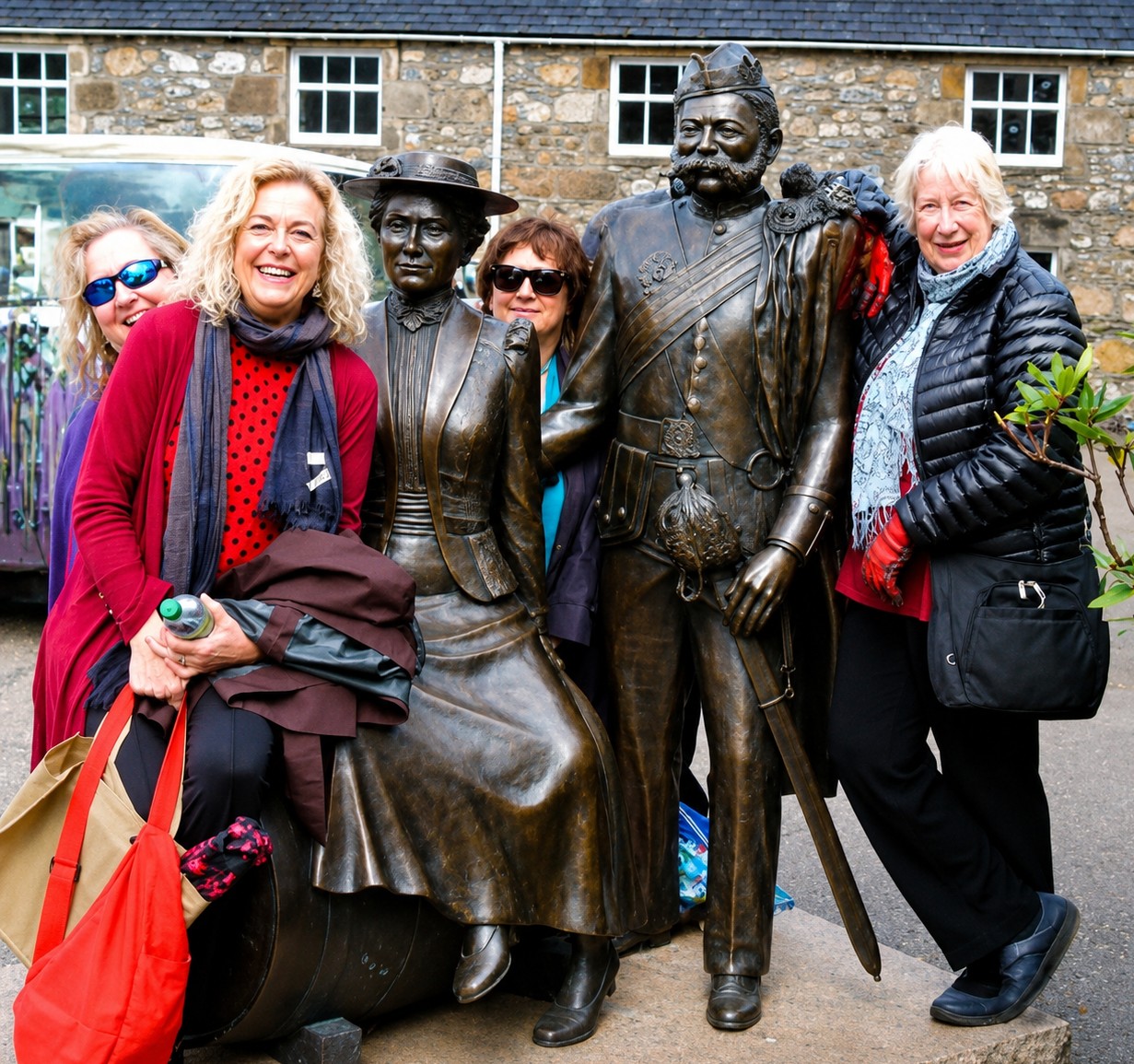
Here we are, serious as usual (ha!) in front of Glenfiddich Distillery in Scotland

I have spent the last week with my Banrigh ensemble mates. What an incredible week! We played together. We bore down in places to ensure we were trying to say the same thing in the music. We skittered over other places and just got on with it. Sometimes we’d get hot but then we hug it out. And laugh – we laughed a lot, with each other, at each other, at ourselves.

Since we’re not physically located together, we often work alone all the while anticipating when we’ll be together in space again to make music. And it’s the time when we’re alone that we need to remember – to keep front of mind – what we’re doing and why. Through all the drills for technique, learning tunes, forming our expression of the music, thinking through how we’ll fit together, the real focus will always be on the making of music together.  

Please don’t lose sight of the brilliant community you are a part of – harpers in particular. Harperists as well. Ensemble members, part of a whole, an important element of the experience. Musicians in general. And don’t forget the connection with the audience and being a part of a mutual happening.

If you don’t have a community within which to make music – reach out. Don’t be afraid to ask someone who plays a different instrument to play with you. Maybe it will work. Maybe it won’t, but you won’t know unless you try. I know some of you live far from other harpers, and there are online groups that would be very welcoming. But keep in mind that there’s probably someone just as lonely holding a guitar, a fiddle, a harmonica, an accordion, or sitting on a piano bench just as lonely and they’d probably love to make music with you.

Are you part of a community already? I’d love to hear about it! And if you are feeling alone and lonely but aren’t sure where to look – let me know. I’m happy to try to help connect you!

PS – I’ll be at the Ligonier Highland Games on Saturday, 18 July at Idlewild Park in PA. It would be delightful to see you there! We could play together for a bit.

Where’d she go?

Ohio Scottish Arts School is done for 2026. What an incredible year! We had amazing instructors in Jo Morrison, Sharon Knowles, and Stephanie Claussen. They brought so much energy and knowledge and depth and music – it was breathtaking and I am fortunate to get to work with them. Add in the other incredible instructors and – whew! What a week! I, of course, as usual, didn’t take any photos, but there are some great captures on the OSAS Facebook Page. It was also my honor to be one of the judges for the OSASPBA competition – what a hoot! We had good tunes, good times, good friends – it’s a good life.

This week is the week in between OSAS and Grandfather Mountain Highland Games. I’m delighted to be invited to judge the Harp Competition and perform a few times with my Banrigh peeps. If you’re within the sound of my voice, come on out and see us. Bring your harp and come play. We’ll also be having a “petting zoo” to share our beautiful instruments with people who haven’t gotten to try them before.

Eventually I’ll be headed to Ligonier Highland Games – at their new time in their usual location. If you’re planning on Ligonier in September – come out at the new date, 18 July. I’m looking forward to judging that Harp Competition and will see you there!

As you can see, I’m on the fly and having a great time, so come out and see me if you’re available. Let me know you’re coming so Iet me know to look for you! And if not, I’ll see you soon!

Who asked you?

This week I’m at the Ohio Scottish Arts School, but I still wanted to have a moment to catch up with you! The great thing about going to OSAS is what I learn. I have the pleasure of being a teacher but this year we have 32 students and I am excited to find out what I will be learning from each of them! Of course, all that learning can lead to self-inflicted feedback!

When was the last time that you played something, were truly happy with it, and then celebrated your success? Sadly, some of you (if you’re being honest) are saying, “never”. Hopefully you’re not one of those. Because celebrating successes is important.

Unfortunately, even when we are doing well, we are quick to let our inner critic have the floor. We discount our good work and highlight our mistakes. We provide ourselves with self-inflicted feedback! Have you ever heard yourself say these things to yourself:

– Well, it was good, but I messed up the entry of the third tune.

– I played it so much better at home

– It wasn’t perfect

Or some variation thereof?

While it might feel like you’re helping yourself, mostly you’re just beating yourself up. The downside to beating yourself up is that it does nothing to help you grow. It just draws your attention to flaws but with too much focus.

How can you fix this? “Reframing” is all the rage just now. If you’re not jumbled up in the lingo, reframing simply means looking at things from a different perspective to give you access to potential new solutions. The best things about reframing are that it’s easy and it’s helpful!

You could reasonably wonder why you might need reframing. Maybe you don’t, but statistically, it’s more likely you do. Because reframing is a great tool for calibrating your self-talk.

Your inner critic might have a point – but only if it “moves the needle” for you and gives you a way to improve. So, the next time you start telling yourself that you could do better I’d urge you to reframe your thinking.

An easy way to get started is to “reframe” your feedback through the lens, “how would I tell a good friend this input?”. You’d never tell your friend they weren’t doing well enough. You’d be encouraging. You’d be supportive. You might provide suggested paths forward, but you wouldn’t suggest that your friend would get lost on the path you’ve suggested!

So, the next time your “critic” provides “feedback”, do yourself a favor and run it through your friend filter. It will help you reframe both your thinking and your feedback and position you to learn from yourself!

And if you find that your inner critic is running roughshod over you, you can always ask, “Who asked you?”

When you feel your inner critic rising, give this reframing a try – and let me know what you think of the approach. Let me know what you think!