Who asked you?

This week I’m at the Ohio Scottish Arts School, but I still wanted to have a moment to catch up with you! The great thing about going to OSAS is what I learn. I have the pleasure of being a teacher but this year we have 32 students and I am excited to find out what I will be learning from each of them! Of course, all that learning can lead to self-inflicted feedback!

When was the last time that you played something, were truly happy with it, and then celebrated your success? Sadly, some of you (if you’re being honest) are saying, “never”. Hopefully you’re not one of those. Because celebrating successes is important.

Unfortunately, even when we are doing well, we are quick to let our inner critic have the floor. We discount our good work and highlight our mistakes. We provide ourselves with self-inflicted feedback! Have you ever heard yourself say these things to yourself:

– Well, it was good, but I messed up the entry of the third tune.

– I played it so much better at home

– It wasn’t perfect

Or some variation thereof?

While it might feel like you’re helping yourself, mostly you’re just beating yourself up. The downside to beating yourself up is that it does nothing to help you grow. It just draws your attention to flaws but with too much focus.

How can you fix this? “Reframing” is all the rage just now. If you’re not jumbled up in the lingo, reframing simply means looking at things from a different perspective to give you access to potential new solutions. The best things about reframing are that it’s easy and it’s helpful!

You could reasonably wonder why you might need reframing. Maybe you don’t, but statistically, it’s more likely you do. Because reframing is a great tool for calibrating your self-talk.

Your inner critic might have a point – but only if it “moves the needle” for you and gives you a way to improve. So, the next time you start telling yourself that you could do better I’d urge you to reframe your thinking.

An easy way to get started is to “reframe” your feedback through the lens, “how would I tell a good friend this input?”. You’d never tell your friend they weren’t doing well enough. You’d be encouraging. You’d be supportive. You might provide suggested paths forward, but you wouldn’t suggest that your friend would get lost on the path you’ve suggested!

So, the next time your “critic” provides “feedback”, do yourself a favor and run it through your friend filter. It will help you reframe both your thinking and your feedback and position you to learn from yourself!

And if you find that your inner critic is running roughshod over you, you can always ask, “Who asked you?”

When you feel your inner critic rising, give this reframing a try – and let me know what you think of the approach. Let me know what you think!

Take the Win

It’s World Cup season and the Beautiful Game is everywhere. If you’re a sports fan, that is great news. If you’re not, it does seem to have been going on forever and it’s only just started.

The World Cup is all about winning – and preferably winning big. But is that the best model for us as musicians? Probably not. We aren’t trying to beat everyone in the world – we only need to be a little better than we were yesterday.

But when a win is big – it is very clear. There’s no missing it. It is loud and proud. But the types of wins we need – small, incremental steps from where we were to where we’re going – are much more challenging to spot.

These small spurts of growth are precisely what we need to watch for. They occur in snippets of practice time. They occur in your sleep when your brain finally puts the pieces together. And they’re most obvious in that moment that the tune, or phrase, or shape that has been fighting you finally succumbs!

You will find these moments more easily if you’re watching for it! So, pay attention. Do your accounting and capture these moments. Savor the moments. Pat yourself on the back (no, literally). And capture both the event and the feeling. Keep a pad of small slips of paper or yellow stickies near by and put them on the wall or in a journal book higgledy-piggledy. You can procure a trophy and use it to stick your notes to. Or get a big jar and put the slips in there. On each sticky write down what you did, when, and how you feel. I’m thinking words like delighted, shocked, chuffed, pleased-as-punch. Whatever the words, put them on the sticky. Just do it.

Later, when you’re inordinately pleased with yourself you can pull them out and bask in your progress. Or when you’re feeling glum that you’re stuck in a plateau, you can pull them out and re-enjoy your journey and realize that you’re not stuck, you’re just marinating.

Take the win. It might be small but if you’re paying attention, the World Cup is actually a compilation of small wins concatenated to make a trophy. You’ve got this!  YAY – You win!

How will you capture your wins? Let me know – I’m always looking for good ideas!

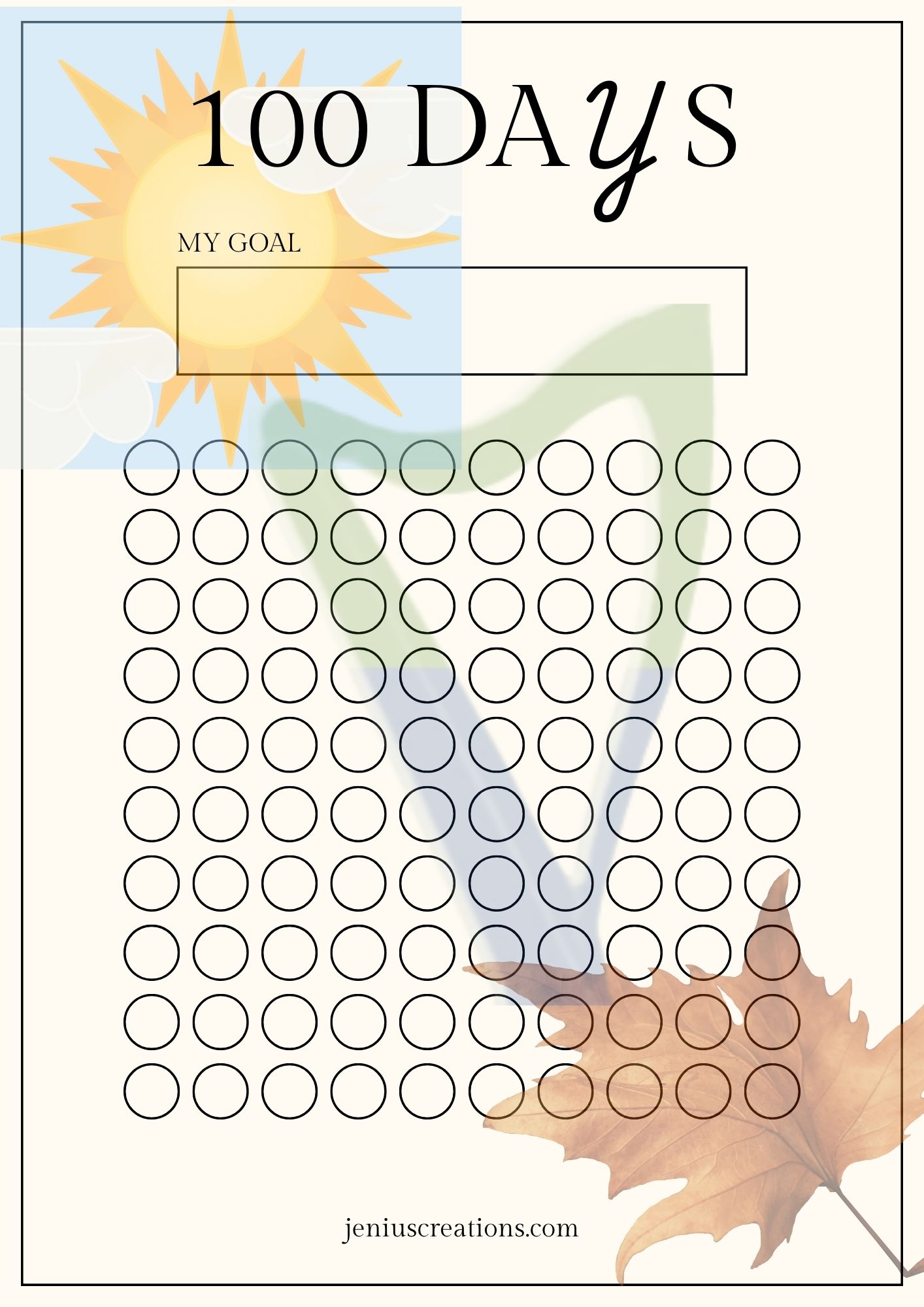
100 Days

I’m not sure what it is about big round numbers, but they are kinda captivating. Like this little bit of inspiration – what could you do with 100 days? I mean – come on – just think of all the things you could do with that time! And keep in mind that in about 100 days we will be looking at the end of summer (of course, it may still be beastly hot). Of course, we’ll have also put away all the fun of summer, but still – before you need to pull out a sweater, what could you do with 100 days?

You could convince yourself that the year’s half over. so you might as well coast.

Or you could dig out your goals for the year, take their measure, and decide the year is wash and maybe next year you’ll start over.

Or you could dig out your goals for the year, take their measure, and decide that you crushed that and you can cruise until January.

Or you could see that opportunity of having all that time remaining to do more cool stuff.  For you. To make even more progress. How great is that?!

So what could you do in 100 days?  How about:

1 Commit to learning one new thing each day (doesn’t have to be music, but that’s probably a sure bet!).

2 Commit to practicing every day.  Actually practicing.  It doesn’t have to be a full blown, formal practice, it could just be for fun.

3 Commit to paying a compliment each day – to yourself. Out loud. And mean it.

4 Commit to identifying what you’d like to do in the following 100 days after this.

5 Consider making an “activity board” so you don’t get stuck in a rut and leverage your creativity!

6 Think about what you would do (differently?) if it was the beginning of the year rather than most of the way through it).

You can focus on music (after all, why are you here?) or you could take an even broader view and approach to enjoying the remainder of the year.

Which of these will you do? What did I forget to include? Let me know in the comments!

* if you’d like to use this tracker, just copy the graphic and print it.

Sherlock Practicing

Do you have a problem? You know the sort of thing that gets in your way when you’re playing. But it’s small. Annoying but not really worth focusing on. After all, you’re motivated, you’ll get over it.

Well, that’s just silly. You don’t develop bad habits or problems overnight. And you don’t fix them by ignoring them! Whether it’s dropping your thumb on a crossover or not closing in a chord or not placing ahead, it won’t get fresher by ignoring it. So, what can you possibly do? Well, here are a few ideas.

The easiest answer is to ask your teacher. That’s a straightforward approach because they can see you from a different perspective and bring all that experience of correcting problems (yours, their own, other people’s). Easy peasy.

But not everyone has a teacher. And some are no longer in regular lessons and have to be their own teacher. Then you have to turn into Sherlock Holmes and detect not only the problem but also its cause and its solution. That’s a tall order. You need a process. A few tools will help too. No, not a magnifying glass! Remember that Sherlock said, “I have the advantage of knowing your habits” – so here’s how you can be Sherlock and get to know your own habits:

  1. Notice the need. This is essential. Pay attention to the clues – poor sound, sore hands, late notes, feeling frenzied. You can’t fix a problem if you can’t at least name it. For instance, if you’re not getting good tone but you don’t recognize it’s because you’re not closing, you won’t get it sorted!
  2. Take meticulous notes. Give yourself time for this and write it down. Rarely do we have a single area for improvement! Note all your challenges – over time. Collect your thoughts on what is happening. Include your observations of what is happening? when? what else is going on? what might be related?
  3. Collect your evidence. The part everyone hates – getting the dirt that shows you that you haven’t imagined it! Use your phone to video your practice (or playing). You want to catch yourself in the act. Video is so good for this because you can push it is dispassionate and faithful. Push play and get back to playing rather than trying to play while simultaneously observing yourself. Don’t worry – we’re going to record, review, reduce (delete!) the video once the work is done.
  4. Develop your theory. This video is a tool, not a documentary. Get in, see what you see, learn what you can learn, and get out. From your observations, what is happening? Is your hand in the wrong place? Are you over stretched? Or are you not giving yourself enough space to work? Are you uncertain and not placing?  You want to determine what is not working so you can focus on that. No attribution, no negativity, just focus.
  5. Strategize the solution. Once you know what’s not working and why, then you really can work on it and apply yourself to correcting it. If more than one thing is happening at a time, then you can also parse what you know and make a plan to fix one thing at a time (while monitoring so you know what to fix next). Lather, rinse, repeat as needed (and remember, it will always be needed).
  6. Verify! Once you think you have got your fix in place, give yourself some time to make it comfortable and automatic. Then record again to verify that your fix is holding! If you find something else to work on, so be it – and don’t despair. We are all always working and developing, learning and growing. It isn’t you; it’s the nature of the beast.

Just like Sherlock’s clues, the answer is out there, you just have to find them and apply that knowledge to your own playing. Give it a try and see what you learn (good and bad) – and let me know how you get on!

Come with Me!

It’s been a while since we talked about going to Scotland, learning tunes and playing harps (or enjoying and listening!). Alex and I have come up with an exciting trip that will be perfect whether you lay the harp or not!   

It’s time! We have set dates for our Highlands (and Islands) trips for 2027. Yup – trips! Two!

We are going to spend our time in Scotland – with harps! What could be better?

Ok, well, bringing a harp appreciator along with you could probably make it even better – so do that!

Highland Cow enjoying the mountainside

If you’ve never been with us before, you’re in for a treat! And if you have traveled with us, you’ll see that we’ve kept all the wonderful parts of traveling in the warm embrace of David and put a new spin on it with Alex!

We’ll fly into and out of Edinburgh and then use a mix of transport modes to enjoy each of the historical centers and their sites. Some of our time will be organized tours and we’ll also have independent downtime. No matchy-matchy tour for us! We’ll hit marquee sites (for our first timers) and some of our favorite local gems (for our tenured travelers). And you know that your harp for the week will meet you there so we can have a tune for each day!

When? you ask. We have chosen two dates so you can definitely fit it into your schedule. We will have five seats for our Spring trip May 3rd to May 17th, 2027 (think cheerful yellow canola flowers and gamboling lambs!). In the Autumn we’ll have five seats September 26th to October 4th, 2027 (think blooming heather and autumn foliage!). Different times of year, different seasons, same beautiful, amazing Scotland!

As I said, we only have five seats on each trip – because we like it that way! We get to know you so we can tailor as we go so you have a wonderful experience! We have a plan but it’s not rigid, so if we want to, we can squeeze something special in – or route ourselves around the sunshine.

Here’s the plan!

Calton Hill in Edinburgh

After you arrive, we’ll head to Sterling and enjoy getting to know this fabulous country. We’ll throw back to the glory days as we explore the fabulous Sterling Castle. We’ll also get the chance to enjoy the stunning scenery with a little bit of time at the indescribable Isle of Skye. From there, we’ll head to Pitlochry for a little bit of time in picturesque small town and see some of the heart of the country. We’ll round out our time in historic Edinburgh and enjoy Scotland’s capital of culture.

Of course there’s more and you’ll find additional details on the website (https://babciaandyiayia.com/scot27) like what’s included and more itinerary details. I know you’re intrigued so if you’d like to learn more about this experience, please schedule a time to chat with us. We’ll answer all your questions and get to know you a bit better!

CLICK TO SCHEDULE A CHAT!

And if you’re already ready to go – save your spot (click the link at the top of the page). If you have trip detail questions or want to ask harp related questions, just ask! I can’t wait to hear from you! I’ll be over here, pre-packing and finding new tunes!

St Andrew's Cathedral