Why worry about making a mistake?

I’m afraid that fear is a constant problem for people like us. The talented and often wise John Cleese (of Monty Python fame) said, “Nothing will stop you from being creative so effectively as the fear of making a mistake.”

That is not funny. Just a little scary.

We are often our own worst enemies. We tell ourselves that when we make a mistake, we are just wrong. Instead, we think we are not creative. We are not good enough because we’re not playing perfectly. We avoid errors and we knuckle down at our harps focusing on playing gingerly, so we don’t miss. We harbor a fear that if we were creative, we would play better. We see other people being creative, and we just appreciate their gifts, either because we don’t hear their mistakes or we view their occasional wobbles as charming.

Short of a brain transplant, how do we get around this? Here are a few things to incorporate into our own practice:

  • Acknowledge that mistakes are not failures. Mistakes are part of learning. In fact, not getting where you meant to gives you the opportunity to learn from where you ended up. This can be a fingering conundrum, landing on a note variation, or launching a non-standard chord for example.
  • The reality is that you only find “cool stuff” when you make “mistakes”. Otherwise, you’re just playing the same thing over and over. You do need to pay attention to where you landed and how you got there. Some of your best ideas will only get captured by turning on the recorder and collecting everything that comes out of your harp, good, bad and indifferent.
  • Honestly, there are no mistakes. Sometimes there are elements that are not as pleasurable as others. But with an open mind those become steppingstones to the next ”right” note. Besides, if the music is too perfect, it gets boring.
  • Acknowledge that, like a beautiful single malt whisky, some ideas need to mature to become what you wanted.  Give yourself time for creativity to happen.  Keep in mind that what you see others create is the finished product while you’re staring at the front end of the same process – you don’t know how many iterations your “perfect” exemplar went through before you heard it! Give your ideas time to breathe!
  • Failure – what’s the worst that could happen? I cannot stress enough that this isn’t Rocket Surgery! You’re sitting alone at your harp and something you didn’t intend comes out? Get over it and move on! Unlike the movies, creativity is not going to smite you with virtue…you’re going to have to work at it…and take the good with the bad.

Some of the best stuff ever has arisen from having the wrong levers set, not quite remembering how the tune starts, landing on the wrong chord, or some other “mistake”. Make a beautiful noise! Work with it! And take in stride that nothing that comes out of your harp is a failure!

What’s your best mistake so far? Do you let things happen or do you focus on getting back on track? What would you do to leverage variations when they happen? Let me know – you know the drill!
What NOT to practice

I’ve been on the go for a bit. Lots of driving with plenty of time to think. So, of course when I wasn’t practicing by reviewing tunes in my head, I was thinking about practicing. And that got me thinking about what should be in the “to be practiced” pile and more importantly, what should be in the “NOT to be practiced” pile.

You already know what is in the “to be practiced” pile. [If you don’t (or you’re not sure), drop me a message and we’ll get that sorted for you!]

But what (really) belongs in the “NOT to be practiced” pile? The list could be endless, but I’ll strive for brevity here.  Things that belong in the “NOT to be practiced” pile include:

1. Notes that don’t align with the tune (mistakes)

2. Technique that doesn’t serve you (there’s a reason teachers pound placing and closing – just sayin’)

3. Trepidation (stressing over that tricky bit that’s coming up)

4. Stressing over what’s for dinner (or other, unrelated event)

5. Hunching (talk about a physical manifestation of stress!)

6. Dead air (this is that long space between notes when you’re playing faster than you’re ready to just then)

7. Focusing on having not practiced (just get on with it…now)

8. A long list of notes (rather than a whole with the fullness of phrases)

9. Focusing on how someone else is coming along with the tune

10. Focusing on what the teacher might say (rather than being ready to hear those pearls that are about to erupt)

11. Shoulds (I should be better, I should have practiced more, I should be more comfortable, I should be like Soandso Overthere, I should have already learned this, I should have overcome this sticky section, I should, I should, I should…)

Typically, here I would give you a list of things you can do to overcome these. And I do have a list, but instead, I invite you to think about all these things (and all the others that popped into your head while you were reading). Are you including any of these NOTs in your practice? Which arrive bidden? unbidden? Which are you partaking of which get you nowhere, but burn up your practice time?

How would your practice benefit or be improved if you didn’t spend time on these NOTs but instead focused on making music? How would your life improve? Do you have others? Want to share them with me? I love to hear your thoughts and ideas!

Kate said: There is a line driving you Nuts, in “regular” practice, just skip it. Work on it separately. Slow down, leave out notes if necessary (you have the score, the listener doesn’t!). DHC commented on the troublesome riff: “anytime you get up to make a cup of tea, or walk by the harp, just play it!”. After a while, it’ll settle. Also: beware overpracting exercises. I did that. Wasted a lot of time/energy. You aren’t going to Perform them! A thought: re “should”: my career was medical/surgical. It was a good day if nobody died.  So harpers, get a grip! It’s ok. Cheers, Kate 

 😄🪉🎶


Connection

I know I’m always rattling on about practicing technique and focus and documenting. And all those things are important. So important!

But it is easy to get so focused on those details as to lose track of the big picture – the benefits and rewards of playing an instrument. Like playing with others. Like laughing together over an incredible blooper. Like feeling as one as you play together. The connection that is nearly palpable when you play together – especially when you’re tight, but even when you’re not.

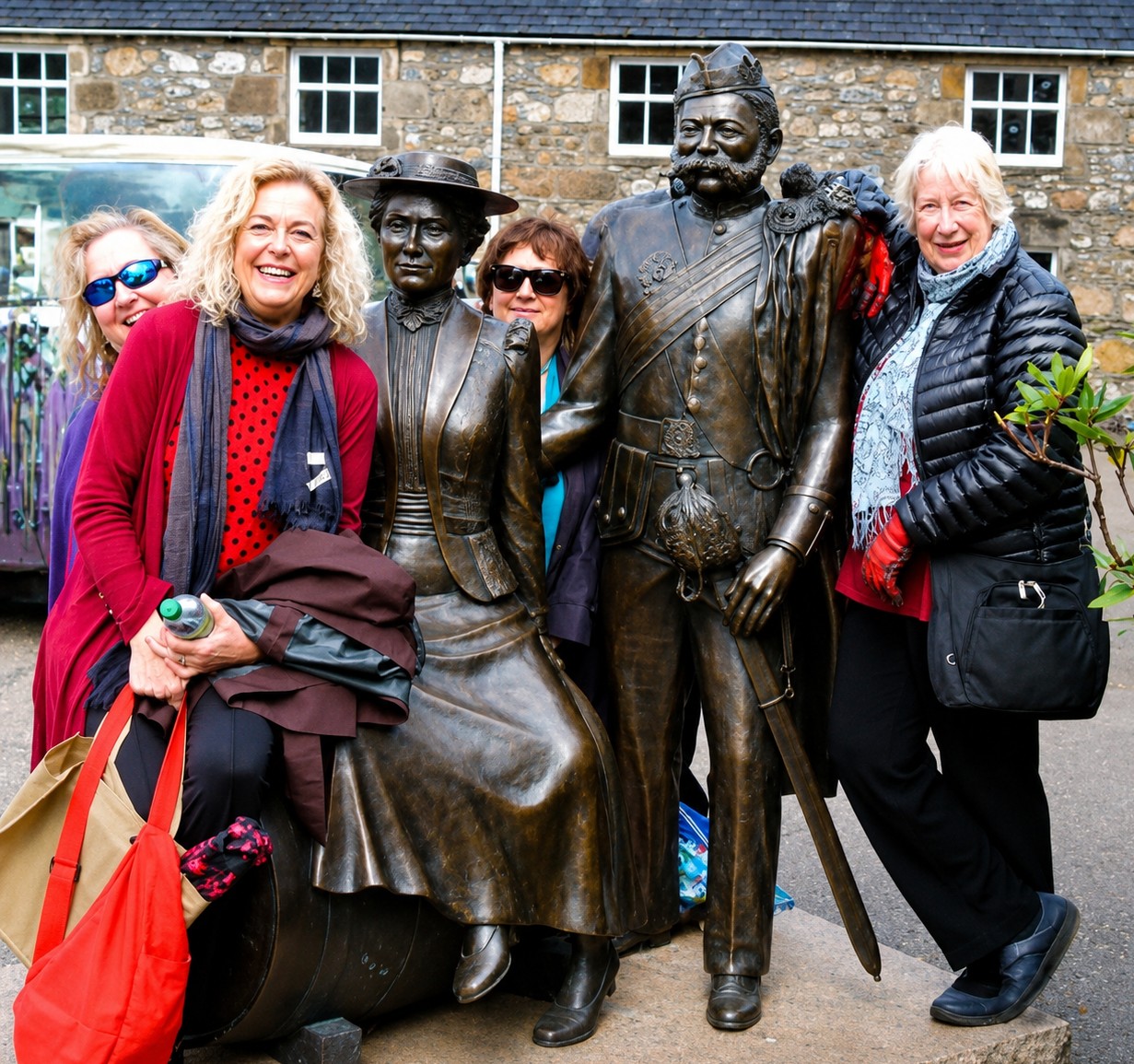
Here we are, serious as usual (ha!) in front of Glenfiddich Distillery in Scotland

I have spent the last week with my Banrigh ensemble mates. What an incredible week! We played together. We bore down in places to ensure we were trying to say the same thing in the music. We skittered over other places and just got on with it. Sometimes we’d get hot but then we hug it out. And laugh – we laughed a lot, with each other, at each other, at ourselves.

Since we’re not physically located together, we often work alone all the while anticipating when we’ll be together in space again to make music. And it’s the time when we’re alone that we need to remember – to keep front of mind – what we’re doing and why. Through all the drills for technique, learning tunes, forming our expression of the music, thinking through how we’ll fit together, the real focus will always be on the making of music together.  

Please don’t lose sight of the brilliant community you are a part of – harpers in particular. Harperists as well. Ensemble members, part of a whole, an important element of the experience. Musicians in general. And don’t forget the connection with the audience and being a part of a mutual happening.

If you don’t have a community within which to make music – reach out. Don’t be afraid to ask someone who plays a different instrument to play with you. Maybe it will work. Maybe it won’t, but you won’t know unless you try. I know some of you live far from other harpers, and there are online groups that would be very welcoming. But keep in mind that there’s probably someone just as lonely holding a guitar, a fiddle, a harmonica, an accordion, or sitting on a piano bench just as lonely and they’d probably love to make music with you.

Are you part of a community already? I’d love to hear about it! And if you are feeling alone and lonely but aren’t sure where to look – let me know. I’m happy to try to help connect you!

PS – I’ll be at the Ligonier Highland Games on Saturday, 18 July at Idlewild Park in PA. It would be delightful to see you there! We could play together for a bit.

Where’d she go?

Ohio Scottish Arts School is done for 2026. What an incredible year! We had amazing instructors in Jo Morrison, Sharon Knowles, and Stephanie Claussen. They brought so much energy and knowledge and depth and music – it was breathtaking and I am fortunate to get to work with them. Add in the other incredible instructors and – whew! What a week! I, of course, as usual, didn’t take any photos, but there are some great captures on the OSAS Facebook Page. It was also my honor to be one of the judges for the OSASPBA competition – what a hoot! We had good tunes, good times, good friends – it’s a good life.

This week is the week in between OSAS and Grandfather Mountain Highland Games. I’m delighted to be invited to judge the Harp Competition and perform a few times with my Banrigh peeps. If you’re within the sound of my voice, come on out and see us. Bring your harp and come play. We’ll also be having a “petting zoo” to share our beautiful instruments with people who haven’t gotten to try them before.

Eventually I’ll be headed to Ligonier Highland Games – at their new time in their usual location. If you’re planning on Ligonier in September – come out at the new date, 18 July. I’m looking forward to judging that Harp Competition and will see you there!

As you can see, I’m on the fly and having a great time, so come out and see me if you’re available. Let me know you’re coming so Iet me know to look for you! And if not, I’ll see you soon!