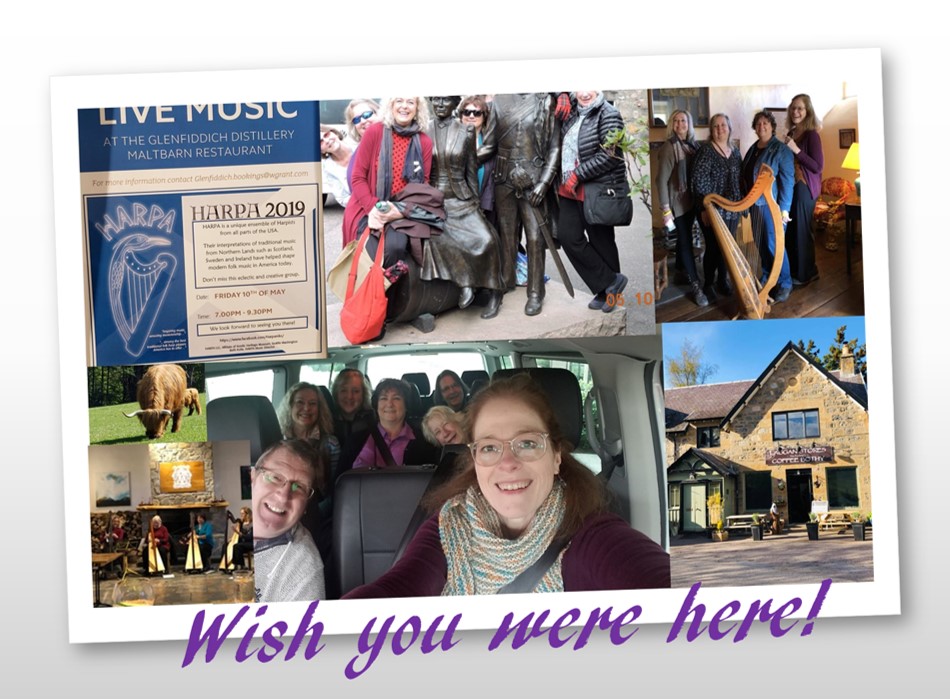
You already know that all of us are back from the Harpa Scotland 2019 Retreat. If the photos, videos, comments, and smiles are any indication – it was another brilliant success. Harpa is so much fun because it has a simple formula:
HARPA =
amazing musicians + fantastic tour guide + incredible roadie =
sharing music joy + enjoying each other + adventure!
You’ve heard the maxim that travel is broadening – and not just from delicious cakes and scones! As you travel with your harp, you develop or hone many sterling qualities including forbearance, faith and patience! Whether you like it or not, you must let go, trust the Fates, and be patient (outside the “Oversize Luggage” belt mostly!).
Most of us are control freaks (especially about our harps). Many of us do not know this about ourselves (or if we do, we underestimate). Few things will test your mettle like traveling with your instrument and entrusting it to the TSA. And while American (airline) may hate guitars, I’m pretty sure it’s the TSA that hates harps. Or at least, hates harp cases. I qualify this, though, to say that although I have gotten my harp back partially latched or completely unlatched, it has always weathered the journey (Forbearance? Faith? Probably both).
But more than that, traveling with your harp opens doors you might not even know were there otherwise. We have been places we likely would have gone right by – simply because those places opened themselves up to the possibility of us playing there! We have never played anywhere dull. This openness on their parts helps us to be more open on our part – to see new things or to see familiar things differently (including toilets, refrigerators, and door locks!). And once we are opened, adventures appear around every bend.
Our trips are always small – this time we had seven. This allows us to go places often overlooked or bypassed. It also ensures we don’t travel as a band of tourists – simply observing, never venturing outside our comfort. But it also generates a community and engenders sharing with one another – we gel in ways that big groups never get. We become a traveling family, if ever so briefly. We share our experiences – and our cookies! And that sharing is part of the fun. And the more fun we have together, the more fun we find. And so it grows!
But perhaps the best bit is that we meet other people – in restaurants and cafes, at attractions, in our accommodations. We were invited along to a stramash by someone we met at one of our concerts. See how that works?! At the time we weren’t sure we knew what a stramash is, but we kinda thought we did, and we went along to it. It was a blast! We got to play tunes with local musicians, we heard some new ones, played some shared favs and heard some lovely singing. We got to share the joy of making music – in a fun, organic, very Scottish way! (Just to confirm, a stramash is a seisiun). We met a delightful couple at a fish and chips restaurant…because they photo bombed one of our group selfies! It is these brief interactions punctuating the trip that not only make great memories, but really define good travels. While chatting with an audience member we learned of a museum that none of our research had unearthed. And later, once there, we met and chatted with more lovely locals and learned more than just looking at some displays would ever have wrought.
All that leads to learning more about yourself. You learn where your unknown assumptions and ignorances lie and have the opportunity to examine them. These assumptions and ignorances are not good or bad, but examining them means you can rethink their utility. I’m not talking about bigotry but rather biases like what we select for our concert program, how we introduce ourselves and our music to the audience, and how we meet them where they are when we perform (and appreciating when they’re not where we thought they’d be!). A small group also learns to accept more – the morning person must be patient while the not-morning person strives to not be cranky at the start of the day (and vice versa at the end of the day). We help one another – with luggage, and art supplies, and fingering, and leftovers, and making tea (and more tea, and yet more tea!).
And best of all – each trip is different. The harp attracts all kinds – players and appreciators and audiences. We make lifelong friends and brief – but enriching acquaintances. Even if we return to a place, it is new, and we grow in it. And being invited back is a pleasure and a privilege.
So Harpa 2019 is in the books – an unqualified success. We’re all home, laundry cycled (mostly), gifts given, postcards received (mostly). And we look forward to the next time!
Once we sleep off our jetlag, we will start planning the next Harpa outing!
But we’re also finalizing plans for the 2020 Harp the Highlands and Islands trip – details coming soon. Would you like to be broadened (by travel and cakes)? Want to be part of the action and first to know the details? Leave me a comment to that effect below!
PS: Photo credit for this week and last go to the Harpaniks and especially Donna Bennett, Therese Honey, and Robin Pettit.
Playing the harp is more challenging than it looks. You already know that. That’s why we work hard during practices. It’s why we try to practice regularly – so that we enjoy small, incremental improvements each day. And this is one reason I’m always suggesting that we track our progress – to acknowledge, accept, and grow from that practice.
Practicing certainly gives us a way to work on the technical aspects of playing, but there is so much more to playing – things that go beyond the technical. However, to get to those things we sometimes need to get out of our own way.
So, how do we do that? We start by giving ourselves permission. Permission for lots of things. But mostly, you have to give yourself permission to be YOU!
Here are 20 types of permission you might consider giving yourself:
There are plenty of permissions to give yourself. What other ones do you give yourself (or do you need to give yourself)? Share that in the comments!
We humans observe…and then compare. We are always collecting data about the world around us, analyzing it, and then selecting a winner. We have a classification scheme for winners and not winners – so we see where we rank in there.
This comparison trap is insidious in two ways. It assumes that you are an unbiased (and knowledgeable) arbiter of truth and it rarely takes context into account.
And typically, when we make comparisons, we find ourselves wanting.
Finding yourself wanting is not motivating.
Are you a “Fair Witness” *? Are you certain that you are qualified to critique the performance of others relative to your own? And can you say, perhaps with more certainty, that you are qualified to evaluate your own performance – clear eyed and unbiased? Are you a Fair Witness to yourself that you can only report the truth with no trace of bias? Likely not – you have a vested interest in the outcome, so be honest about your ability to assess.
I just learned that my sister writes poetry. I learned this while thumbing through an anthology in which she is published! This very clearly highlighted the second point of context. You very rarely have insight into the context of others (even in a close relationship). Even though we are all made of stories – we don’t tell them all to everyone. And there are some we tell no one. In addition, many have no insight into the context of themselves, much less that of others. And even if you know someone, you might not have an accurate view of their context.
On occasion, you’ll hear someone “praise” another by stating baldly that playing the harp comes easily to (another). I find this both horrifying and irritating. You might think you should be delighted to receive what might be meant as a compliment. But because you have worked quite hard to be where you are, and even if you give the illusion that it comes easily, you might rather be annoyed that someone has discounted all that hard work. When you compare your own playing to someone else’s (or someone compares themselves to you), you never know the entire context – where they are, what is happening, or how your comparison may upset them. By the same token you may not be fully aware of how things affect you and impact your own playing.
As the trope goes (did you know that “trope” originated as a music term?) Comparison is the thief of joy. Why do we make comparisons? Because we’re good at it. We are quite adept at making pairwise comparisons (choosing a preference between two options). There are entire lines of research built on these comparisons – we’re that good at making them! But in this case, our strength (comparison) is a real weakness – because, you don’t have to pick! Someone else can be good and you are still too!
In addition, comparing yourself to someone else is more likely to make you feel bad than to make you play better (and you can see how that’s not helpful – the comparison makes you feel bad, so you’re not motivated to practice, so you do not become better (and may lose ground), which makes you not play as well the next time you’re with others and your comparison results in your poorer showing – etc.…you can see how that’s a downward spiral of not very helpful).
At a recent workshop I overheard a relatively new harper wistfully comment, “I’ll never play as well as (insert significantly experienced, p-r-o-f-e-s-s-i-o-n-a-l harp player here).” ** Well, DUH! Of course you don’t! You’ve been playing the harp for 10 minutes and they’ve played for 20/30/40 years. You dabble, fit it in, get to it when you can, as a hobby. That person is a pro – it’s their job! And they are seasoned, they work at it – you know, for hours – every day. And they are absorbed in multiple aspects of being a musician, not just the practicing for 20 minutes when they can!
Of course you don’t play at the same level! When I overhear this, I am always tempted to ask, “Do you w-a-n-t to play at that level? Or do you just wish you played at that level?” Big difference! (of course, the start of the difference is – you know what I’m going to say – practice!)
Do you say to every Dentist or Auto Mechanic you meet, “oh, I wish I pulled teeth or rebuilt transmissions as well as you”? Bah! No, you don’t, so why do you do that with harpers? (and if you do, stop, you’re creeping people out!).
But how can you escape the Trap and emerge solid in your own story (and possibly helping other people grow fully into their own stories)?
Be honest – and clear – about where you are and where the other person is (and the path from here to there). And be frank about your willingness to take that same path (or not)!
Be content, but not complacent – You are where you have gotten. You are not your harp hero. But you might be someone else’s (did you ever think about that?). So kindly and gently encourage yourself to continue to work and grow. You already know that it is work to continue – but it’s fun work! And there’s no deadline, so just keep at it.
Be analytical (but only part of the time) – note how much you have grown as a harp player. No, really note – be aware. At one point you hadn’t even touched a harp – and look at you now! One of the reasons I’m always exhorting you to keep a journal of your practice is so that you record (and therefore don’t forget and can review) your small, “every day” successes! Because those small accomplishments are what matter.
Be-YOU-tiful (stolen from a tea towel!) – you are amazing! Be that. You have strengths and weaknesses – just like everyone else. Celebrate your strengths. Be mindful of your weaknesses. Work on those weaknesses you want to be stronger at, set up systems to support the ones you know need work (but are still working on), and forget the rest. If you have to, turn your picture upside down so the weaknesses are in fine print at the bottom rather than in headlines at the top of your page.
There is one comparison that does matter – how are you now relative to you previously? Are you growing? Are you becoming the you that you want to be (not wish – but want). Do your thing. Let everyone else worry about being them. Do you have another way of keeping your thief of joy in check? Share that in the comments!
* If you haven’t read this, you might enjoy it – at your local library or at online
**I have no problem making this claim since I hear this at nearly every workshop I attend.
Sunday was Armistice Day, and the 100th anniversary of the end of the war to end all wars.
Ok, so they didn’t get that bit right.
Armistice Day, Veterans’ Day, Remembrance Day – no matter where you live, it is an opportunity to remember the fallen who gave their lives, and those who pledged their lives so we could enjoy ours in peace and freedom.
That seems like a good reason to give them their due the way we are best able – through music.
There are so many things you could do at this point. You could do nothing, of course.
But instead, you could commemorate the original Armistice and play the tunes of the day – there was some great tunes written at that time including Keep the Home Fires Burning, It’s a Long Way to Tipperary, or Carry Me Back to Ol’ Virginie.
You could play music from other post war eras including anything from Irving Berlin. Or you could just play music of our own time – which we enjoy because of those that came before.
You could compose your own pieces.
And you could play in a number of places including a Veterans’ Home, for a veteran’s group, or another civic group.
Just play – and enjoy that you can do so in peace!
I heard a very interesting story on the blahblahblah radio station* as I was traveling home from a delightful trip to the Stone Mountain Highland Games in Atlanta (always fun – and so very pleased to have been invited to judge the competition, to teach a workshop, and to perform!).
The story on the radio related that there will be a marathon runner in this year’s Marine Corps Marathon 10K (which, for any couch potatoes in the crowd, is nearly 6¼ miles!). What made it interesting is that the runner is retired US Army Master Sargent Cedric King, who stepped on a large explosive while in Afghanistan, losing both of his legs.
As you might have guessed, he had a hard row to hoe making a comeback from that. But he did. And now he’s a distance runner. What he said in the interview really struck me – from the beginning when he said that this event – and its outcome – are what made his life take a turn for the best.
Yikes, I am relentlessly upbeat, but even I am awed by that attitude!
In the interview, he said some things that I thought are important and applicable to us. Now, I don’t in any way, equate the challenges we have as we try to learn, master, and perform our music with all the things Master Sargent King went through. However, he has an inner strength and a focus that could help anyone become better at anything they chose to focus on. Here are my take-aways (I was driving, so I couldn’t really take notes, these are my impressions rather than quotes!).
Remember that everything around you is likely to have an application to your harp life – just listen – and be grateful. Your struggle for flawless scales is nothing compared to recovering from a life altering injury. But your attitude will certainly make it go easier. Have you fallen? How did you get up and get moving? Let me know in the comments!
* you can read the whole story at https://wtop.com/marine-corps-marathon/2018/10/marine-corps-marathon-before-he-could-run-this-soldier-had-to-learn-to-walk-again/slide/1/
Many of us took up the harp (or knitting, or golf, or baking, or something else) as a hobby – something we enjoy. Something that makes a pleasant way to spend time whilst also making us happy. Because these activities are fun and happifying (why yes, I did think that I had just made up that word…which made me happy, but it’s in the dictionary – it’s a real word which makes me happier still), sometimes the pleasure drives us to keep at it – allowing the activity to consume more and more of our time and other resources.
To whit
“What is the right number of harps to own?”
“One more!”
The pleasure. The fun. The happiness. The enjoyment. The drive to learn more, experience more, enjoy more – the thirst for the activity, only slaked by more of it. Ah, so sweet! Playing the harp is a most excellent hobby!
And then, someone prevails upon you to play at church, or a wedding, or a tea, or a funeral. And you agree. It’s just this one event. You’re helping someone else. You’re bringing solace, or contributing to joy, or setting an atmosphere, or creating a milieu. What fun.
And then it hits you. You’re not a performer. You’re not a pro. What have you done?!?
The safety of being an amateur falls away.
And you’re left, terrified. What will you play? Do you have enough repertoire? What if you make a mistake? W-h-y did you agree to do this?
The fear creeps in…like a freight train!
Does fear grip your joy? Does it chase away the happiness? Does the color drain from your delight?
But wait! What are you afraid of? No, really. STOP!
Identify – and name – your fears. By naming your fears (e.g. “I’ll be laughed at”, don’t name it “Harry”), you begin to hold them up to the light. To see what they actually are and to work around them. Maybe start by reminding yourself that loads of people share your fears. And no, that’s not different for you – despite you telling yourself that…just like all the other people do!
Afraid you’ll make a mistake? Some mitigations are available against this. Practice more, only play things you feel strongly confident about, create (and practice) repair points throughout the music, practice “playing through” the mistakes you make, and practice improvising on the tunes. Don’t plan to play anything shaky (do not plan to “pull it out of a hat” while performing – that very rarely goes well!). And build your program to support you – start strong, back every (relatively) weak tune with a “comforter” (a strong, well learned tune) and end strong. Practicing these things will help you feel more confident and help to fight off the fear.
Afraid you won’t be good enough? You’ll be fine – build a strong program, prepare and practice, remember it’s only one day (and that we all have good days and bad days, even your harp hero!). Remember the point of each practice session is to get a little better, stronger, more poised than the practice before. No, you’re not _____ (insert name of current harp crush), but they didn’t ask her to play their event, did they? Nope – they asked YOU! Get out of your own way and play!
Afraid of the audience? That they may laugh, or boo, or leave? Or worse, that they feel nothing. Remember that you are communicating, and they are eager to get the message! Remember too that you are giving and it is not a contest. If you intend to give, what you give will be just right to meet that intention. Also remember that while about 20% of kids (and even fewer adults) have music lessons to learn an instrument, over 80% of adults report wishing they played an instrument! They are too impressed, in awe, and/or envious to laugh or boo. [SIDE NOTE: I hope you have one of the most amazing antidotes to this – to have an audience member seek you out to tell you how much they enjoyed your music. It will make your heart swell with pleasure and pride! And before you dismiss their comments as them “just being nice”, remember this – that person so enjoyed your music that they fought their own fears to come up to you, possibly face your rejection of them(!), to share with you that you made a difference to them (sometimes effusively, sometimes haltingly) and that they are grateful. Honor that, use it build your own confidence – and DO NOT THROW IT AWAY! {Haven’t had this experience? Be patient}]
Afraid you’ll embarrass yourself? The only way to do this is to be unprepared and to not bring your best effort with you. Do the work, and don’t let the fear stop you.
What are you afraid of? Don’t be! Instead enjoy all the things you learn, feel, and share and really get into it. And don’t let fear steal your joy – just enjoy.
Do you get fearful when you sign up to perform? How do you go about getting past it? Was it worth it? Let me know in the comments!
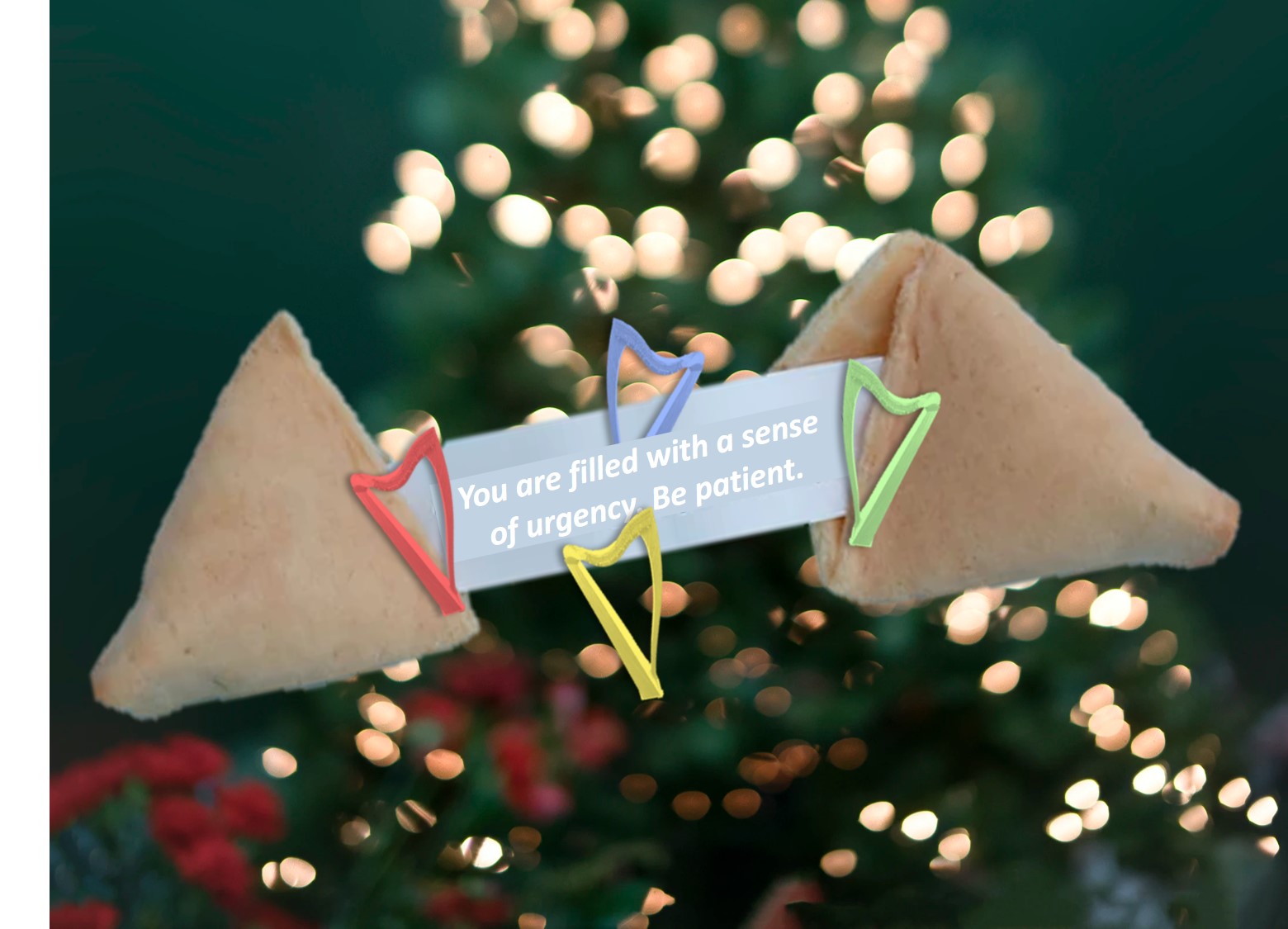
There’s a reason you always need to check your fortune cookie, even if you don’t eat the cookie! There’s some potential wisdom in there. Alan Alda appeared in my fortune cookie the other day. Well, his well-known quote did. My cookie said, “Be brave enough to live creatively.”
Do you think that you are brave? Have you recognized your own bravery? It’s highly likely that at this point you are shaking your head, laughing, saying “I’m not brave!”
But – you are. Many of us began playing the harp as adults. Minus the devil-may-care approach of children, that may be the first sign of your innate bravery. The willingness to try new things requires a leap of faith – one most adults are not willing to take. So, you have already exhibited a great deal of bravery!
But, as Mr. Alda said, being brave is actually essential to making art – in our case that would be our playing, our being musicians, our being artists. And being brave continually is central to achieving everything you strive for with your harp.
Being brave is a lot of things. Some things being brave is not (or does not require):
It’s this willingness to do something in the face of fear and uncertainty that demonstrates your bravery!
You’re still shaking your head, aren’t you.
You think I’m wrong. But still, you’re thinking you might look pretty sporty in that cape! (By the way, thinking about wearing that cape – fairly brave!).
What bravery is – is persisting in the face of ambiguity and uncertainty.
There is a lot of ambiguity in making music. Confronting that ambiguity is part of the art of making music. You address it every time you play. How will you render the tune? What will your interpretation be? Should you always bring the tune forth the same way, or can it vary based on a number of factors (possibly including how brave you’re feeling that day)? Are you technically capable of delivering the tune the way you imagine it?
And the uncertainty is rampant as well. Are you making the tune show it’s best self? Is your audience responding to your presentation? Have you done all the work?
Being brave takes practice. The more you do it, the easier it gets. This is something you already know how to do – make a plan, keep notes of your progress, figure out your best system for success – and just keep at it! Playing the harp is unlikely to be the hardest thing you ever have to do in your life – and practicing being brave at the harp will probably help you be ready for the really hard stuff!
As noted above – there is plenty of opportunity to be brave. So, embrace it. Acknowledging that bravery is required is probably the first step in being your bravest self. And who knows, you might even enjoy being brave enough to be creative!
Joseph Cossman, the well-known entrepreneur, is quoted as saying, “Obstacles are things a person sees when he takes his eyes off his goal”. That’s worthy of being embroidered and hung over your harp.
And this point couldn’t be more true than when you have heard a beautiful piece of music that you desperately want to play….and then you see the sheet music. Few things are more disheartening than that initial visual assault of the dots. All those pages! All that ink! All those notes! All at the same time! Chords and ornaments and complex rhythms – who has that many fingers?!?
I always tell my students that there is nothing they cannot play. There may be a wide gulf between where they are just now and the skills a particular piece requires – but that just means that the path to playing that piece lies in not being afraid of a little hard work. It also means that it might take some time to master the music, but – there is nothing you cannot play*.
Clearly, the music is playable (remember – you heard it!). So, the real challenge is to focus on the music. And to stop staring at the obstacles. Keep an eye on the goal – see past the dots.
What are the obstacles, typically? And how do you see past them? Here are some that are reliably likely to trip you up:
There are other obstacles, but for now, keep your eye on your goal. Don’t lose sight of the path. Give yourself permission to divert and learn. And periodically you can return to the piece. And make sure you know what you can see.
* don’t be obtuse – of course there are arrangements that may not fit on your harp, but assuming the arrangement is appropriate to your harp (that is, if there’s pedal markings and a lot of accidentals, you might want to pass on trying to play it on your lever harp – but even then, if you’re really up for a challenge, you go ahead and give it a try!).