Be Brave!

There’s a reason you always need to check your fortune cookie, even if you don’t eat the cookie! There’s some potential wisdom in there. Alan Alda appeared in my fortune cookie the other day. Well, his well-known quote did. My cookie said, “Be brave enough to live creatively.”

Do you think that you are brave? Have you recognized your own bravery? It’s highly likely that at this point you are shaking your head, laughing, saying “I’m not brave!”

But – you are. Many of us began playing the harp as adults. Minus the devil-may-care approach of children, that may be the first sign of your innate bravery. The willingness to try new things requires a leap of faith – one most adults are not willing to take.  So, you have already exhibited a great deal of bravery!

But, as Mr. Alda said, being brave is actually essential to making art – in our case that would be our playing, our being musicians, our being artists.  And being brave continually is central to achieving everything you strive for with your harp.
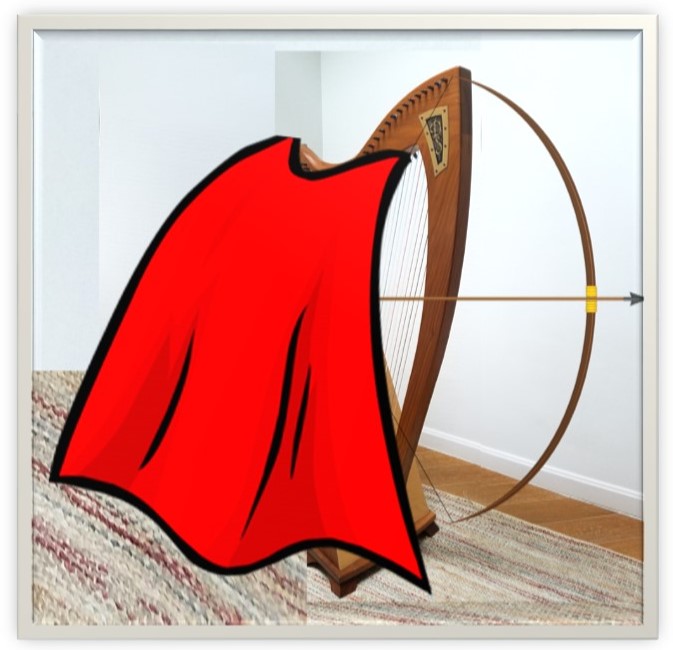
Being brave is a lot of things. Some things being brave is not (or does not require):

  • Wearing a cape (of course you can, if it helps you, but it is not necessary)
  • Being unafraid (bravery is not being unafraid, it is being afraid and taking action anyway)
  • Not knowing what you’re getting into (rather, bravery stems from knowing the risks, but then schooling yourself and taking on those risks)

It’s this willingness to do something in the face of fear and uncertainty that demonstrates your bravery!

You’re still shaking your head, aren’t you.

You think I’m wrong. But still, you’re thinking you might look pretty sporty in that cape! (By the way, thinking about wearing that cape – fairly brave!).

What bravery is – is persisting in the face of ambiguity and uncertainty.

There is a lot of ambiguity in making music. Confronting that ambiguity is part of the art of making music. You address it every time you play. How will you render the tune?  What will your interpretation be?  Should you always bring the tune forth the same way, or can it vary based on a number of factors (possibly including how brave you’re feeling that day)?  Are you technically capable of delivering the tune the way you imagine it?

And the uncertainty is rampant as well. Are you making the tune show it’s best self?  Is your audience responding to your presentation? Have you done all the work?

Being brave takes practice. The more you do it, the easier it gets. This is something you already know how to do – make a plan, keep notes of your progress, figure out your best system for success – and just keep at it! Playing the harp is unlikely to be the hardest thing you ever have to do in your life – and practicing being brave at the harp will probably help you be ready for the really hard stuff!

As noted above – there is plenty of opportunity to be brave. So, embrace it. Acknowledging that bravery is required is probably the first step in being your bravest self. And who knows, you might even enjoy being brave enough to be creative!
What do you see? Obstacles and Goals

Joseph Cossman, the well-known entrepreneur, is quoted as saying, “Obstacles are things a person sees when he takes his eyes off his goal”. That’s worthy of being embroidered and hung over your harp.

And this point couldn’t be more true than when you have heard a beautiful piece of music that you desperately want to play….and then you see the sheet music. Few things are more disheartening than that initial visual assault of the dots. All those pages! All that ink! All those notes! All at the same time! Chords and ornaments and complex rhythms – who has that many fingers?!?

I always tell my students that there is nothing they cannot play. There may be a wide gulf between where they are just now and the skills a particular piece requires – but that just means that the path to playing that piece lies in not being afraid of a little hard work. It also means that it might take some time to master the music, but – there is nothing you cannot play*.

Clearly, the music is playable (remember – you heard it!). So, the real challenge is to focus on the music. And to stop staring at the obstacles.  Keep an eye on the goal – see past the dots. What are the obstacles, typically? And how do you see past them? Here are some that are reliably likely to trip you up:

  1. Poor, or as-yet-undeveloped technique. When you hear lush beauty, it is backed by strong, solid, developed and practiced technique. Always be working on your technique including learning things you haven’t had to use before. For example, if you’re self-taught or just haven’t gotten there yet – do you know how to do a glissando correctly? Always be on the lookout for things you haven’t learned how to accomplish properly and include them in your overall practice plan.
  2. Lack of practice reading. If you are not a strong reader, even looking at relatively simple music notation can be intimidating. And looking at a complex piece of music (whether it has a complex rhythm, a lot of big chords, or notation that’s new to you) can really throw you. Reading, like every other aspect of playing, requires practice. Identify music that you can read with some effort, and practice. Work and time will get you to that place where you are comfortable identifying the notes and their names, the intervals by their locations, and repeated patterns used throughout the piece. If you need it – do some flashcards time.  Learn and practice analyzing the page and you will get better at it – and that will make it come more easily too.
  3. Not making the time to get the music. If you are growing into a piece of music – you need to give yourself time. Time to analyze, to work, to practice, to become comfortable with the music and the playing of it. If you are working on a stretch piece – or if you have identified a long-range goal, be sure to give yourself the time you need to do the work, including any things you have to learn to master the piece. If you are a relatively new harper, there may be a large number of things you need to learn – and that’s ok – as long as you give yourself the time to learn all of them!

There are other obstacles, but for now, keep your eye on your goal. Don’t lose sight of the path. Give yourself permission to divert and learn. And periodically you can return to the piece. And make sure you know what you can see.

* don’t be obtuse – of course there are arrangements that may not fit on your harp, but assuming the arrangement is appropriate to your harp (that is, if there’s pedal markings and a lot of accidentals, you might want to pass on trying to play it on your lever harp – but even then, if you’re really up for a challenge, you go ahead and give it a try!).

“It’s like a painting except it’s here…and then it’s gone” Harry Connick, Jr.

Harry Connick, Jr made that comment in a program about the process of building concert pianos. In full disclosure, as much as I love playing the harp, I also love playing the piano. It was my first instrument and it provided the foundation for my musical life. I was fortunate to have an incredible teacher who taught me the importance of being a whole musician – the importance of practice, reading, interpretation, performing, and enjoying all of it. It is a strong underpinning that I continue to build on now, even though I don’t take the time to play my piano as much (note that I didn’t say I don’t have time…because truthfully, I don’t make time). And although I never got the concert grand I always wanted…but I got the mental equivalent and I’m grateful for that.

But Harry had a good point – music is ephemeral – fleeting. It can be like a breeze in summer…worth waiting for and so enjoyable when it comes. And best of all, as musicians, we can create our own breeze!

In the height of summer, when you get a cooling breeze, you don’t think, “well, that wasn’t right” or “I didn’t like that, I am a terrible breeze appreciator” or “that breeze was a chore to experience” or “that breeze was terrible, I’m going to repeat it over and over and over until I get it perfect”.

No, you just think, “oh, wasn’t that nice”.

Take that same appreciative approach to your music – enjoy the process and the activity, and the cool breeze it brings you. Enjoy the brief respite from the heat of the rest of the day. Revel in making music. Don’t focus on the details but delight in the sensation.