Category Archives: Teaching and Learning
Listen, listen, listen
If you’re reading this, it is likely that you are primarily playing traditional folk music. One of the beautiful things about trad is that is has always had a significant aural component. There was a time, according to the historians, that all harpers learned their music by ear. In fact, they learned everything by ear – the tunes, the words to songs, the epic poetry, the histories – all in the aural (and oral) tradition.
Teaching helps make you a better learner.
Choosing new music
- Do you like it? Early in my harp career I got excellent advice – don’t play music you don’t like! Just don’t. Life is short, enjoy the music! (If you are booking weddings, this does have the unintended consequence of requiring you to know more music so you have something to suggest to counter a request you don’t like.)
- Does the arrangement work for you? We all have strengths and weaknesses. We have “tricks” we like, while there are others that just don’t fit our hands. Make sure you select arrangements that are a good match to you…or arrange the tunes to make that match.
- Does it match your comfort zone? This goes both ways – if you are seeking to add to your repertoire, staying in your comfort zone will make learning the tunes easier and faster. However, if your goal is to learn new things while learning new tunes, work outside your comfort zone and stretch!
- How are you going to play it? What’s it story to you? There is more to playing than getting the notes in the right order – what do you want to do with the tune? You can be forming those ideas while learning the notes but coming to the tune with the story in mind might make it easier to learn.
- Is it over-played? If everyone is playing a particular tune (especially if you’re choosing a “party piece”) do you want to be playing the same music? Select the tunes to catch your attention. [Note – this does not include session tunes, in which case the entire point is to learn tunes everyone is playing!]
- When you play the song for the first time, does it seem easy? One of my favorite indicators that a tune is a good fit is that it comes “falls into my hands”. Don’t beat yourself up learning a tune that will not come together in your hands. There are so many to choose from. And if you really, really love the tune – come back to it later – it might just surprise you.
There is no substitute for having a teacher
This may be sacrilegious in some quarters, but I’m going to say it anyway. There really is no substitute for having a teacher. Now, before you write this week’s content as self-serving drivel from someone who makes money teaching, hear me out. There are so many things about playing the harp that are challenging, why not learn someone who can save you the difficulty of learning those things the hard way?
-
Give you wisdom, gained at the knees of their teachers.
-
Give you the benefit of their experiences.
-
Provide you timely feedback that will help you spend less time learning (and then unlearning) things that are not productive.
-
Provide you positive feedback that will allow you to focus on growing rather than have you smarting from falling backward.
-
Although there are some very good books available, nothing is the same as having someone who’s walked the road before you to show you the ropes.
-
Inspire you to grow to your full potential rather than letting you fester where you happen to be.
-
Encourage you to stretch and grow, to achieve your potential and reach your goals.
-
Coddle you when you hit the inevitable plateaus that are so disheartening.
-
Give you their knowledge – they’ve been in your seat and left it behind…wouldn’t you like to move along too?
-
Work with you, to help you develop yourself.
You need to find the teacher that fits you and there are plenty of really good ones around. I highly encourage you to work with a teacher – you don’t have to commit to unending lessons and in the end, the progress you make will be a function of your hard work. But a teacher can coach you through that progress so you can make good time on it!
Hang out with people who play better than you do.
Every once in a while it is gratifying to be the most accomplished person in the room. But the good news that it doesn’t last! There is a lot of pressure on you when that happens. So, the remedy is to hang out with people who are more accomplished than you are – or as we say colloquially, people who are better than we are!
Those better players may be other harpers but it is also possible that they will be playing some other instrument. Either way, you always have a lot to learn, so get in there!
Teaching is the best way to learn
Learning tunes is one of those never-ending challenges. The matter how many you learn not only are there thousands more, but great composers keep generating new ones! Although we know we will never get to the end and learn every tune ever, we keep trying.
This is harder than it looks
I just got a fancy new software package. It’s perfect for me – now instead of typing on my keyboard, I just talk to my computer. It really isn’t hard. Except now it is. I’m having to learn to do things completely differently. My little machine listens to me and dutifully writes down everything I say.
This is a problem. You see, I’m not used to saying aloud what I’m trying to write. And actually, it’s quite challenging to write while you’re talking – this is very different. When I’m typing it just comes out. I can correct it on the fly (of course when I’m typing the computer isn’t trying to guess what I said or how to spell it either!). So, I am going to learn how to do something new. It’s a lot harder than I thought it would be.
Off to OSAS
It is Ohio Scottish Arts School week! Always a great week – playing tunes we have learned before, learning new ones, staying up too late, practice, jamming, and a lot of laughter!
Each year we look forward to a week of learning from amazing tutors – this year is no exception with Corrina Hewat and Abby Palmer, Sue Richards Ann Heymann and Charlie Heymann bringing their unique perspectives and experiences…and wonderful tunes! It’s difficult to not be effusive!
And there is the broader view, sharing and hanging out with other harpers as well as fiddlers, dancers, pipers, and drummers. What looks like a fun jam session will also be a full rich opportunity to learn skills all musicians need, to practice musicality, adaptability, and flexibility.
|
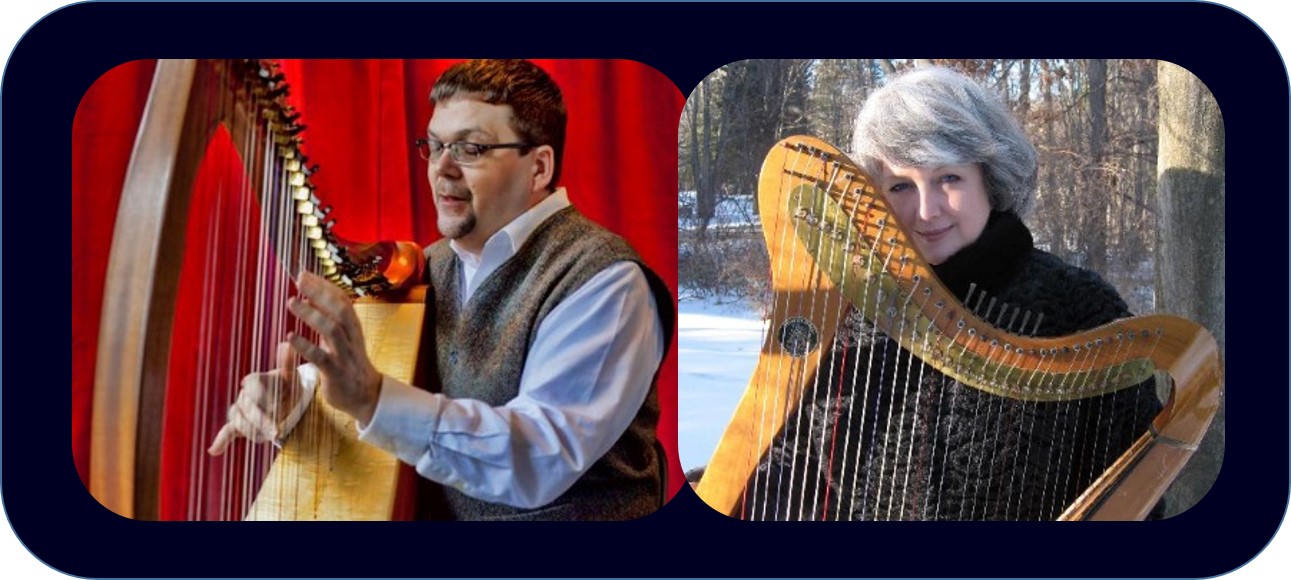
Start of last year – photo unceremoniously pinched from Steve Schack, a fellow OSAS alum (http://stevetheharper.blogspot.com/2012/06/ohio-scottish-arts-school-day-1.html) |
If you’ve been to OSAS before but weren’t able to come this year, be there in spirit by playing through the tunes from your summer and brush them up and remember the great times you had.
And if you’ve never been before, I sure hope you figure out a way to work it into your schedule next year. It is not just a learning experience but also just FUN!
I’ll trying to remember to take photos to share with you – but sometimes I get too caught up in the fun so no promises! Thanks for understanding! See you soon.
Put it in writing
If you work from printed music you have many opportunities to make notes. Use a pencil – you might want to come back to the tune and do something completely different in the future. Mark all the challenges you meet – fingerings, lever (or pedal) changes, dynamics, expression and phrasing – all of these will help you work through the music and will also serve as documentation of your ability to play it when you were working on it. Always use a pencil so you can make changes as you become more capable and experienced. For instance you could start a practice and performance journal.
No matter how you learn your music, make yourself a journal. Write yourself notes about your practice. Write down what is going wrong. Note what have you tried. Jot down what went right. Be sure to include notes about what do you want to try as well as writing out how are you going to go about learning these new things. Also note things you still want to learn.