Just a thought…

Just a thought…
It’s amazing to realize that I started writing this blog 10 years ago this week! The time has flown by. I started to blog to get the word out about the Harp the Highlands and Islands trips. And here we are, so much later, talking not only about the trips but also about becoming better harpers and learning stuff!
Have you ever wondered how the trips came about? Through serendipity of course!
My first trip to Scotland was to St. Andrews. I didn’t even play the harp then. The weather was horrible – grey, drizzly, much colder that I expected. And then – it snowed. And it was windy and the water looked angry and the beach was bleak – and I l-o-v-e-d it!!
 Over time, I went back to visit, getting a better appreciation for the varied areas. And the people, the geography, the history, and the sky – the breathtakingly, achingly beautiful sky! I had a favorite hotel, a favorite B&B, lovely friends to visit, etc. My favorite place was anywhere within 70 miles of the ocean*.
Then I began to play the harp, and after a few desultory attempts at celtoid music, my wonderful teacher gave me a gentle nudge that introduced me to Scottish music. And I found that it was quite possible that I loved the music even more than I loved the sky!
While at the Ohio Scottish Arts School one summer, it hit me (finally) that nearly all the tune names referred to real places, real people, real events. I had just seen Killiecrankie Leap – and was possessed with the need to play the tune Killiecrankie. It was while walking to a meal in Oberlin, Ohio that I was struck by how cool it would be to sit on that rock where the great leap occurred and play that tune!
I wanted to go to all the places and play all the tunes!!
That thought simmered for a few years. I had no idea how would I drag my harp along all those rivers, braes, burns, battlefields, towns’ streets, and through all those castles and stately homes!
In January 2009 I was invited by my dear friend David to play a Burns Supper. It was an incredible event and I thoroughly enjoyed myself. At the end of the trip, on the way to the airport as we chitchatted as friends do as their time together draws to an end and I shared my crazy idea to “play the harp at all the places” with him.
Well, he took those wisps of thoughts and crafted a trip that landed in some great spots by getting off the beaten track to show people Scotland unpackaged – the place I had come to love and not just some glossy brochure “Outlander” paper doll cut out! And he scheduled in time to play the harp – every day! I put together arrangements of tunes that fit the itinerary (and a few extras, just in case) and the trip was born!
We focused on very small groups in a highly curated approach to travel (and we still do). David is an amazing host. I got to meet harpers I would not know otherwise and share tunes I love in locales I adore.
In 2020, we’ll celebrate our 10th year of sharing with you! Perhaps the highest complement is how many people have come back to travel with us repeatedly. In the digital age, I know I should have more photos, but I’m usually too busy being in the moment, sharing with new friends, or making music to take too many photos, but others have done a great job. In addition, our 2020 trip is sold out already! Thank you for joining us!
We’ll keep at it as long as we’re having fun. If you’ve missed us for our 10th year but you want to come along, leave me a comment and I’ll add you to my contact list for the next trip. And lift your metaphorical glass – to our anniversary!
* FYI, no part of Scotland is 70 miles from the ocean!
It is the Bleak Midsummer – that time of year when it might as well be winter for all that you intend to go outside! It’s predicted to be about 100o tomorrow – ugh. And raining. The remnants of a tropical depressed (yes, I meant that).
Of course, it will be pouring while I try to load my car to head to Somerset Folk Harp Festival. Why does it always rain when you need to load your harp into the car? It’s just a law of nature I supposed.
 But that’s the thing about the Bleak Midsummer (you might call it the Summer Doldrums, but that’s not bleak enough for me) – the heat, the humidity, the knowing that it will last another eight weeks – all gang up on you and sap your strength and motivation! Who wants to play when you know you’re going to sweat on your harp?
Ugh.
So, how do you stay motivated? Here are 8 ways that might work for you:
Power through – it’ll be autumn soon and before you know it, we’ll be complaining about how cold it is! There’s eight ideas – do you have others? How do you stay motivated throughout the summer? Leave me a comment and share!
You already know that all of us are back from the Harpa Scotland 2019 Retreat. If the photos, videos, comments, and smiles are any indication – it was another brilliant success. Harpa is so much fun because it has a simple formula:
HARPA =
amazing musicians + fantastic tour guide + incredible roadie =
sharing music joy + enjoying each other + adventure!
You’ve heard the maxim that travel is broadening – and not just from delicious cakes and scones! As you travel with your harp, you develop or hone many sterling qualities including forbearance, faith and patience! Whether you like it or not, you must let go, trust the Fates, and be patient (outside the “Oversize Luggage” belt mostly!).
Most of us are control freaks (especially about our harps). Many of us do not know this about ourselves (or if we do, we underestimate). Few things will test your mettle like traveling with your instrument and entrusting it to the TSA. And while American (airline) may hate guitars, I’m pretty sure it’s the TSA that hates harps. Or at least, hates harp cases. I qualify this, though, to say that although I have gotten my harp back partially latched or completely unlatched, it has always weathered the journey (Forbearance? Faith? Probably both).
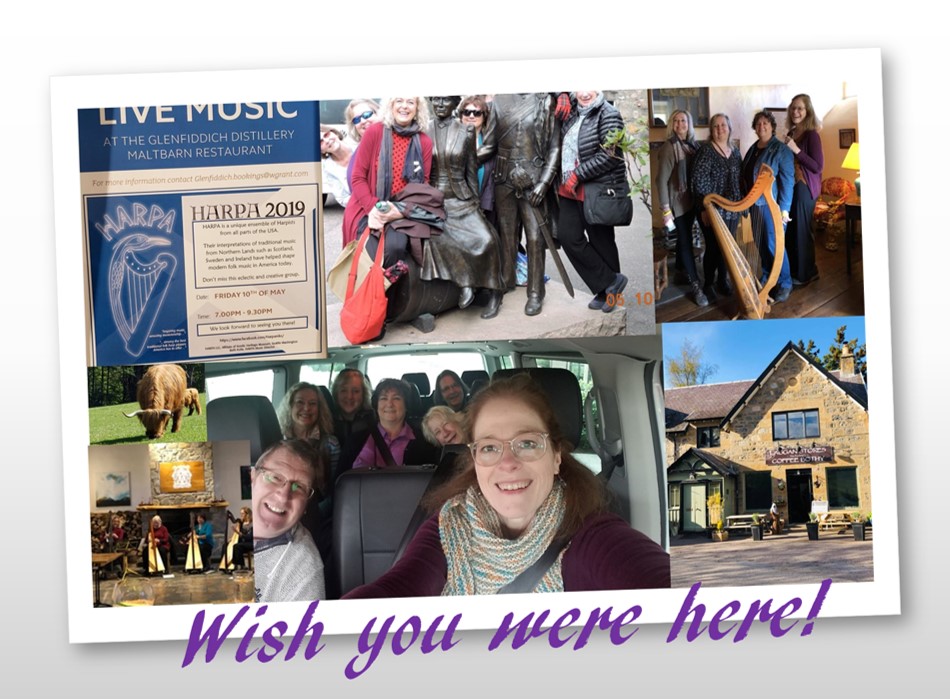 But more than that, traveling with your harp opens doors you might not even know were there otherwise. We have been places we likely would have gone right by – simply because those places opened themselves up to the possibility of us playing there! We have never played anywhere dull. This openness on their parts helps us to be more open on our part – to see new things or to see familiar things differently (including toilets, refrigerators, and door locks!). And once we are opened, adventures appear around every bend.
Our trips are always small – this time we had seven. This allows us to go places often overlooked or bypassed. It also ensures we don’t travel as a band of tourists – simply observing, never venturing outside our comfort. But it also generates a community and engenders sharing with one another – we gel in ways that big groups never get. We become a traveling family, if ever so briefly. We share our experiences – and our cookies! And that sharing is part of the fun. And the more fun we have together, the more fun we find. And so it grows!
But perhaps the best bit is that we meet other people – in restaurants and cafes, at attractions, in our accommodations. We were invited along to a stramash by someone we met at one of our concerts. See how that works?! At the time we weren’t sure we knew what a stramash is, but we kinda thought we did, and we went along to it. It was a blast! We got to play tunes with local musicians, we heard some new ones, played some shared favs and heard some lovely singing. We got to share the joy of making music – in a fun, organic, very Scottish way! (Just to confirm, a stramash is a seisiun). We met a delightful couple at a fish and chips restaurant…because they photo bombed one of our group selfies! It is these brief interactions punctuating the trip that not only make great memories, but really define good travels. While chatting with an audience member we learned of a museum that none of our research had unearthed. And later, once there, we met and chatted with more lovely locals and learned more than just looking at some displays would ever have wrought.
All that leads to learning more about yourself. You learn where your unknown assumptions and ignorances lie and have the opportunity to examine them. These assumptions and ignorances are not good or bad, but examining them means you can rethink their utility. I’m not talking about bigotry but rather biases like what we select for our concert program, how we introduce ourselves and our music to the audience, and how we meet them where they are when we perform (and appreciating when they’re not where we thought they’d be!). A small group also learns to accept more – the morning person must be patient while the not-morning person strives to not be cranky at the start of the day (and vice versa at the end of the day). We help one another – with luggage, and art supplies, and fingering, and leftovers, and making tea (and more tea, and yet more tea!).
And best of all – each trip is different. The harp attracts all kinds – players and appreciators and audiences. We make lifelong friends and brief – but enriching acquaintances. Even if we return to a place, it is new, and we grow in it. And being invited back is a pleasure and a privilege.
So Harpa 2019 is in the books – an unqualified success. We’re all home, laundry cycled (mostly), gifts given, postcards received (mostly). And we look forward to the next time!
Once we sleep off our jetlag, we will start planning the next Harpa outing!
But we’re also finalizing plans for the 2020 Harp the Highlands and Islands trip – details coming soon. Would you like to be broadened (by travel and cakes)? Want to be part of the action and first to know the details? Leave me a comment to that effect below!
PS: Photo credit for this week and last go to the Harpaniks and especially Donna Bennett, Therese Honey, and Robin Pettit.
Harpa 2019 has started! We have all arrived in Scotland and are already having a blast. We are seven this time – five harpers and two appreciators, as well as David our intrepid guide and Heather, our harp-playing roadie. We are significantly missing our lead Harpanik. Beth Kolle, who founded Harpa, is home recovering from a demonstration of gravity and we are missing her terribly. But we press on, carrying the Harpa flag!
This year we decided that we would benefit from a “vacation from our vacation” type trip and began developing the Harpa Retreat concept. We came to Scotland because – well, Scotland!! We have two concerts for different charities scheduled. And we’re planning on more down time so we can really savor our time here, make art, jam and really enjoy each other musically, and just breathe. Because that can be the problem of a vacation – you go somewhere interesting, that you want to see and soak up, and share with friends, and really experience, and you spend some short but manageable time there. But you’ve spent a lot of money to get there and you want to see it all! And you really do try, but you can’t succeed and you get very tired trying! And worst of all, in all that trying, it’s easy to miss the very thing you went there for. So this year, we are trying to take it a little slower, to chill a little. So far it’s been a great idea!
We have just started yesterday and we have an amazing group. Our performers are Sue Richards, Therese Honey, Martha Hill, Donna Bennett, and me. Sue, Therese and I started a little early in Glasgow so we could meet some of the members of the Glasgow Branch of the Clarsach Society and share a workshop (which was just an incredible day – thanks to Gillian Fleetwood for making that happen!), see some great museums, and ride trains with harps.
We took a Preparatory photo to help explain to taxi people what we were looking to get into the cab . It didn’t help the planning, but was fun to take. Photo by Therese Honey – who is a much better photographer than I!
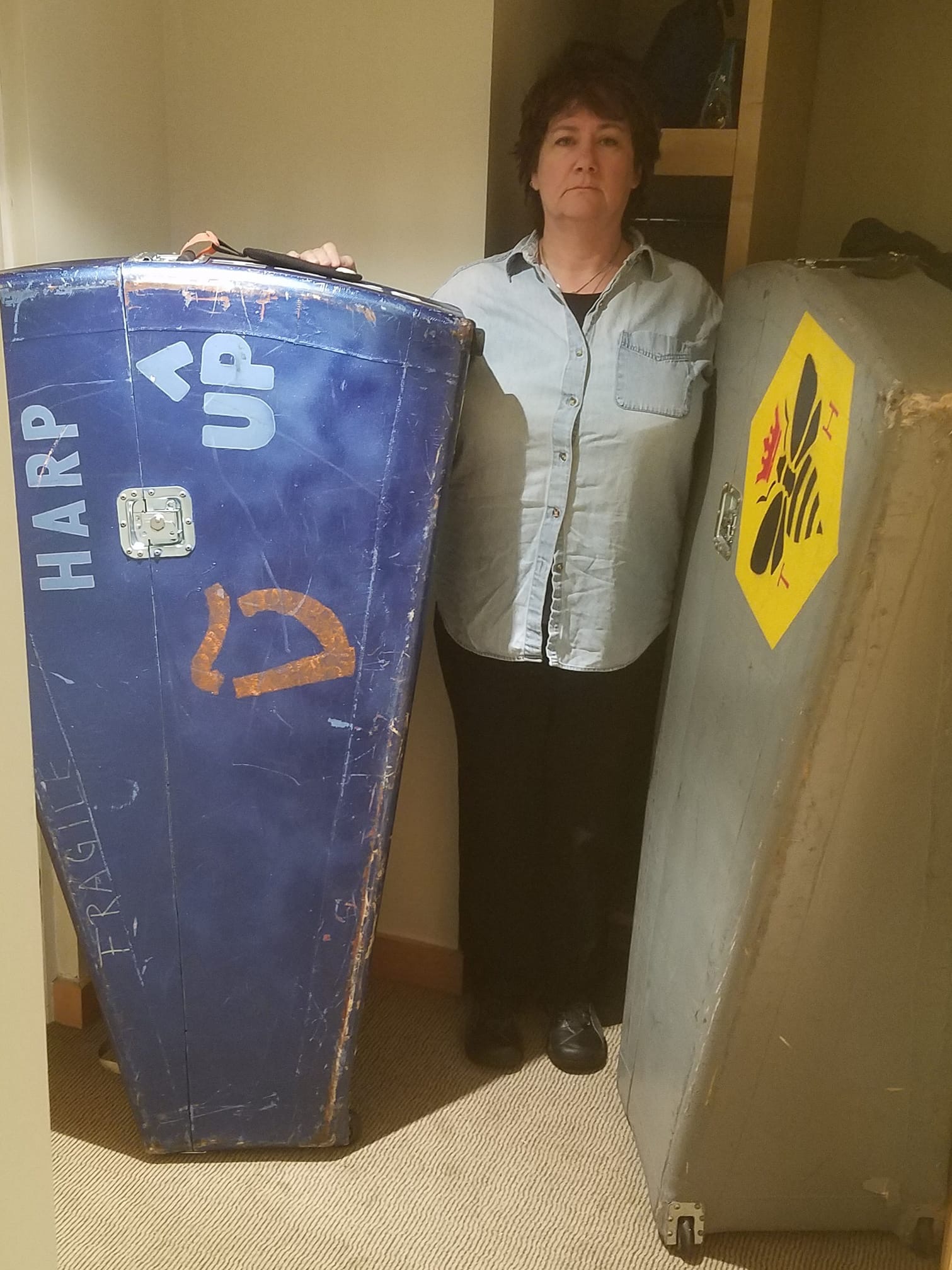
Why yes, you c-a-n get two harps into a cab, onto a train, still have fun and enjoy the ride! Another Therese photo – she’s good about taking them!
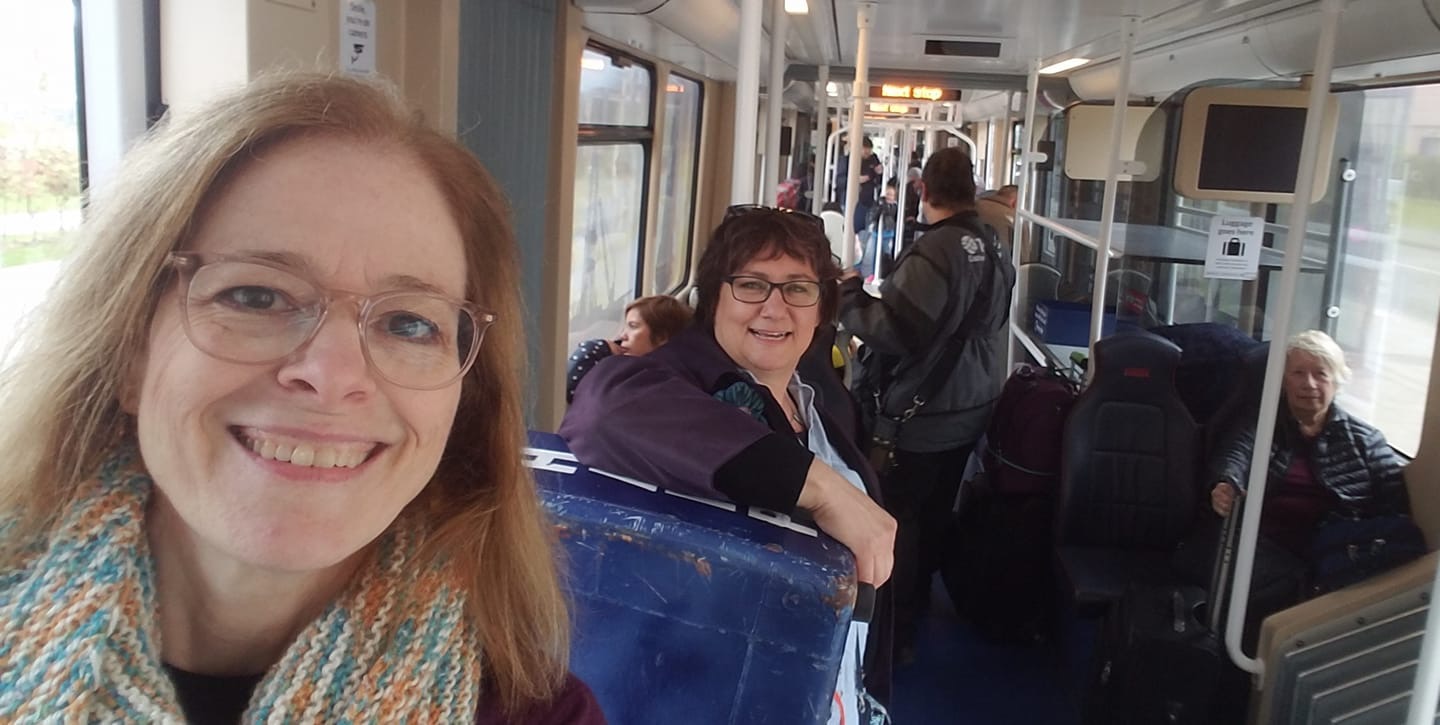
We all met up in Endinburgh and yesterday we set off on another adventure.
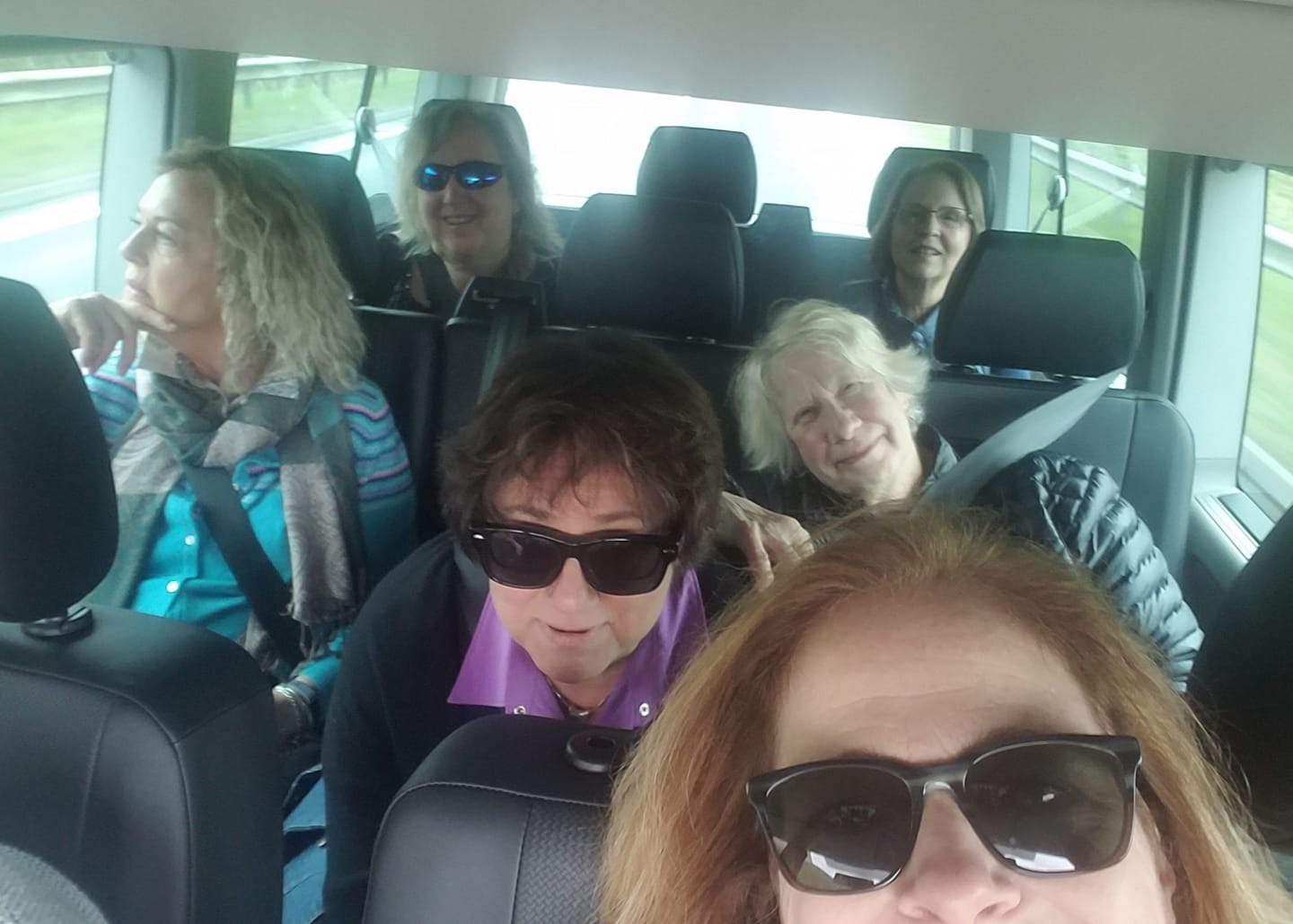
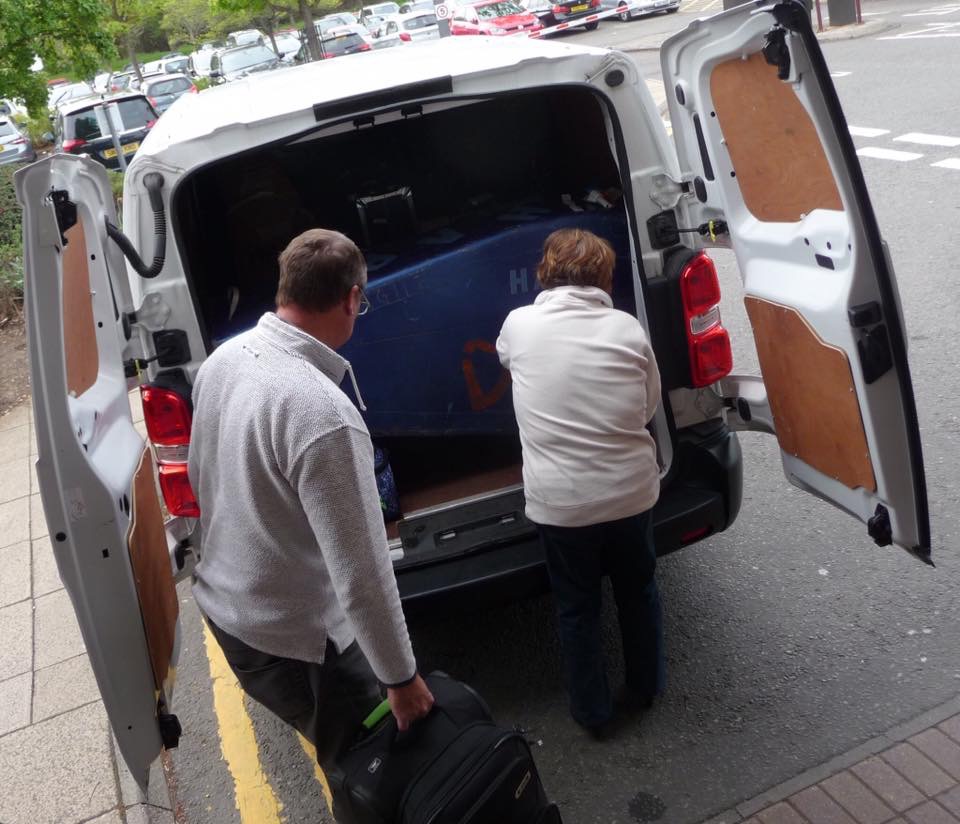
And yet another photo from Therese – she finds the best photos – just the way she looks at the world is amazing! We had the easy job. David and Heather had to figure out how to get the harps into the vehicle – puzzle for the day.
We have been posting photos on Facebook here and on the FB Harpa group. Wish you were here! More later, we’re busy having fun! Wish you could see Scotland through a harp? Leave a comment and let me know!
PS – just like if you have more than one harp, you have a favorite, I have a favorite computing device…and I chose to travel with the other one, so please forgive any errors. I’m blaming them on the #%~*^ ipad!
Playing the harp is more challenging than it looks. You already know that. That’s why we work hard during practices. It’s why we try to practice regularly – so that we enjoy small, incremental improvements each day. And this is one reason I’m always suggesting that we track our progress – to acknowledge, accept, and grow from that practice.
Practicing certainly gives us a way to work on the technical aspects of playing, but there is so much more to playing – things that go beyond the technical. However, to get to those things we sometimes need to get out of our own way.
 So, how do we do that? We start by giving ourselves permission. Permission for lots of things. But mostly, you have to give yourself permission to be YOU!
Here are 20 types of permission you might consider giving yourself:
There are plenty of permissions to give yourself. What other ones do you give yourself (or do you need to give yourself)? Share that in the comments!
No matter where you live, the first day of Spring can be a wonderful day. The farther you are from the equator (and whether you have Spring in March or September), Spring portends change and newness. Although I grew up near enough to the equator that Spring is just another day on the calendar, I now live where Spring occurs very palpably. And although it is my least favorite season, I still very much look forward to it’s arrival.
Here we are slowly transitioning from winter, and just now we are enjoying a faux May day. Of course, we’re not quite there yet and we will be returning to our regularly scheduled March in just a few hours. But for the moment, it is Spring. And it’s a perfect day to take get harp outside…and play!
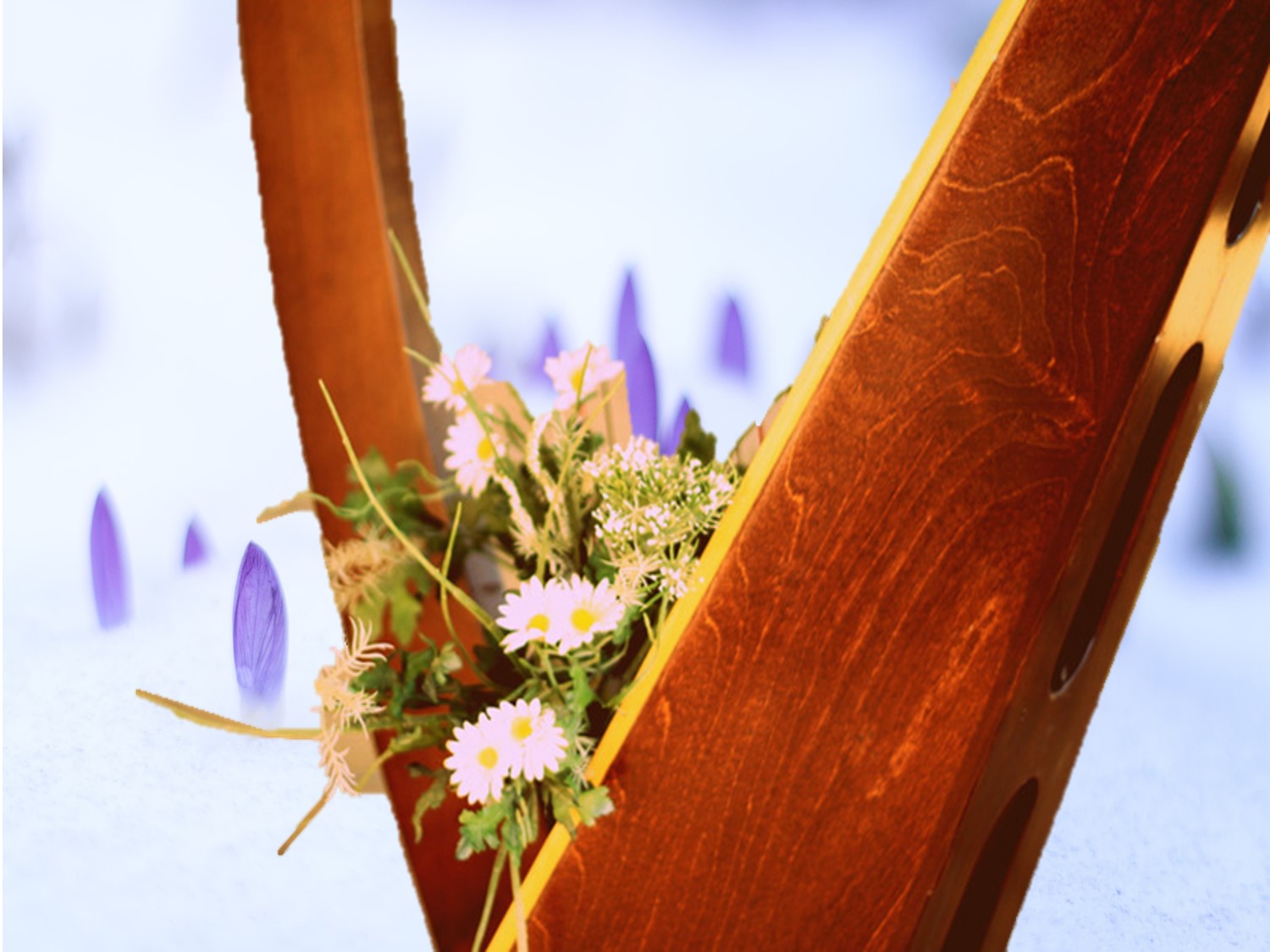 There are all kinds of reasons to take the opportunity to do it right now!
Spring is a great time to remind yourself to be thoughtful. After the bundled up, flurry and flutter of the holidays and the start of the new year – take a breath. Be here. Now. Enjoy your harp.
Go play now. Spring is fleeting. Soon it will be Summer, with its hustle and bustle and A/C and harp events! Ok. Gotta go – the deck is calling me, the trees are beckoning, the birds are off key so they need help. Where will you play? Let me know in the comments below!
We humans observe…and then compare. We are always collecting data about the world around us, analyzing it, and then selecting a winner. We have a classification scheme for winners and not winners – so we see where we rank in there.
This comparison trap is insidious in two ways. It assumes that you are an unbiased (and knowledgeable) arbiter of truth and it rarely takes context into account.
And typically, when we make comparisons, we find ourselves wanting.
Finding yourself wanting is not motivating.
 Are you a “Fair Witness” *? Are you certain that you are qualified to critique the performance of others relative to your own? And can you say, perhaps with more certainty, that you are qualified to evaluate your own performance – clear eyed and unbiased? Are you a Fair Witness to yourself that you can only report the truth with no trace of bias? Likely not – you have a vested interest in the outcome, so be honest about your ability to assess.
I just learned that my sister writes poetry. I learned this while thumbing through an anthology in which she is published! This very clearly highlighted the second point of context. You very rarely have insight into the context of others (even in a close relationship). Even though we are all made of stories – we don’t tell them all to everyone. And there are some we tell no one. In addition, many have no insight into the context of themselves, much less that of others. And even if you know someone, you might not have an accurate view of their context.
On occasion, you’ll hear someone “praise” another by stating baldly that playing the harp comes easily to (another). I find this both horrifying and irritating. You might think you should be delighted to receive what might be meant as a compliment. But because you have worked quite hard to be where you are, and even if you give the illusion that it comes easily, you might rather be annoyed that someone has discounted all that hard work. When you compare your own playing to someone else’s (or someone compares themselves to you), you never know the entire context – where they are, what is happening, or how your comparison may upset them. By the same token you may not be fully aware of how things affect you and impact your own playing.
As the trope goes (did you know that “trope” originated as a music term?) Comparison is the thief of joy. Why do we make comparisons? Because we’re good at it. We are quite adept at making pairwise comparisons (choosing a preference between two options). There are entire lines of research built on these comparisons – we’re that good at making them! But in this case, our strength (comparison) is a real weakness – because, you don’t have to pick! Someone else can be good and you are still too!
In addition, comparing yourself to someone else is more likely to make you feel bad than to make you play better (and you can see how that’s not helpful – the comparison makes you feel bad, so you’re not motivated to practice, so you do not become better (and may lose ground), which makes you not play as well the next time you’re with others and your comparison results in your poorer showing – etc.…you can see how that’s a downward spiral of not very helpful).
At a recent workshop I overheard a relatively new harper wistfully comment, “I’ll never play as well as (insert significantly experienced, p-r-o-f-e-s-s-i-o-n-a-l harp player here).” ** Well, DUH! Of course you don’t! You’ve been playing the harp for 10 minutes and they’ve played for 20/30/40 years. You dabble, fit it in, get to it when you can, as a hobby. That person is a pro – it’s their job! And they are seasoned, they work at it – you know, for hours – every day. And they are absorbed in multiple aspects of being a musician, not just the practicing for 20 minutes when they can!
Of course you don’t play at the same level! When I overhear this, I am always tempted to ask, “Do you w-a-n-t to play at that level? Or do you just wish you played at that level?” Big difference! (of course, the start of the difference is – you know what I’m going to say – practice!)
Do you say to every Dentist or Auto Mechanic you meet, “oh, I wish I pulled teeth or rebuilt transmissions as well as you”? Bah! No, you don’t, so why do you do that with harpers? (and if you do, stop, you’re creeping people out!).
But how can you escape the Trap and emerge solid in your own story (and possibly helping other people grow fully into their own stories)?
Be honest – and clear – about where you are and where the other person is (and the path from here to there). And be frank about your willingness to take that same path (or not)!
Be content, but not complacent – You are where you have gotten. You are not your harp hero. But you might be someone else’s (did you ever think about that?). So kindly and gently encourage yourself to continue to work and grow. You already know that it is work to continue – but it’s fun work! And there’s no deadline, so just keep at it.
Be analytical (but only part of the time) – note how much you have grown as a harp player. No, really note – be aware. At one point you hadn’t even touched a harp – and look at you now! One of the reasons I’m always exhorting you to keep a journal of your practice is so that you record (and therefore don’t forget and can review) your small, “every day” successes! Because those small accomplishments are what matter.
Be-YOU-tiful (stolen from a tea towel!) – you are amazing! Be that. You have strengths and weaknesses – just like everyone else. Celebrate your strengths. Be mindful of your weaknesses. Work on those weaknesses you want to be stronger at, set up systems to support the ones you know need work (but are still working on), and forget the rest. If you have to, turn your picture upside down so the weaknesses are in fine print at the bottom rather than in headlines at the top of your page.
There is one comparison that does matter – how are you now relative to you previously? Are you growing? Are you becoming the you that you want to be (not wish – but want). Do your thing. Let everyone else worry about being them. Do you have another way of keeping your thief of joy in check? Share that in the comments!
* If you haven’t read this, you might enjoy it – at your local library or at online
**I have no problem making this claim since I hear this at nearly every workshop I attend.
It’s early March and so here in the US, whether you agree or not, it’s time to set the clocks ahead – it’s Daylight Saving Time. Yea.
It’s not really all that bad. It does lead to “longer” days, in that, while the sun is up as long as it is going to be each day, the clock pushes us to use more of it awake. So it feels like we have more daylight than we do. So then the question is – what are you going to do with all that sunlight?
Well, you could use it to play your harp more! And like anything – there are bad things but also good things about moving the clocks to take advantage of the sun.
What are the bad things?
You have to get used to it. Your body is not wired to make these jolting shifts and it might take you a little time to adjust. If you don’t want to experience a wrenching difference, you could take a few days to prepare yourself – go to bed, eat, and go for a walk 15 minutes early each day from now until Sunday – that will help ease you into it. If you can’t work this shift into your schedule, at a minimum, keep to your current schedule so that you are only adapting to one hour change (sort of like jet lag!).
Everyone’s health takes a ding. Research has shown that there are more of all kinds of accidents – car, industrial, just being dumb. But also there are more heart attacks and strokes for the first week of the time change – so take care of you! Eat carefully, sleep, and take a little exercise (use all that extra daylight to go for a walk!).
Then add your harp into the mix! Now you can look at the good things –
First, acknowledge that although the time change can be a bother, you will adjust in just a few days. So cut yourself some slack. Be nice to you – don’t do a lot of forced or concentrated practice. Instead, just play and allow the sound energy to envelop you – all that vibroacousticness might help you adapt (well – it can’t hurt!).
After the first week of adaptation – you’ll be ready to use all that glorious sunlight to be more energetic – you can apply that energy to your practicing. Practice in natural sunlight. Go outside (as I write this, it’s about 20oF so that idea might have to wait!) or open the curtains and play in the window. Just take the opportunity to enjoy the sunshine!
You can let the beautiful lengthening days be an inspiration – make music, play music, share it with others! Can you compose an improvisation of the day, the transition from night to day or from day to night? It’s in you – let it out!
You may enjoy playing more. Sunlight helps combat any kind of “blahs”, so if you layer that over the joy you get from playing – you’ll be nearly euphoric. Keep that up for the eight months of DST and you’ll be…happier? Probably!
You’ll have more time to practice. Of course you won’t. But you’ll feel like you do. When the day is unending – you can practice in the morning, in the middle of the day, and in the evening and still have loads of day remaining.
So there are good things about changing the time for the spring. Layer that on top of the gentle flow of time here on earth, longer days, warmer days, an uptick in harp events everywhere (!) and it just doesn’t seem so bad. Spend a little time preparing this week and you’ll have eight months of enjoyment (before we have to get ready to go back again in November!).
PS – I’m trying to mix it up with the graphics – let me know what you think! Leave a comment below –
Not just the enigmatic lyrics of a Depeche Mode tune but a strongly worded suggestion.
There is so much sound in our lives. Every day. Sounds we enjoy. Sounds we would rather not hear. Combinations of sounds. So many that we don’t even hear some of them. And so many that we often cannot hear ourselves think.
And note that I say sound. You may have mentally transposed that to say noise. But “Noise” carries a value judgment against the source of the sound or against it’s characteristics (like volume, timbre, pitch, complexity, etc.). But it isn’t just noise that there is so much of – there’s just a lot of sound in our world.
As musicians, we are familiar with the concept of silence. We have symbols for many types of silence (well, lengths of silence – almost as if you buy it off the bolt*). We write silences into the music all over the place.
And yet, even as musicians, we often are slightly afraid of silence. Maybe repulsed is a better word. Even the best, strictest musicians sometimes cut the sound short, not allowing it the full time allotted in the score. The longer it is, the more eerie it becomes.
We harp players have an added element to our relationship to sound. After all – so often we have at least one string continuing to oscillate – to ring on and on and on (the beauty of bass wires…the bane of bass wires). Actually getting to silence can be difficult for us. Sometimes silence becomes an anathema to us – because we are no longer used to hearing it.
Silence, the absence of sound, often makes us uncomfortable. Especially if we are performing – silence leaves us feeling naked. Almost as if we think the gossamer of sound provides a veil to protect us – without it, we are bared by the lack of vibration being put into the air.
Despite this, we know intuitively the power of silence. When you’re looking for an address or you’re lost – you turn down the radio. When you really (really really) need to study, you go somewhere quiet (even those who insist they need the sounds of the tv to study). When you need to reflect, you find a quiet spot like a shrine or a meadow or a closet. But there are other reasons to find (and enjoy) silence. Silence really can be good for you – for many reasons.
Silence is like Brylcreem – a dab’ll do ya. Try injecting a little silence into your day and see what comes up. You can include some silences into your practice – by thinking before launching into whatever needs work or by pausing to think about what you’ve done and what you might do next. You could incorporate silence into your performances – don’t leap into a new tune as if you’re trying to get away from the last one – enjoy the brief silence (before the wild applause breaks out!). And you can include some silences into the rest of your day – at the beginning (before anyone knows you’re awake?) or at the end (when everyone thinks you’re asleep?) – you’ll be amazed what you find when you Enjoy the Silence!
*admit it, did you just visualize what a bolt of silence would look like?