Preparing for Competition – Mind

When you decide to compete you will need to prepare! While you might think, “Oh, I’ll just plop myself down here,” you’ll feel so much more confident (and play so much better) if you spend some time getting ready ahead of time. How much time? Well, that depends on you!

There are three areas in which to focus to maximize your time – Music, Body and Mind, this week – look at your Mind!

So here’s where the competition really occurs – in your head! On the day, will you feel ready? What are you really concerned about?  Keep in mind that most of our music is from inside our heads so your preparation (or lack thereof) will show – mostly to you!

Be honest about why you are competing. Is it very important to you that you win? Or do you just want to acquit yourself respectably? Are you focused on your performance or everyone else’s? Check in with your ego before the day so you can be prepared for any outcome…and learn from it.

Remember that the judge is looking forward to hearing you play and will share any gems to help your development as a musician – no one is looking badger you (unless you intend to do that to yourself – which is not very helpful).

Don’t forget that this is one day. Whether you play a personal best or instead are humbled to learn your fingers seem to have developed contrary minds of their own that have embarked on a petite version of the Hundred Years War with one another, tomorrow is another day….

Enjoy (and practice looking forward to) the social and fun atmosphere of being with other harpers. Cheer them on and look forward to learning new tunes, meeting new people, laughing, smiling, and learning from the comments you get.

It’s just a competition – not an audition. It won’t decide your fate for eternity. Live a little, laugh a lot, love your harp! See you out there!

Preparing to Compete – Body

When you decide to compete you will need to prepare! While you might think, “Oh, I’ll just throw on a kilt and sit down to play”, you’ll feel so much more poised if you spend some time getting ready ahead of time.

Of the three areas in which to focus to maximize your time – Music, Body and Mind, this week – it’s your body*

While competing isn’t running a marathon, being physically prepared certainly helps!

Work on your bench stamina – if you can’t sit on your bench comfortably for longer than it will take to play your competition set, you may need to improve your stamina. You won’t be sitting on the stage for very long (although it might feel like it) but the time you have spent on the bench practicing will help you get settled and comfortable more quickly which may help you be more comfortable as you start to play.

Practice all the movements – we spend a lot of time practicing our technique like closing our fingers appropriately and sitting up strait by also practice breathing while playing, relaxing between notes, gesturing (but not wildly – please, you’re not Liberace!), sitting without slouching, walking on stage without schlumping, and smiling! All of these things will come more easily if you practice them – just like the music itself!

Variety – try to practice in different locales to become used to changes in lighting, temperature, furniture layout, and sound qualities. This will help you be more focused and comfortable when you make ready to play your comp set. Practicing in your stage clothing will also allow you to get used to it (or change it before it makes you crazy!).  Definitely practice sitting down in a kilt!

General stamina – no matter how you cut it, competition day is long! It is also a total disruption of your regular routine. Add that disruption to the excitement of competing and you will be better able to enjoy the day if you are in better physical condition. You don’t need an arduous workout – just get some exercise each day. If not for your heart, then for your art!

Practice enough to feel confident in your skin and you’ll have moved yourself more of the way there! Next time – preparing your Mind to compete.

* I’m not a physician or a fitness expert, these statements have not been evaluated by the Food and Drug Administration and this product is not intended to diagnose, treat, cure, or prevent any disease, malady, disorder, problem, difficulty, trouble, woe or ill. Quit whining and go back to practicing!

Preparing to Compete – Music

When you decide to compete you will need to prepare! While you might think, “Oh, I’ll just throw out a few tunes”, you’ll feel so much more confident (and play so much better) if you spend some time getting ready ahead of time. How much time? Well, that depends on you!

There are three areas in which to focus to maximize your time – Music, Body and Mind. This week it’s the Music

Before you even begin to consider tunes – read the rules! Nothing is more frustrating that talking to competitors on the day of a competition only to discover they have prepared tunes that don’t meet the rules – wrong tune types, not enough tunes for the category, too many of the same type of tune, etc. It’s disheartening! But I can guarantee you that every competition has rules – and that they all state that in the end, the competitor is responsible for reading and complying with them!

Learn your music – unless you have an iron ego, most of us would prefer to play our best and that requires actually knowing the music we intend to play. Be sure you actually know the tunes – otherwise when you sit you will activate that switch in the bench – you know the one that empties your brain as soon as you start to play? Yup, that switch.

Consider a backup plan – having prepared at least two sets of music that conform to the rules can be very freeing. This backup plan means that if for some reason you have a crisis of confidence with a particular tune on the day of the competition, you can shift to your other set. Just knowing that makes you feel more confident and gives you flexibility to play whatever feels right that day (or to switch when everyone before you plays the same tune – don’t laugh, I’ve seen it happen!).

Practice enough to feel confident with the music itself and you’ll be most of the way there! Next time – preparing your Body to compete.

Break it up and move along

February is a great month – not so long that you get bored with it, not so short that you can’t learn something new – so this month we’ll focus on learning.

Reading music is a challenge for many people.  It is, after all, a whole new language. Written music conveys a lot of information in relatively little ink.  Ok, it does look like a lot of ink!  Music scores are built from a set of symbols that come together to express musical ideas.  Just like letters build to make words, sentences, paragraphs, or entire stories!

So how do you get to the meaning of all that ink?  Well, you have to read it.  It’s important to remember that just like in a word book, those little strokes and splotches convey a lot of information.  The score conveys pitch, movement, rhythm, volume, and more.  That’s a lot to take in and it can be intimidating.

Musicians with strong formal training quite literally read a score.  Just like you read a book, their eyes move along the lines as they recreate in their heads what’s being conveyed. They have a lot of practice – they’ve already sat at the equivalent of the blue bird table just like you did when you were learning to read words.

Sounding out words?  Reading aloud?  Pronouncing (and mispronouncing) strings of symbols while you learned what they meant and how to voice them.  Remember that?  No, you probably don’t (or the details may be fuzzy) – you practiced very hard to learn the symbols, then to put a couple together (remember sh-, ch-, th- and ae, ai, ea, oa?), and then put more together, until you were speeding through sentences and then whole books!

You need to do the same thing with your score! Practice reading, learning the symbols.  Then practice reading them in pairs.  Then move on to longer strings, until eventually you are zorching through entire tunes.  Keep at it and soon you’ll be reading Sonatas and Symphonies!!

But it all starts by looking at the sheet and not panicking but by slowly breaking it up, getting the idea and moving on to the next couple…just practice, take it slow, acknowledge the work you are doing.  Break it up and move along!

The Switch in the Seat

Have you ever noticed that when you go to see your physician you have a number of questions to ask, but as soon as you sit on the seat in the office you can’t remember any of them? There’s a switch in the seat that makes you forget everything you came in for – I’m sure of it!

Your harp lesson can also be like that, with the switch being strategically located in the bench. You will have practiced all week and struggled with some aspect of something you were working on – tricky fingering, a rocky rhythm, a set of chords that are particularly difficult to read accurately and quickly. But as soon as you come in for your lesson, you forget what specifically was the problem.

harpoYou fumble through trying to explain what you couldn’t get.  Even worse, try though you might, you cannot remember what you already tried even though you spent all week on it!  And you can’t remember why you think it didn’t work.

(Of course, even worse is when you did remember what didn’t work but you didn’t spend any time during the week thinking about what that might mean!)

What can you do to make sure you and your teacher work on the things that give you trouble? How can you capture your specific questions, the remedies you have already tried, and the explanations for why those haven’t worked?

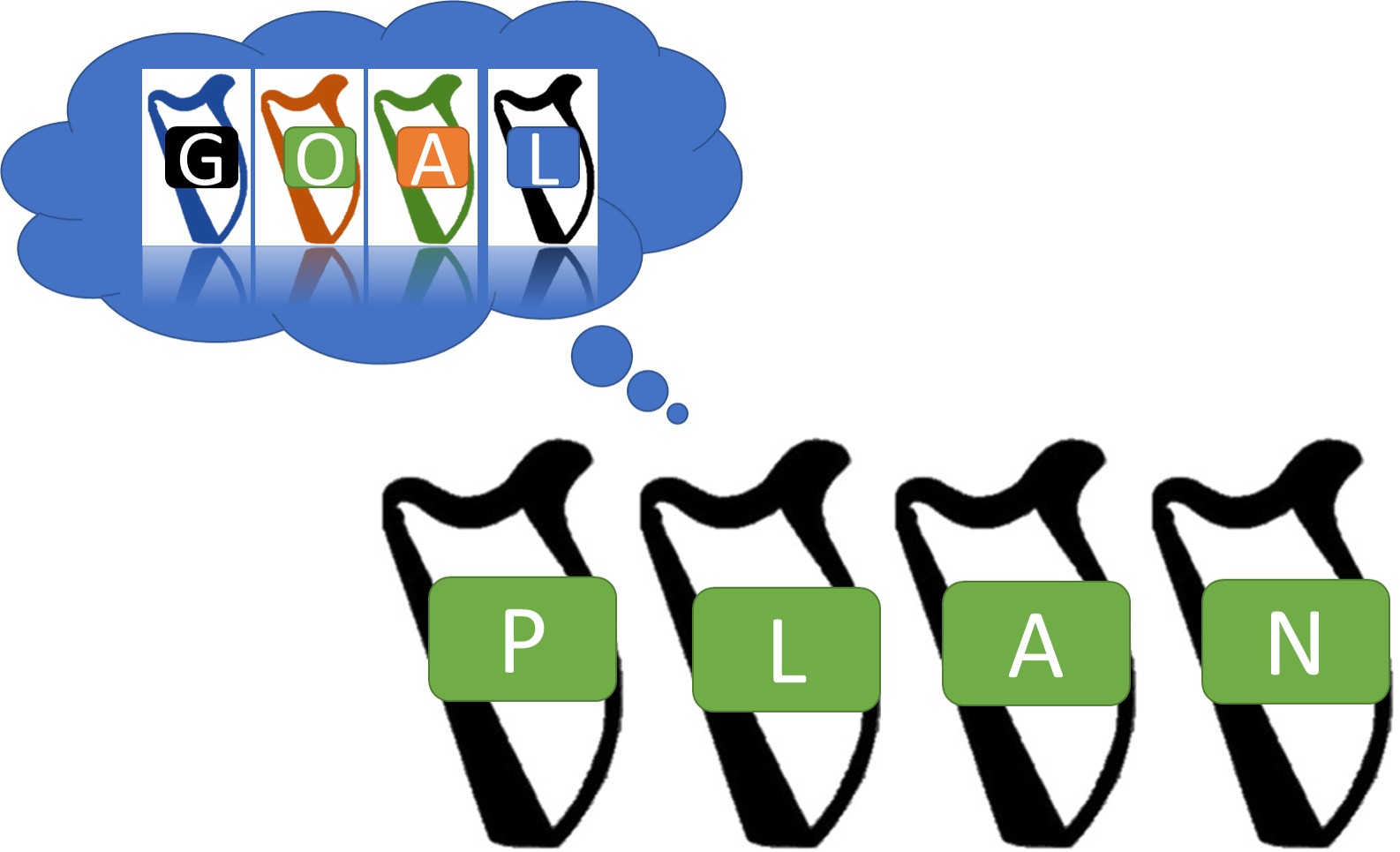
A Mnemonic is helpful. A mnemonic is a device that helps to aid memory. It should be simple and easy to remember (go figure!) – and if it is related to the content to be remembered, all the better. So, here is a mnemonic for the next time something is giving you a hard time: HARPO.  Work through each of the elements, note the answers and you’ll be that much more prepared for your lesson.  The elements are:

  • H – Headache – What isn’t going right? What are you not getting?
  • A – Attempted – What did you already try? What about that didn’t get you where you meant to be?
  • R – Reuse – What do you already know (from another piece of music) that you could bring to this?
  • P – Practice – What specifically did  you do during practice to overcome the issue?
  • O – Outcome – Did that work or do you need to try something else?

Note your HARPO answers in your practice journal so you will have them when you get to your lesson.  This will successfully deactivate the switch in the bench and you’ll be able to make some progress!

It’s the little things

You know that I am always suggesting that you develop a journal. I have told you that writing things down will help you in the long run. And I bet you believed me. And I’m nearly as sure that you still haven’t started journaling.

You’ve probably told yourself that journaling would be good for other people – those that have less experience than you do, those that have more experience, those that are professionals, those that are hobbyists, et cetera, ad nauseum.

incremental-progressBecause journaling is like cod liver oil – yes it’s good for you, as long as “you” refers to someone else!

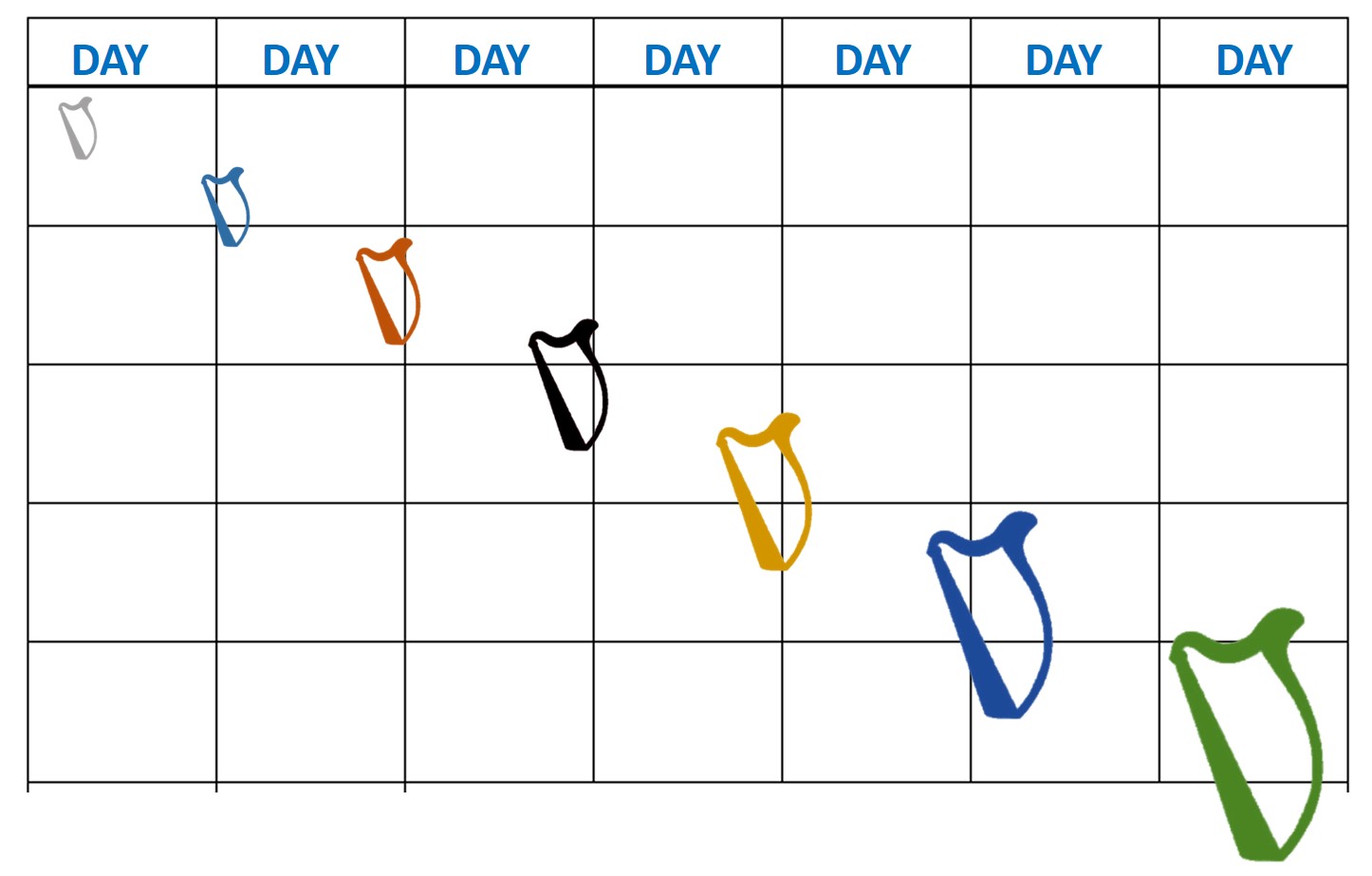
But look at this way – writing it down will help you remember…where you’re going…where you’ve been…what you’ve been through to get from one to the other. And this is important because it will allow you to see small, incremental changes in your playing.

Because no one makes giant leaps every time! We all progress in little (tiny? minute?) steps. And those small steps ahead are difficult to see – especially if you (actually do) practice every day! It is a forest and trees problem – it’s just perspective. Regardless of the metaphor – we are not especially good at seeing our little victories. Ever notice how your nails always need cutting but you can never catch them growing?! Same thing!

You wouldn’t wake up and say, “I think I’ll run a marathon today”.  You know it would take a lot of work and exercise.  You would build up – slowly, over time, while you adjust to the work.

You do the same thing with your music – with incremental progress you will be able to do amazing things – by working at it a little over a long time. That’s not news – so you might as well help yourself by making your progress clear.

In effect, you can use your journal to catch your nails growing! And to see those little progress markers in every day.

Put on your thinking cap

I don’t know about you – but when I’m excited about learning a new tune I want to get right into it. Do not pass Go, do not collect $200, just start playing. I want to sink my teeth into the music and hold on for dear life while I learn it.

How dumb is that?

There is a smarter way – an approach which would probably allow me to learn the tune faster and get past the ugly stage sooner so I really could get to the part where it’s pretty much just a joy to play. How, you might ask, would that work? I’m so glad you asked!

Analyze your music

Well, you can think first! By spending some time focusing on analyzing the tune, you can save yourself a lot of grief and be playing sooner. Now, this isn’t sexy and it might not be fun, but it sure does work.

You can analyze a lot of things about the tune, all of which will help.  Identify the time signature.  What scale is the tune in? How does the tune lie on the harp? What are the big patterns? What is it telling you?

And do not assume that this can only be done for written music. Although the analysis is done differently – by reading the dots or by listening, the bottom line is the same. Find the patterns, where they repeat, how they move, and more.

Put on your thinking cap, do that work up front and you will be able to move into new tunes more quickly and maybe even more confidently!

Box it up!

Being organized will help you get more from your practice time by allowing you to spend more of your precious time at the harp rather than trying to find music. There are many ways to get organized – lists, practice journals, etc. will all help you focus your attention so you can spend the limited time you have to practice on practicing. But once you learn tunes, then what? How do you keep them in your head? You can have a Tune Box.

Organize your musicThis is a DIY project – you can be as creative (or not) as you choose on this project. You can make it fit your décor, your time available, your favorite color, or you can leave it as you found it – it’s up to you!  Here are the Step by Step Instructions:

  1. Get a packet of 3 x 5 (or 4 x 6) cards and a recipe card box (sized to the cards).
  2. Paint and decorate the recipe card box as you like (or leave it plain if you’d rather have more time to practice).
  3. While the box is drying (assuming you’ve painted, decoupaged, or glued things to the box), for each tune you know, write a card. On the card put:
  • Name of the tune (as well as it’s “real” name if it is in another language – if you’re squeamish, also include the phonetic pronunciation of the name).
  • Key signature (or write out the key in which you play the tune) and mode (if you know it)
  • Time signature
  • Type of tune  (or how you tend to play it – air? song? march? reel? jig? etc.)
  • You can also copy (and shrink) the first few measures and glue that onto the card to help you remember how the tune starts (if you only know a few tunes this seems silly….until the time you start to play Tune A and belatedly realize you’re actually playing Tune B which can be a bit disconcerting!)
  • Other tunes with which you might put the tune to make a set
  • Other items of interest you care to add – they are YOUR cards after all!

I’d suggest you put the cards in alphabetical order just to make them easier to locate in the box – I typically file by the way I think of the tune title (for instance, although the tune is Amhran na Leabhar, I think of it as The Song of the Books, so it is filed under Song not Amhran. But you can do them however you choose (I had them sorted by tune type but that didn’t work for me, so back to alphabetical).

After polishing but before you play your reward tune, pull a card at random and play that tune*. As you learn more tunes this will become more challenging – but it will help you to remember what you have learned and to refresh (to keep in your fingers, not concert ready) all the tunes you have worked so hard to learn. And you can also see physical proof of how much you have learned as you have worked so hard at the harp – it’s all in the Box!

*hopefully the tune (the melody at least!) goes swimmingly, but if it goes pear shaped, then you know you need to work on the tune some more, so you can leave the card out to remind yourself to give that tune a little extra practice so you remember it the next time

Quote of the week

Typically, I see or hear things that lead me to think about everything else. This week isn’t like that! This week, the quote pretty much speaks for itself.

We’ve talked before about the importance of being kind to yourself in your practice and in your performance. But this quote takes it another step closer to the origin of the thinking. Here’s the quote:

Creativity is allowing yourself to make mistakes.

Art is knowing which ones to keep.” Scott Adams

You’ll recognize the source – the creator of Dilbert. He usually has an incisive, if cynical, take, but this quote is certainly spot on – it couldn’t be more right!

Make Mistakes

There is an craft to making art and it stems from your own willingness to make mistakes, and then to pick up those mistakes and lick them, and keep the ones that taste good (you know, the sonic taste) as you keep going in the music.

My early teachers who taught me two important things with respect to this, although it took me a while to appreciate these gems. The first gem was that, no matter what string you land on, you are never more than one string away from a sound you might prefer! The second nugget was that we don’t make mistakes, we make impromptu improvisations.

For a long time, I really didn’t believe them – I thought they were being “nice” because I made so many mistakes. But over (a very long) time I learned that they weren’t just being nice – they were giving me gentle permission to make mistakes and to learn not only which ones to keep but also to learn my processes for selecting them. They were helping me to learn to do my own taste testing so I could select what worked and toss out what just didn’t speak to me. They were showing me that being willing to make “mistakes” was the point. That this was how I would make my art – by transitioning these excursions into elements of my music. That while safe was comfortable, and it might be creative, it certainly wasn’t moving my art.

So, go make some real whoppers, some complete stinkers, some small and some large mistakes…and see what you can make of them!

Make yourself practice – do some good

If I were to be honest out loud, there are more days when I have to force myself to practice than I care to admit. There are always so many other things that need to be taken care of and which require my attention. And often sitting and playing feels too decadent to be work – making it even more difficult to practice and do the work. I know many of us have this same challenge. (And we know this is different from the occasional, “I just don’t feel like practicing! <whine>” malaise we sometimes find ourselves in!)

I recently came across a quote that is modifying my perspective on all this. This is an excerpt – it was part of a talk delivered by Karl Paulnack, Music Director of The Boston Conservatory*. I thought he made a good point – about taking ourselves seriously. He said

Karl Paulnack our value as musicians

“If we were a medical school, and you were here as a med student practicing appendectomies, you’d take your work very seriously because you would imagine that some night at two AM someone is going to waltz into your emergency room and you’re going to have to save their life. Well, my friends, someday at 8 PM someone is going to walk into your concert hall and bring you a mind that is confused, a heart that is overwhelmed, a soul that is weary. Whether they go out whole again will depend partly on how well you do your craft.”

And he’s right!  There is little more rewarding than chatting with an audience member after a performance and learning that you have created an experience that touched that person very personally and specifically.

He goes on to say more, about our value as musicians, the effect we can have, the good we can do. All of these are important – and we need to remind ourselves of these truths. No matter our level of play or our amount of experience, we have something to contribute, a good to give – and we have to work to bring our best when we are sharing.

So, go practice – the world is counting on us to do our craft.

* read the whole address here