Tag: Practice

  • Now what?

    Hopefully you believed me and at least started making your index card file. If so, you’ll have started the cards going, and once you’re caught up, adding your new material will require a less herculean effort!

    But you’ve asked – now what? What are you supposed to do with this?

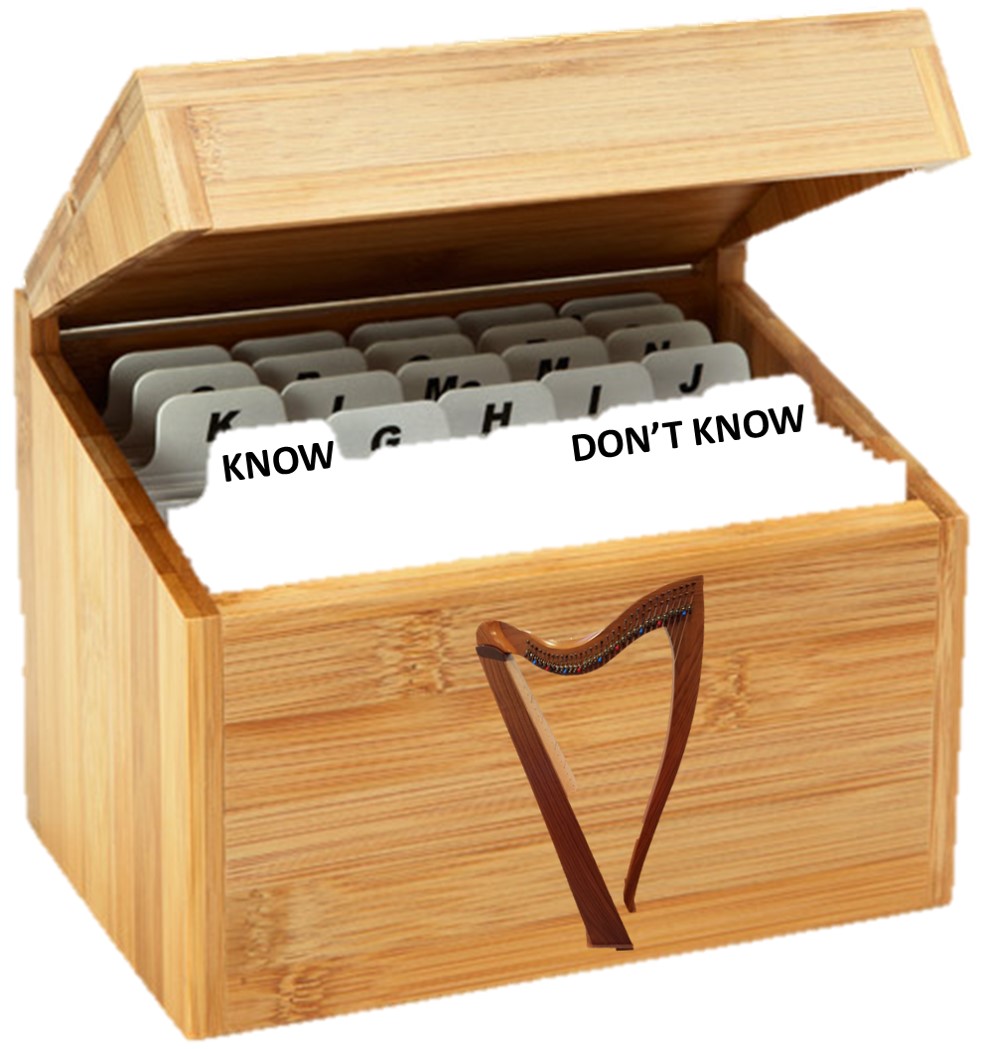
    Well, there’s a reason I suggested this card catalog rather than just a list (however, if you opted for a list, that’s ok too – keep reading, it’s down below!). If you’ve made a card catalog, no matter if you are sorting by title or by tune type – you should also include another set of divisions:

    Know |  Don’t Know  |  Needs Polish

    (you can also add additional dividers if you want to be more specific or to fit the way you think about it)

    At each practice, you can pull the cards you need. Clearly, you will put the things you are actively working (from the “Don’t Know” section). The tricky bit is what else to pull. It is tempting to think the “Needs Polish” should come out infrequently, but you’d be wrong. These should be in your regular rotation for practice.

    “Needs Polish” is code for, “I’d like to think I know this, but if push came to shove, I’d have to admit that I don’t really know it cold”. So, add those tunes to your regular practice. Also acknowledge that “Needs Polish” may be the weirdest/broadest category, so don’t despair. You will get there if you keep working on these tunes!

    But how do you use the “Know” cards? Pull one at random from the box at each practice. Play the tune and see how it goes. If you play it well – Yea! and put it back into the box. If it is wobbly when you play it, it goes into the “Needs Polish” section so you can get it back to scratch. And if it is a struggle (or you don’t remember large chunks of it*) put it back into “Don’t Know”. The number of “Knows” you pull out in each practice is up to you (and typically based on how much time you have each day).

    If you’ve made a list (or set of lists) here are some other ideas. I’d suggest you use a spreadsheet (so you can move tunes easily from one section to another), but any format that works for you is the right one! You’ll still need to identify your categories and all that is above still applies.  When it comes to choosing a tune from the “Know” pile, just close your eyes and point to a title. Or use a random number generator. Or roll some dice. Whatever works – just so you can select a tune to include each day.

    No matter if you make cards or lists, you might want to make another, more flexible category and label it – these are the tunes you’re currently in love with (or just infatuated). We all have them. They are like summer loves – they make your heart go pitter pat just thinking about them. You play them obsessively and to the exclusion of many others. They quickly make the “Know” category. You can even put a on the card – you love them that much! I suggest this because, as so often happens with summer loves, they flame out quickly, only to be forgotten. When you pull one of these out, it is fun – like pulling out old summer photos. You can play these with a bit of wistfulness, and a chuckle at what you had become so obsessed with at the time. Some will make it back into your repertoire which will be fun. And even if you don’t put it back into your regular repertoire, it will be fun to see how you’ve grown!

    You need to manage the number of pieces you’re working on at a time. It is very easy to attempt to work on too many tunes (especially after a great summer event like Ohio Scottish Arts School when you come home with boatloads of new tunes!). You want to work on them all – but you need to pace yourself or you’ll end up with nothing.  Using the cards gives you an easy way to keep track of what you need to work on, what you need to polish, what you need to review, and what you want to get to soon.

    If you make a plan for each practice you will be able to add tunes, move them along in learning and make strong additions to your repertoire. What are you adding right now?

  • Stay between the lines!

    I was driving down the highway the other day. I was going about 1000 miles, so on one particularly long, straight stretch, I started remembering when I learned to drive.

    For me, one of the hardest things to learn was staying in the middle of the lane. When you start to drive, you know you need to stay in the lane – and between the lines. The lane is defined by the lines, so I looked at the lines – constantly. But you know how that goes – the more you look at the lines, the farther you are from your desired position – in the middle of the lane. The best advice (or training) I got was to look down the road – look way down the road. After I (finally) learned that, staying in the lane was so easy. Now, as an experienced driver, I don’t even see the lines close to me and keeping the vehicle in the middle of the lane is something I take for granted.  It seems that I just go where I meant to be.

    The reality is, no matter how good a driver you are, you will never stay in your lane to get where you’re going if you don’t look ahead.  So, what does that have to do with playing the harp? Everything!

    When you’re learning a new tune – what do you do? I don’t know about you, but when I’m having trouble getting a tune into my head, I naturally narrow my thinking down to just what comes next – what’s the next note. But this doesn’t actually help me learn the tune. It just frustrates me (thus drawing my focus away from what I’m trying to do – learn the tune). If I lift my head and keep my focus “down the road”, then I can think of the phrases (as phrases, not as a trickle of sounds). When I can hear the tune in my head, the notes that come next become so much easier to remember.

    When you’re reading music, the notation (the lines and everything else) are helpful – but can be distracting. Again, sometimes just having all that ink only serves to draw your attention to the individual blops – and you lose track of where you are on the page, in the phrase, in the music. When you lose your place, your hands may not end up in the right place, or they might be going the wrong direction or be overstretched! Keeping the long view will allow you to read the music rather than focusing on the ink and better allow you to be more able to play.

    When you’re playing, you have learned the tune or become familiar with the dots on the sheet. When you’re playing, you want to be “in the moment” – and that is important. But remember that music isn’t static or fixed.  Music is serial, it comes out over time – like the road!  It can’t come out all at once (although there are some composers who clearly do not agree with me on that!). So being in the moment has to include the plans for this moment, and then for the next moment, and then the following moment, and on and on until the end of the piece – as a flow. This is not contradictory, rather, you need to hold the music in your head as a piece rather than as a set of notes. Looking at the whole of the music, rather than on just it’s representation (that you learned or are reading), will help keep you on track.

    When you’re performing, you really are taking all that you have learned and putting it out there in the world to share. This is more than just playing in that now. Because now, in addition to being in the moment with the music, you must also be present with the listeners. Whether there are 2 or 200 or 2000 in the audience, your focus has to be “farther down the road” to include not only the music but also the hearers and what your message to them/with them is. Here, your long view includes them, the music, and the presentation.  Keeping an eye on where you want to take them with the music, what it is you want to share, and how you mean to do that will help give you a smooth ride.

    Of course, this is a simple analogy.  There are many things on the road that require attention (like stop signs, traffic, pedestrians, etc.).  And just like that, music (written or aural, practice or performance) has details (like dynamics, tempo, timbre, etc.) which enrich the ride and improve the experience.  But, just as staying between the lines becomes second nature, learning, reading, playing and performing can also become second nature so that your music grows, flourishes, and delights. And just like any journey, when staying between the lines comes naturally and effortlessly, you can enjoy the journey so much more easily. What are the lines you have a hard time not looking at? How do you stay in the lane? When you look down the road – what do you see? Leave me a comment and share how you do it!

  • It’s beginning to look a lot like Christmas –

    It’s barely begun to cool down, the days have hardly gotten any shorter and the trees haven’t really begun to show their colors. It’s October! But it is also definitely time to start preparing for Christmas! From parties to church services, from fundraisers to celebrations, ‘tis the season to be asked to bring a little joy to people by playing for Christmas. Will you be ready? Here are 8 things you can do to be prepared this season:

    Picture1

    • Start now – Christmas is right around the corner, but the holiday season is even closer. Holiday decorations had appeared in big-box retailers before Labor Day and the Christmas events will start after Thanksgiving if not before so you need to start now to be ready.
    • Make a preparation checklist – write down those things you need to do to be prepared (some of the items in this post might be helpful for that). Use your checklist to help yourself prepare.
    • Budget your time – be sure to manage your time effectively – refreshing tunes you’ve learned before, learning new material, whatever you need to spend your time on – arrange to have that time available.
    • Select your tunes – know what you are preparing for and use that information to generate a solid set of tunes (and specific tune lists).
    • Schedule practice – not kidding. The holidays are notorious for days filled up beyond reason, earlier than expected, and with way too much to do. Be sure to schedule your practice time in – or you won’t get any!
    • Use your practice time wisely – because your practice time will be at a premium, be sure you plan for that time so you can get the most out of every moment. No shillyshallying at the harp, no unfocused playing through – actually practice when you’re practicing.
    • Make notes for next year – some of your preparation will be very good, some will be no help whatsoever. Make notes to yourself for next year so have even better preparation in the future.
    • Enjoy yourself – the preparation is challenging, and the added stress of performing may get to you, but be sure to enjoy yourself. And also be sure to acknowledge any improvement in your performance, the level of difficulty of the music, the speed of refreshing tunes you had learnedin previous years – all those positive indicators that arise from your preparation.

    Christmas comes but once a year – fortunately, it stays for a while and provides you a great opportunity to prepare and to play for family, friends, and customers.