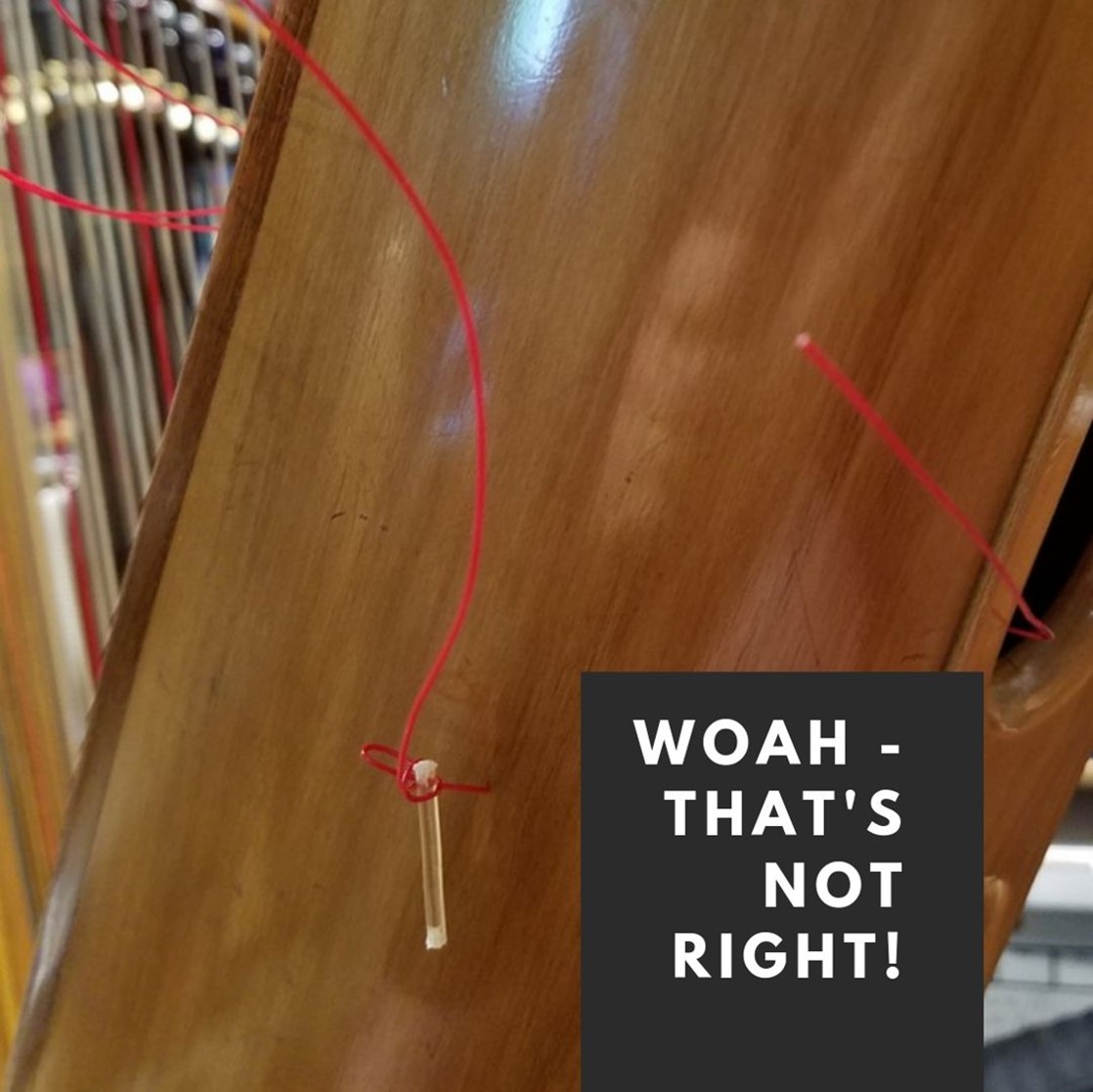
Sometimes you just need a little, visible nudge to remind you of what is important to you. So this week – a downloadable poster. Print it out (up to 18 in x 24 in) and hang it up near your harp so you remember each time you sit. Yes it’s goofy – but if it makes you focus or makes you laugh, at least you’ll already be at your harp – so you might as well play a little. To get your copy – just let me know you would like to have it – leave me a comment and I’ll get it to you!
Author: Jen
-
Harp Room Bling
-
If it was easy, it would be easy!
I have told you before that I find many parts of making music are relatively easy. I would say that it’s easier to play the harp than to calculate cubic roots in my head or to determine the easiest way to teach unified field theory to toddlers.
But not everyone agrees – especially less experienced musicians who often express frustration and dismay over how hard it can be to play the harp.
To less experienced harp players, ease seems to be either a sadistic ploy to make them feel badly about their level of experience (it isn’t, I assure you – we’ve all been there at some point) or a cruel twist of fate that leaves some people finding it easy, with others finding it impossible. I will not take up the nature/nurture question vis a vis musicianship, but I will tell you something that will (upon reflection) not surprise you –
That apparent ease that you see in experienced players – especially in professionals – is a result of (you know what I’m about to say…)…PRACTICE!
The more you practice something – the more often you perform that skill – the easier it becomes. Continued, focused practice can result in the task itself becoming automatic. You can do that thing without even thinking about it. In fact, if you think about it, you may not be able to do it! The more you practice something, the less you have to consciously think about it to make it happen. And that comes about through practice.
 If you practice anything accurately you will become better at it (of course if you practice inaccurately, you will become better at doing something incorrectly!). If you practice counting, you will get more proficient at counting. If you practice reading you will become better at reading. If you practice making hand shapes and blocking, this will become second nature – it will become just the way you do it.
Even beginners have developed some skills. If you’re more experienced, you have already mastered many activities and made them automatic. Complex tasks can like walking, jumping, writing, etc. all once required a great deal of concentration and effort but are now automatic. If you think this is not the case, I recommend you spend more time with very young children – you can watch them find behaviors and practice them. When walking is new, you don’t just wish to walk better – you walk and walk and walk, and fall down, and get up and walk some more – until you can do it all by yourself!
So, if you are working hard to play – whether it is counting, or blocking, having consistent fingering, sitting up straight, or reading – you now know that you just need more practice with those basic behaviors. Strong practice of these basic skills – making them automatic – frees up your brain to do other hard work, like learning new pieces, adding appropriate dynamics, or writing your own!
There are no short cuts. If it was easy, it would be easy. Now, go practice!
Are there things you find easy? Things you find difficult? What are they? Leave a comment below!
-
Better get moving – 10 steps to get ready for the holidays!
It’s nearly October (yikes!), the summer is over, the kids are back to school, the days are palpably shorter. And you know what that means – the holidays are nearly here!
There are only 12 weeks to go – but you know that festivities will start in about six to eight week so there will be plenty of time to fit in all the parties, pageants, festivals, parades, celebrations, get-togethers, gift exchanges, as well as gatherings. And each of those will be an opportunity to share one of your greatest gifts – your music!
Better get ready – but how? Here are ten (relatively easy) steps:
 First, manage your expectations. Be realistic. You might want to capture all the things you will be doing during the run up to the season as well as the season itself. You know you will have work and practice, and family traditions, and social events that you anticipate you will be part of. You can make a list or pencil them into your calendar or make a spreadsheet. What you really need to know is how much time you actually have. How much time do you really have to practice? How much time do you have to prepare? How much time do you have to share?
Second, manage other people’s expectations. If you want to be playing for others, let it be known so you might be asked. Not interested in playing for an event? Just say no. It is, however, the season for music and people will try to be persuasive (or maybe they will gently bully you into trying to get you agree). Worried about saying no? Ask someone you know who does want to be playing. Be prepared with their name and contact information. It will be a win-win-win: you don’t have to give a flat no because you have a referral ready (you win). The referred harper gets a gig they might not have been positioned for otherwise (harper wins). And the audience gets a willing performer (so they win too).
Third, make a list of the tunes you have played in the past. These will likely come back quickly and can be the backbone of your playing.
Fourth, make a “learn these” list of the tunes you want to play but haven’t learned yet. These will be work, but they will be worth it! Be reasonable given the amount of time you have to practice.
Fifth, if you will be playing for others, estimate how much music you will need. I usually guestimate about 6 – 8 tunes to 15 minutes. This might be conservative, but it assures that I don’t run out of music before I run out of time. I also suggest you build two set lists – because I like to be overprepared and having too much music means I can pick and choose once I get there depending on how the audience is responding. It also means that I won’t have to play something that feels shaky or just hasn’t come together enough yet. Remember that you can insert other music into the list – include the winter themed tunes or favorites to make an enjoyable performance. Especially later in the season, people will begin to fatigue of holiday music so some other tunes will wake them up and keep them engaged.
Sixth, now that you have a list and know about how many tunes you’re looking for, play through your old tunes and critically (but not harshly) determine what work is needed to get them up to scratch. Revise your list as needed (move anything that feels like it might be a train wreck to the “learn these” list).
Seventh, make a schedule to get the new music learned and ready to go and to make the old stuff polished and shone. This will be a plan to structure your practice between now and the holidays. Be realistic!
Eighth, schedule your practice time. Write it in your calendar. Make a date with your harp every day. Keep practicing your “regular” music too – although they come quick, the holidays are here and gone – so you might as well stay up to date for January!
Ninth, keep an eye on your plan and revise as necessary! Update your lists, adjust as needed, keep the end in mind. Remember the goal is to play well and feel comfortable when it’s time to play.
Finally, have fun! You’re going to make so many people happy when you share your gift – make sure one of those is you! The holidays are a time for joy – share yours!
Follow these ten steps and you will be well on your way to sharing your gift! How do you prepare for the holidays? Share your tips in the comments.
-
Scotland is calling! Be an Early Bird
 I am already excited about our next trip to Scotland…and it’s still eight months away!! I know that you’re so excited about the prospect of going too since I have talked to you and some have already taken advantage of the Early Bird pricing and booked your spot.
I know that some of you are still thinking about it. So, I wanted to encourage you to get in on the Early Bird pricing.
I talked with David this week and I have a new urgency to share with you – lots of other people want to go then too. All those other interested people translate to accommodations booking up.
Since so many of you said you’d love to go to Skye (or as some said, go to Skye “again and again and again!”), David’s been planning an itinerary around that. Even those of you who have come with us before have only seen a small fraction of all the breathtaking beauty of Skye. But if there are no accommodations available, we’ll have to reroute (after all – we need to have a place to sleep!).
Now, that’s not a problem…unless you want to see Skye.
If we were a big bus tour, it wouldn’t be an issue – we’d just take the reservation…and at the last minute, let go of the rooms we don’t need. But we’re not, and that’s not how we roll. Besides, we need to get the right room for each of you – and to do that we need to know how many singles, doubles, or twins!
Our trip will be 9 – 16 September 2020. The Early Bird booking closes 1 October. While we cannot take more than six people and we do need at least four. We are getting there – but we’re missing you.
So, I’d like to encourage you to make your final decisions and book soon. Get the Early Bird price! We’ll take reservations first come/first served and your deposit holds your place.
The early bird price is $3200 per person. Concerned you might have to pay the $350 single supplement? Sometimes others are willing to share – so don’t let that stop you!
As always – if you have questions, ask away. I’m always happy to talk about our trip and how you can get the most from it. You can email me or leave a comment and I’ll get back to you.
Looking forward to sharing some of my favorite tunes – and seeing new things with you in just eight months!
-
It’s been that kind of week – Six (or so) elements of Harp Care
Ok, it’s probably more like two weeks, but it sure feels like it’s all happened in a week. Two subscriber emails that didn’t quite work the way I wanted. And a surprise trip that sort of skewed the entire week toward the weird. And then, on top of everything else, six broken strings on three harps! SIX!
This is especially perplexing because I don’t think over my entire harp life, over all of my too many harps, I’ve had this many broken strings – total! (ok, that might be a slight exaggeration, but not much of one).
I’m pretty sure I know why it’s happened – temperatures swinging nearly 40 degrees, a hurricane passing not too far away, bright sunny days, heavy humid days, the placid shift toward autumn, and frequent travel that resulted in infrequent tuning all probably went a long way to disturbing the gentle equilibrium of the strings on all my harps.
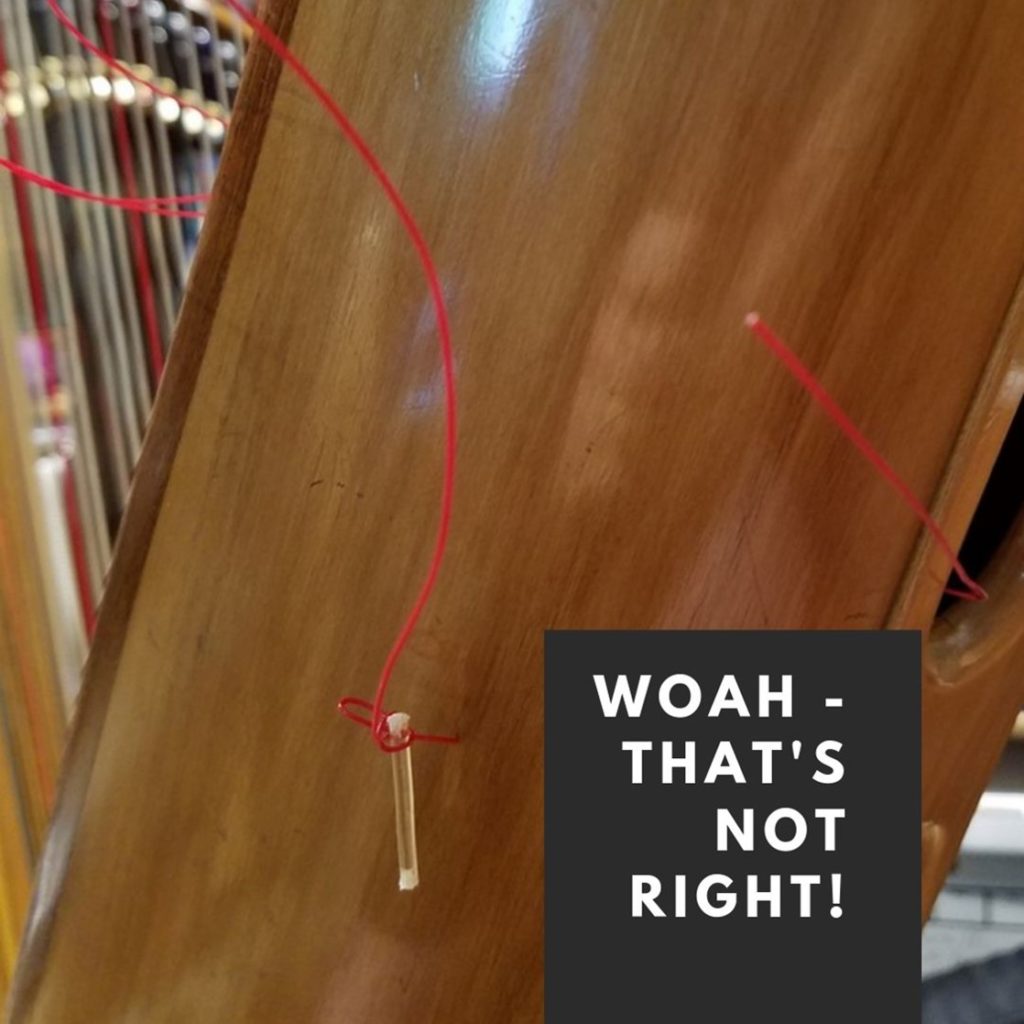 And then this. What’s wrong with this picture?
I wish I had staged that photo, but nope. I really did that. Which just highlights that e-v-e-r-y-t-h-i-n-g needs to be practiced so that it is as effortless as you can make it. If you’re still trying to figure out what’s wrong with the picture – I knotted the string on the wrong end!
All of this combined to highlight that you can always be doing something to improve your playing. Regular harp maintenance is an important piece of your self-care.
How is that self-care? Because when you take good care of your harp, it will be ready for you to play when you want to practice, when you need to practice, and when you just need to play.
What things should you be doing regularly to care for your harp? Here are six (or so) things to include:
- Change strings quickly. After a string breaks, install a new one as quickly as possible. Have spare/extra strings available. Know where to get the ones you need. Keep your string chart up to date. If you have questions about what strings to get – ask!
- Dust it! Using a soft microfiber cloth or a fuzzy sock. Don’t use your vacuum cleaner. Definitely DO NOT use polish! There are also dust covers available. I don’t have one but having one would probably cut down the amount of dusting needed.
- Check your air. Buy yourself a hygrometer so that you’ll know how dry the air in your house is (you can buy them at huge online or IRL retailers – you know the ones). Hygrometers measure the humidity in the air. Harps are happy when the humidity is about 40 – 60%. If you’re constantly running your air conditioner or when you have the heat on, it will be dry. You can improve the humidity relatively inexpensively by installing a small tabletop fountain (with the additional benefit of having the delightful sound of running water in your harp room). You could also add some house plants. If you want to spend more money you can get a room humidifier (like you’d use for a bedroom) or install a whole house humidifier (which is quite expensive). A final suggestion (especially for housebound harps) is to put the bottom of 2-part travel soap keeper on the bottom of your harp (inside the sound box) and place a dampened (cut to fit) sponge inside the lid. Check it daily to assure the sponge is damp. This will likely provide enough moisture to keep your harp happy – and you won’t be broken up at finding a cracked sound board.
- Very early in my harp career (before it was even a harp career at all!) I was told that I should treat my harp like a baby – never leave it in the car, or in the sun, or in cold or the heat, and never just stand it up and walk away. I think you can take a little liberty with this, but it bears thinking about before you just leave it somewhere. Remember that your harp is held together with glue so especially in warm weather, it could be vulnerable. And it is your baby after all!
- Tune it or die! (ok, I stole that from a bumper sticker – but it’s true). Tuning frequently is a good idea to help keep your harp in good shape. All the parts of the harp really do need to work together – the strings are a part of that. Letting the strings get way out of tune puts unnecessary stress on the sound board. It doesn’t take long to tune. Yes, I know it seems to take forever, but it really doesn’t. And, of course, the more you do it, the faster (and more accurate) you’ll get.
- Related to tuning – make sure you play all your harps. I try to have a rotation so that I play each of my harps. Note, I say try because I’m always playing favorites. When I’m feeling dramatic, I play my Dusty Strings FH-36S. When I’m feeling outdoorsy, I play my Sharpsicle. When I’m stressing about playing an upcoming gig, I play my Fisher since it’s currently my “work” harp. But I do try to make a concentrated effort to play each of them (which also assures that I tune them all!).
Finally, find a luthier you like, know, and trust. Not everyone has a local luthier (I am forever grateful to live nearby my solidly reliable, dependable luthier who clearly knows more about my harp than I do, and that I just genuinely like). If you don’t know a luthier and especially if you don’t live near one – make sure you find a harp luthier (because luthier is general term for anyone who makes or repairs stringed instruments – but you might have noticed that a harp is quite different from a guitar!). You can also watch for harp technicians that travel and/or participate in workshops and conferences. Build that relationship. Make sure that you have your harp regulated regularly (or learn to do it yourself).
So, as you can see from the photo, I was having that kind of week – the kind that comes from being relatively out of practice with changing strings! Be sure to include taking good care of your harp in your regular practice. There are other things you can do, and I’d love to hear what you do as part of your regular harp maintenance – let me know in the comments below!
-
What to play?
How about a free arrangement of a classic?
We are always casting about for new things to play. I am forever looking for tunes to add to my repertoire that meet my criteria:
- I like the tune (after all, I have to learn it and then will hopefully play it forever, over and over again – liking it is very helpful)
- It fits on the harp (because if I’m going to keep it, I have to be able to play it!)
- It’s “catchy” (the tune structure lends itself to being easily parsed and remembered – because I need to learn it – typically quickly!)
Catchy is also helpful when people are listening – catchy means that they will recognize the tune more easily (and probably like it too). And playing what people want to hear is one key to success.
Classics are, by definition, well known and typically well liked. And you’re probably going to be asked to play them. So, having some under your belt will help you shine when you’re playing for anyone (want to bet your cat probably knows all the standards already too?).
 So this week, the tune I’ll share with you is a classic traditional tune – well-known, well loved, and currently well used. Everyone should have this one in their toolbox. This arrangement is designed to be playable by advanced beginners. The tune itself is short and so you’ll need to develop some of your own ideas too to make it last longer than a musical amuse bouche. Use this arrangement as a launching board.
 The tune is hot right now since it is being used as the theme for the Outlander television series – the Skye Boat Song. It is a song, so feel free to inflect it with all the emotion the lyrics suggest to you. There is no joy to expansive, no pathos too pathetic – really work your musicality muscles. And enjoy playing it!
Would you like a copy of this arrangement? It’s easy, just send me an note here (and I’ll subscribe you to my free weekly email) so you don’t miss a post and each week you’ll get a direct link to the blog, the occasional freebee and more.
Let me know how you like the tune in the comments. And if you’re really excited about it, send me a recording of what you’ve done – I’d love to hear from you!
-
Are we done stretching? Not yet!!
So, throughout August we have stretched our artisticness away from the harp. We’ve stretched our bodies and we’ve stretched our repertoires. What could possibly be left?
Maybe the most important part. Have you stretched you?
I hear you grumbling. I’m all stretched out. Yes, I’ve stretched me.
But have you stretched all of you?
 Have you stretched to playing for others, in new places? For new audiences? Have you put yourself out there to share your art? Have you stretched emotionally?
I really thought I had. I’d played for all kinds of people. What could be left? And then I was asked to play for first graders! Wow! A very different audience that I had never even thought of. They were great! Just imagine what I would have missed if I had said no. Was it out of my comfort zone? Oh yeah – I couldn’t even see it from my comfort zone! But if I had to take a chance, what a great place to land!
How about that gig that isn’t your norm? I booked that one. Now I’m learning a tune that I’d never select – a pop tune I have always hated! But, now that I’m working on it, while I don’t like the tune any better than before, I can appreciate its rhythmic qualities. And I can respect the technique that I need to play it accurately. It is drawing on skills I rarely use. So, I also got to stretch my practice routine to boot!
How about finding a new way to share with friends, family, or audiences? Have you taken the opportunity to unguard your heart (you know, the one that’s in your mouth when you contemplate something new, different, and challenging!) and share just a bit of the joy you find in playing? Or some other emotion – loss? happiness? contemplation? contentment?
Stretching to share your emotions can be very freeing. You know, after the freefall of terror. As we’ve identified before, stretching can be many (good) things, and here are six:
- Stretching is the opposite of static and facing things straight on is definitely not static! Meeting your resistance to something will help you keep moving, growing, developing.
- Stretching makes you flexible. When you’re sharing with others, you can telegraph what you’re feeling. Being flexible gives you the opportunity to change up what you’re doing to suit your audience (and yourself). I try to have a couple of options available for each program – for those times when noting is coming together. I want to convey to the listener that, even in the face of [pick one: forgetting how the tune goes, being unable to exert any control over my fingers, starting in the wrong key, (why yes, I have done all these things and more – in front of audiences)], I’m glad to be there with them, and grateful to know that they’re on my side, even if I can’t seem to conjure any knowledge of how to play the harp!
- Stretching helps alleviate stiffness – and putting yourself out there might make you feel stiff (terrified stiff?). Nothing like working on music way beyond the pale of your favorites will help you approach new, different things with more freedom – that comes from the comfort of being less stiff as you approach the music…or the audience. Remember to “bend your knees” musically. Just imagine what I might do with that tune I hate (after I deliver it for the gig – I could completely rejigger it (perhaps literally – make it into a jig? Just an idea – I’m flexible like that!)
- Stretching helps relieve stress. Don’t you ever think that you’re the only one who feels stress (nervousness, tension, etc.) when you’re performing. We all do – even your harp hero! If you’ve done the stretches we have been talking about, you will be more comfortable no matter where you play. And that will help you feel less stress while you are playing. Don’t get me wrong – you might feel a little bit of nervousness (and research suggests that this actually helps you play better) but you won’t have that heart-pounding, breath-stealing paralysis that gets in the way (ok, you can call it stage fright, but I can only focus on how I can’t breathe…until I remember that I’m looking forward to playing…once I get started!).
- Stretching helps develop and maintain focus. By stretching yourself to new audiences, you have to focus on them to share all that you have brought. You will, of course, get better at this with practice, so keep at it! And remember to focus on the good – you know your music, you enjoy playing, and they will love you!
- Stretching stretches you. You will definitely benefit from sharing yourself and your music with others. Open your heart and give your gift. Do not worry about receiving a gift in return – just enjoy the delightful feeling of giving! And keep on giving as you stretch yourself again and again.
So, as the end of summer nears and we have stretched ourselves in so many ways – physically, artistically, emotionally, and through our repertoire. Each of these aspects of playing are essential – and stretching in each of them helps keep you flexible – ready to take on any challenge and not only succeed but also the enjoy it! Now that you’re all stretched – what will you take on next? Let me know in the comments!
- Stretching is the opposite of static and facing things straight on is definitely not static! Meeting your resistance to something will help you keep moving, growing, developing.
-
Expand your musical reach – another stretch (or 7!)
We have talked about stretching through making art and stretching our bodies. There’s another place we need to stretch and that is in our music. And it’s the perfect time to think about it – it will be the winter holidays and all the lovely opportunities to play will be coming. I mention the holidays because they are the perfect foil for stretching our music.
The holidays are great from a repertoire perspective. There is a relatively small set of tunes to work from and each year, those that have been on our set lists for a while seem to become easier to prepare and to play. It’s also easier to knuckle under and practice – we know it’s coming; we know we’ll be playing; and we know the bulk of what we’ll bring to each performance.
That doesn’t exactly sound like stretching.
 And that’s why it’s so great! There are loads of holiday tunes – so you probably don’t know them all. But you know some and so each year you can add another one or two to fill in your set list. But we have to fight the urge to be lazy and just play all the same stuff.
 I don’t know about you, but I really like hearing new (to me) stuff at the holidays. From countries whose music I don’t know well, from new sources, and from the set of those songs that hardly anyone records but are just so good.
So, the holidays are an opportunity to stretch ourselves – musically.
What does stretching musically mean? Trying new things! It can be adding techniques we don’t usually use, playing music we don’t usually play, finding stuff we didn’t know existed and fitting it into our lives, arranging music we like (from other instruments) and playing it on the harp, or more.
How is stretching musically good for us? Here are seven unsurprising ways (some of these might sound familiar since they are as with making art)
- Stretching is (still) the opposite of static! Static is not moving or changing. Static introduces b-o-r-i-n-g into your playing. It also means that you’re not growing as a musician. So, learn how to do some effect you think is cool…and actually use it in your playing! Do the work of technique practice. And after learning some new technique, actually add it to your playing!
- Stretching makes you more flexible. By adding new music, new sources, new techniques, new practice approaches, just new stuff to your playing, you will begin to explore yourself more and bring that into your playing and performance. And you will be free to do more than you thought you could when you were less flexible.
- Stretching helps defeat stress. The more you stretch your music, the more comfortable you become with playing it – because you’ll become more accustomed to being stretched. In your practice, in performance, in ensemble, in sessions – no matter where you’re playing you will be more relaxed, able to enjoy the process and product of making music. That comfort is an indication of your reduced stress.
- Stretching helps overcome pain and discomfort. You might decide to stretch your music when you feel the discomfort be becoming bored. Of course, once you decide to stretch your music, you might feel self-conscious, uneducated, or ignorant. The music activities that stretch you might make you feel uncomfortable in and of themselves. But keeping at it – a little bit each day – will help you be more comfortable and soon, you’ll be interested in the flexibility of trying new music. I’d suggest adding time for creativity in your practice each day so you will be able to stretch musically with less (perceived) “stiffness”.
- Stretching helps you focus. You can be mindful when you are stretching your music. Mindful of what it is about the music that attracts (or repels) you, what technique elements you need to work on, what your harp really shines with. In addition, a broader repertoire may help you to feel more accomplished and allow you to comfortably book gigs previously out of reach. Be sure to pay attention as you’re stretching your music to identify what to keep on doing.
- Stretching improves your range. As you add music to your toolbox, and include the listening, reading, technique and effects the new music might require of you, you will become more able to do more things with greater musicality – and add new things more quickly.
- Stretching stretches you. There’s nothing like playing something you never thought you’d be able to (or possibly even that you never thought about adding) to boost your confidence and encourage you to try even more new things!
Stretching – the gentle kind that broadens your abilities, and leaves you relaxed and enjoying making music, is just what you need. With these seven stretches you might become a better musician! What kind of music might you add to stretch yourself? What else might you do to stretch yourself musically? Tell me in the comments – I can’t wait to hear!
-
Can there be a First Inning stretch?
Last week we talked about stretching yourself in your art and I hope you’ll agree that is important. But, we might have been a little bit ahead of ourselves. Typically when we talk about stretching, we are talking about moving our bodies, stretching our muscles. Maybe that’s the First Inning stretch?
Well, that’s pretty important too. And for a lot of the same reasons. And for a few different ones. Physically stretching may be important purely because playing the harp is a physical activity. Don’t believe me? Play a 3 hour gig! Or even an intense hour long practice. Then you’ll know.
 So that physicality, which is easy to minimize or rationalize away, is exactly why we need to be rigorous about stretching our bodies. Here are six benefits when you need to stretch your body.
- Decrease stiffness – all over. You won’t just stretch part of you – stretch all of you! As stated before, stretching will also increase your ranges of motion – all those joints and muscles need to work together so you can play…and play well.
- Remember what relaxed feels like. Now, you might think this is about chilling out, but really it’s about letting the muscles relax. This relaxation needs to be paired with the contraction of the opposing muscle. And together these actions make playing possible. Balancing these is what really makes the tone possible – and you’ll get that when you not only contract the muscles but also let them relax.
- Stretch your body, refresh your mind. Whether you’re practicing, performing, or just going through your day, you can have a little break just by stretching.
- You already know this – stretching may help you avoid injuries. And while it will help you be flexible enough to not develop big injuries – perhaps more importantly, you’ll be more likely to avoid those nagging little nigglings that bug you but don’t qualify as injuries in your mind. These little insults can build up over time while you’re ignoring them – so stretch to prevent them in the first place.
- Stretching helps you become aware of your body. That includes when you’re body is humming along….and when something is out of whack.
- Stretching helps you focus. By helping to increase circulation and by promoting breathing, you will be more able to draw your focus to your activities of practicing, playing, and performing.
If you’re not already stretching, you might consider adding it to your day. You can incorporate ministretch sessions throughout your day. At a minimum consider at least stretching during your practice time. Are you really out of practice? Then you could start by having a big stretch before you get out of bed in the morning!
Are you stretching? Do you stretch as part of your harp practice? What stretches do you do? Which is your favorite? Let me know – share them in the comments!
-
7th Inning Stretch
The start of August is sort of the “7th Inning Stretch” of Summer.
Most of the Summer is gone, but there’s easily another six (or more!) weeks to go, so it is the metaphorical 7th Inning. For those of you unaccustomed to baseball, there are nine innings (in a regular game) so the 7th is about ¾ of the way. Onlookers are encouraged to stand up and stretch before the end of the game commences. It is a time of frivolity, merriment, and getting the last snacks before the vendors shut down.
In our case, it’s not the inning that matters – it’s more about the stretch. So, for August, we’ll talk about stretching.
 We actually started stretching ourselves in July by giving ourselves permission to cross into making art in other media. This challenge to ourselves is a type of stretching –
- Stretching our creative muscles
- Stretching how we think about our arts
- Stretching our comfort zone to share pieces in various phases of done-ness
- Stretching our world of sharing.
So many of you graciously shared your work in other media (and continue to do so – don’t stop!). This is a relatively easy way to stretch yourself.
Why is stretching so important? There are loads of reasons you should stretch yourself, but here are 7 (one for each Inning up to the stretch? Maybe ????):
- Stretching is the opposite of static! Being static is stultifying. It is not making progress of any type. It is status quo. What it isn’t is electrifying! Or creative. Or enriching. So we want to avoid being static.
- Stretching makes you more flexible. The more you stretch, the more all of you can be brought to everything! Practice. Creating. Lunch with friends. Everything!
- Stretching helps defeat stress. The more you stretch, the more comfortable you become with being stretched. Because you are comfortable with stretching and being flexible, you can be more relaxed in the face of stressors and this comfort allows you face every stressor more easily. And the more you create, the more flexible you will be as you create – anything.
- Stretching reduces pain and discomfort. When you first start stretching you will feel self-conscious, uncoordinated, ignorant, and you might feel discomfort or pain from the activities that stretch you. But if you go gently and keep at it daily, you will soon (sooner than you think) adapt and become more flexible. So, by adding some time for creativity in each day you will be able to do so with less stiffness (e.g. “I don’t know what to draw!” or “I can’t paint!”)
- Stretching helps you focus. You can be mindful when you are stretching, and your enhanced presence means you can focus on where you are rather than being focused on any pain or discomfort. By creating more in all domains, you will be able to focus on the act of creating at your harp when you are there (or your easel, your notebook, your kitchen counter – wherever you are focused and being creative).
- Stretching improves your range of motion. As you might have seen by the challenge, your “range of motion” in other media might be limited – by self-critique, by lack of experience, by lack of training. Stretching will allow you to side step these things and create anyway.
- Stretching stretches you. What? That might sound silly, but by stretching you are always challenging yourself to try more, new, different – and it feels good!
So, we’ve sort of gone backwards starting with stretching your creativity but that’s ok – we’re nothing if not flexible, right? As we progress through August, we’ll look at other, more conventional views of stretching. But as you’re creating, remember to stretch and be flexible. What do you do to be creatively flexible? Share in the comments – I can’t wait to hear!
PS – as I mentioned last week – if you’ve got a piece of art from another medium that you’d like to share – I will add it to the post. Haven’t finished your piece? Haven’t finished convincing yourself? Still on the fence about sharing? Just do it for yourself! When you send it to share, I will put it up. If you missed last week’s post where people shared their amazing art from other media, prepare to be amazed and check it out here: