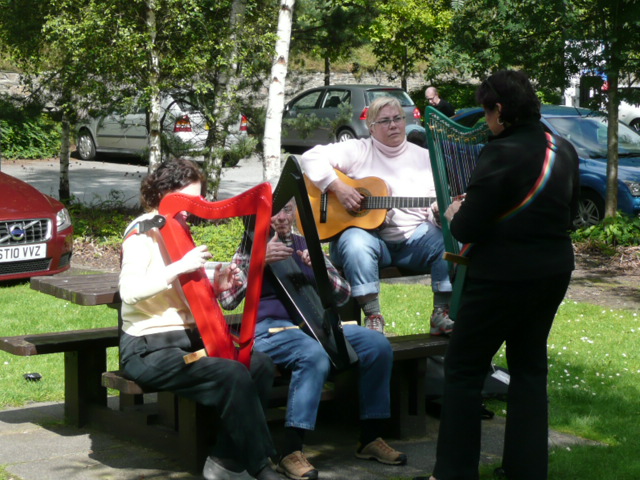
We will travel 11 – 19 September beginning and ending in Edinburgh. We have a great time, see amazing stuff and learn from terrific tunes! Hope you’ll join us! For more details go to the website.
The days are short, the nights are long, the solstice in nearly upon us, and the weather is tailor made for reflection. Take a moment and look at your past Harp year. Did you meet your goals? Did you do well? Are you happy with your progress?
If no, why? Did you set overly ambitious goals that didn’t take into account the rest of your life? Did you set unrealistic goals like moving from your first lesson to performing Ceremony of the Carols within the year? Did you not plan for the work your goals required (including enough practice time)? Did you have too many competing goals? Were your goals vague such that you could not actually determine if you made any progress? Or did you not set any goals, preferring to see what happened naturally?
Remember that the point of goals is to guide you, to help you see that you have made progress, and to remind you over time, not to generate yet another way to beat yourself up!
As the new year looms, we will, of course review goal setting. Whether you met goals or not, the year is nearly past and we can look forward to next year. Many things will change and many will be different, but your harp will be there with you – take the time to be there too!
This may be sacrilegious in some quarters, but I’m going to say it anyway. There really is no substitute for having a teacher. Now, before you write this week’s content as self-serving drivel from someone who makes money teaching, hear me out. There are so many things about playing the harp that are challenging, why not learn someone who can save you the difficulty of learning those things the hard way?
You need to find the teacher that fits you and there are plenty of really good ones around. I highly encourage you to work with a teacher – you don’t have to commit to unending lessons and in the end, the progress you make will be a function of your hard work. But a teacher can coach you through that progress so you can make good time on it!
We have spent a while talking about tuning. I hope you’ve come to realize that tuning is an essential skill although it is often glossed over. Be sure that no one glosses over it because they are uninterested. It’s just that, as you play longer and longer and more and more, tuning becomes a habit and it frankly, it is so ingrained it is hard to describe.
As for how much is too much and how far do you turn the key, when do you stop? These are complex questions. The answer to each truly is – “It depends.”
Go gently, make very small adjustments. It doesn’t take much to move the string too much. And it is easier to make another small adjustment than to change a broken string!
Take your time, go slowly. Tuning can be very therapeutic and relaxing once you’re comfortable with it. Move the key ever so slightly. See if you can change the pitch of the string without being able to detect the movement of your hand. With practice you may begin to enjoy the simple ritual of tuning (NB, this is not true if your Harp Circle, Ensemble, or Conductor are waiting!)
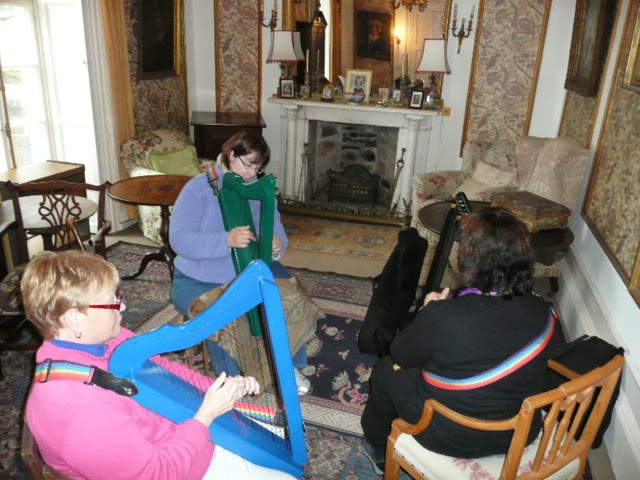
I ran across this quote the other day
A lot of people tune their harps to Eb. The question is, should you?
Being able to get into so many keys certainly limits the number of pieces you can’t play.
So you should think about your tuning before you commit to it on your harp. Do you need to be able to get into all those keys or do you typically stay in just a few keys (think about which levers you typically use)? You can use the answer to that question to finalize which tuning you want. If you want the best tone from your harp, keep it open and select the tuning that gives you the fewest engaged levers.
Then sit back and enjoy the full throated singing of your harp most of the time.
Most people use their electronic tuner for a number of reasons – it’s easy, effective, consistent, and it gives you the impression that your harp is tuned accurately. But are you really in tune?
You can choose to tune by ear. Many people do this because it results in I won’t kid you, learning to tune by ear requires some willingness to work – you have to practice doing it and you have to practice listening closely. But if you start tuning by ear it won’t take you long to get good at it.
First, the equipment. Assuming you do not have perfect pitch, you will need something to give you a pitch to reference. You can use a tuning fork or a pitch pipe (available on a number of websites) or a piano (assuming it is in tune). You can choose which pitch you’d like to tune to. I have a 440 A tuning fork. That might not have been the best choice as I have my harp tuned to Eb which means that I have to set a lever and occlude the string to get to A. I’d suggest a pitch you can tune to on an open string.
I’ll focus on the tuning fork as it is easy to carry and use. The tuning will be the same regardless of your reference. Strike the fork on something solid (I use my ankle bone) and then place the base on the sound board. You will hear the pitch loud and clear. Then tune the appropriate string (A in my case) until you can’t hear it.
‘Til I can’t hear it???? Yup – when you can’t hear the string differently from the tuning fork, it is in tune…they are inseparable. Remember that the 440Hz refers to the frequency of the string – so if you have it tuned, it will “disappear” into the tone of the tuning fork. Then I’d suggest you tune all of that string (all the As for example). Tune them against each other (based on the A you started with). Octaves are directly related (so if the middle A is 440 Hz, the A below it will be 220Hz and the A above it will be 880Hz. If you play them in octaves you will be able to hear if one is out because of this relation.
If you’re willing to give it a try, start with your A’s strike your tuning fork and bring them in line. We’ll move on to tuning the rest of the strings later! Don’t get frustrated, just take a breath and listen – you’ll hear it when it happens.