Wishing you all the best on Thanksgiving –
enjoy the grateful feeling of playing such a beautiful instrument!
Wishing you all the best on Thanksgiving –
enjoy the grateful feeling of playing such a beautiful instrument!
Have you ever noticed that when you go to see your physician you have a number of questions to ask, but as soon as you sit on the seat in the office you can’t remember any of them? There’s a switch in the seat that makes you forget everything you came in for – I’m sure of it!
Your harp lesson can also be like that, with the switch being strategically located in the bench. You will have practiced all week and struggled with some aspect of something you were working on – tricky fingering, a rocky rhythm, a set of chords that are particularly difficult to read accurately and quickly. But as soon as you come in for your lesson, you forget what specifically was the problem.
 You fumble through trying to explain what you couldn’t get. Even worse, try though you might, you cannot remember what you already tried even though you spent all week on it! And you can’t remember why you think it didn’t work.
(Of course, even worse is when you did remember what didn’t work but you didn’t spend any time during the week thinking about what that might mean!)
What can you do to make sure you and your teacher work on the things that give you trouble? How can you capture your specific questions, the remedies you have already tried, and the explanations for why those haven’t worked?
A Mnemonic is helpful. A mnemonic is a device that helps to aid memory. It should be simple and easy to remember (go figure!) – and if it is related to the content to be remembered, all the better. So, here is a mnemonic for the next time something is giving you a hard time: HARPO. Work through each of the elements, note the answers and you’ll be that much more prepared for your lesson. The elements are:
Note your HARPO answers in your practice journal so you will have them when you get to your lesson. This will successfully deactivate the switch in the bench and you’ll be able to make some progress!
This week we celebrate Veterans Day. Originally Armistice Day celebrating the end of World War I the day eventually became a celebration of all those who had served in the US Armed Forces.
Thank you to the US Military – the largest employer of musicians in the world! And thank you to all our veterans throughout the years!
This is a great opportunity – go play at a Veterans Hospital or Nursing Home or play on the street with a sign telling people that you’re celebrating or play a benefit and donate to a Veterans charity. Snap a photo and share it with us while we show appreciation to those who pledged their lives to defend ours.
Yea – it’s coming winter and the days are shorter and the nights are ever so long – so there should be plenty of time to practice! This weekend you will set your clocks back (OK, some of you did that last weekend) and you start the season with that extra hour of sleep unless you use the hour to practice rather than to sleep).
But those early nightfalls can actually make it more difficult to fit a practice in because it is prime time to snuggle into a blanket, drink hot chocolate, and read a good book! And nature is telling you to go to bed, so it can seem like no matter how much you know you need to practice, you just can’t fit it in. Do you have that problem? Maybe it’s just me, but if you feel it too, here are six things you can do to get through the time change relatively successfully:
Enjoy the lengthening nights, the coming cold, the looming busy winter season – all starting with this beginning of autumn marked (again) with the clock falling back!
Are you ready? We know it’s coming – it happens the same time every year. It’s easy to be only sort of excited. On the one hand, it’s easy – you know all the songs and you can kind of get away with playing the same stuff every year. On the other hand, that can get sort of boring, never learning anything new and always playing the same stuff.
So, what’s a harper to do?

Well, you could take the easy way out – no one would know. You’ll entertain your audience, even if it is the curtains and the cats. You will coast through the season and all will be well. You’ll play stuff you’re comfortable playing and your stress level can stay (relatively) low. But you would know you hadn’t learned anything new.
Or you can take the difficult way and play all new music – the crazy carol written in 12/8, that jazzy arrangement of your favorite post-war song, that new, lever change filled music that was published lately. You’ll have to work really hard (actually, you should have already started), you will be stressed out nearly every time you play and you will be uncomfortable until January! But you will know that you have stretched yourself.
Maybe the best path to take is the middle road – add some new pieces while continuing to play your favorites. That way, you can have a little growth, but from a strong base. You will know you have had a little stretch and you will still be able to perform confidently.
At your various outings, play those tunes your audience will be happy to hear. And don’t forget that nothing makes Christmas music more enjoyable than mixing it with other music. Even the cats will enjoy that!
The 2016 Washington Area Folk Harp Society (WAFHS) Annual Harpers’ Getaway will be held November 4 – 6, 2016 – you don’t want to miss it!
As always, there are two excellent presenters coming and you won’t be able to help but to learn a lot. There’s also the concert, the fellowship, and the venue – all things to look forward to. But there isn’t much time left to register.
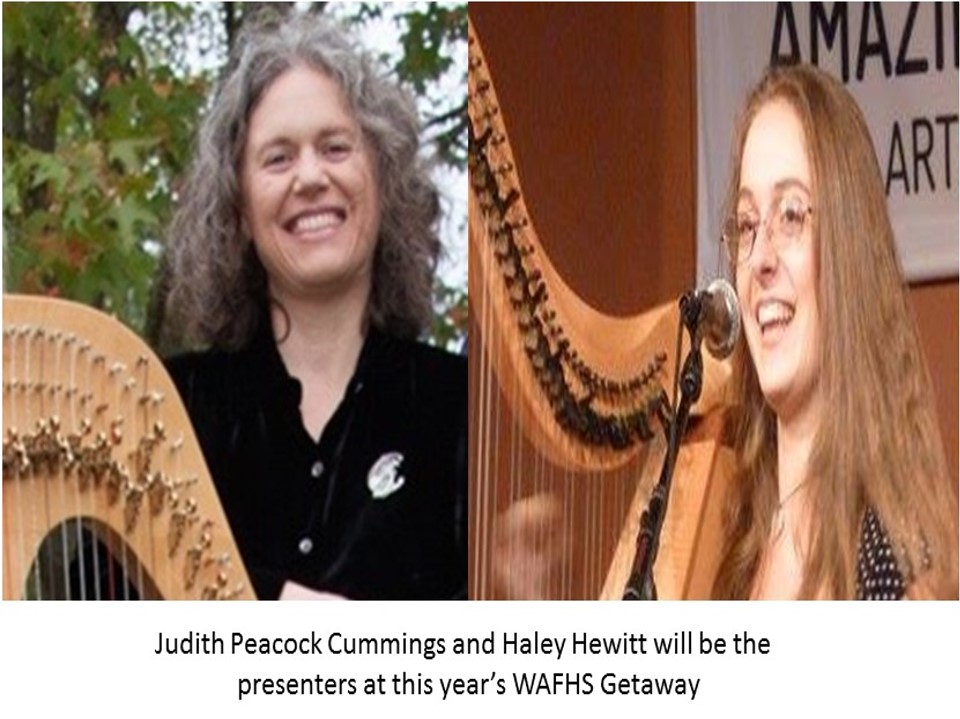
The presenters this year are the irrepressible Haley Hewitt from Boston and the amazing Judith Peacock Cummings from Seattle via Scotland.
The Getaway is at Shepherd’s Spring near Antietam Maryland in Sharpsburg, MD. There will be excellent learning opportunities, lovely social opportunities, and of course, the Silent Auction!
Deadline to register is October 21. Go to http://wafhs.org/getaway/ for the details and the forms. Don’t miss this opportunity!
You know that I am always suggesting that you develop a journal. I have told you that writing things down will help you in the long run. And I bet you believed me. And I’m nearly as sure that you still haven’t started journaling.
You’ve probably told yourself that journaling would be good for other people – those that have less experience than you do, those that have more experience, those that are professionals, those that are hobbyists, et cetera, ad nauseum.
 Because journaling is like cod liver oil – yes it’s good for you, as long as “you” refers to someone else!
But look at this way – writing it down will help you remember…where you’re going…where you’ve been…what you’ve been through to get from one to the other. And this is important because it will allow you to see small, incremental changes in your playing.
Because no one makes giant leaps every time! We all progress in little (tiny? minute?) steps. And those small steps ahead are difficult to see – especially if you (actually do) practice every day! It is a forest and trees problem – it’s just perspective. Regardless of the metaphor – we are not especially good at seeing our little victories. Ever notice how your nails always need cutting but you can never catch them growing?! Same thing!
You wouldn’t wake up and say, “I think I’ll run a marathon today”. You know it would take a lot of work and exercise. You would build up – slowly, over time, while you adjust to the work.
You do the same thing with your music – with incremental progress you will be able to do amazing things – by working at it a little over a long time. That’s not news – so you might as well help yourself by making your progress clear.
In effect, you can use your journal to catch your nails growing! And to see those little progress markers in every day.
You might have seen that there are only 90 days remaining in the year (fewer by the time you read this!). Have you made significant progress toward your harp goals for the year? Do you remember what they were? Did you write them down? Did you make a plan?
Fear not – all is not lost – there are, after all, nearly 90 days remaining to make some progress. So you can end the year with a strong (and deserved) feeling of accomplishment! And if you are no longer aligned with the goals you set (or if you never got around to setting goals), here are seven things you can still finish this year to end on a high note of accomplishment!
Just keep focused on what you’d like to accomplish and make a plan to spend the end of the year moving toward that!
John Cleese, legendary funny person and noted actor is quoted as saying, “Nothing will stop you from being creative so effectively as the fear of making a mistake.”
And truly, that is not funny.
We are often our own worst enemies, telling ourselves repeatedly that our mistakes are not creative, just errors, cowering in our harp space not playing so we don’t miss, harboring the fear that we are not good enough to be creative, that other people are creative and we just appreciate their gifts because while they make charming mistakes. our own mistakes come out more like farts.
Hogwash!
 So how will you get around this?
Some of the best stuff ever has arisen from having the wrong levers set, not quite remembering how the tune starts, landing on the wrong chord, or some other mistake. So, make a beautiful noise and work with it – nothing that comes out of your harp is a failure!
I often get asked about tunes, their provenance, their history – in other words, where do they come from? Whether you are just generally curious, preparing for a Scottish Harp competition, or you simply want to correctly catalog your tunes, knowing where the tunes come from can tell you a lot.
First the easy answer – tunes come from all over and are held everywhere (and sometimes nowhere). Many people learn the tunes they pick up in lessons or workshops, enjoy them immensely and go on. Some learn tunes from popular books (such as Sylvia Woods’ many collections or the copious books available from MelBay, Afghan Press* and others) and play them for their own enjoyment. Some musicians learn tunes, play them, and are there for the tune and nothing more. Take off your judgment hat – because there is nothing wrong with that!
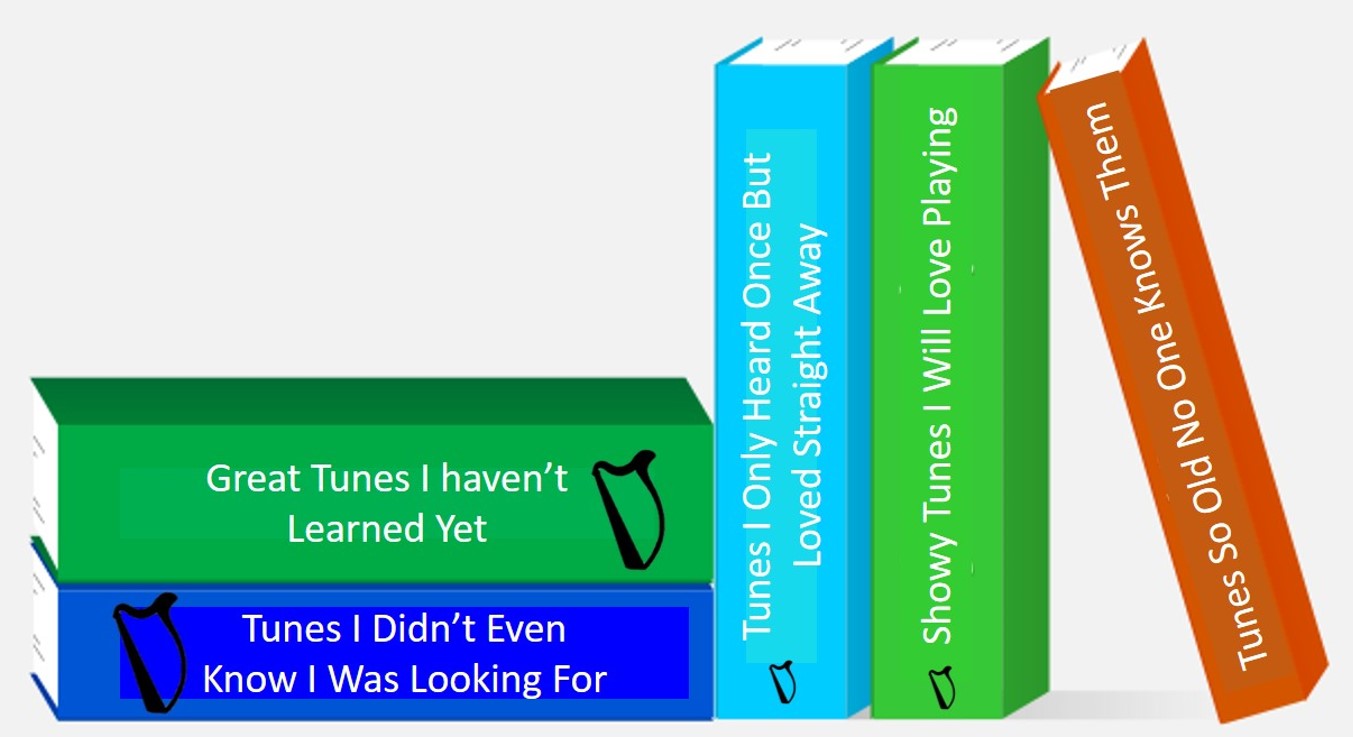 The second answer is a little more nebulous – tunes are everywhere. Some are breathtaking, but difficult to find and others are in every book you pick up (or so it seems) – so where do you find new tunes? Here are seven places to look for your next best loved tune:
Do your homework and you will be delighted to find your next favorite tune!
* I don’t have the good sense to do affiliate marketing so this is just my opinion – there’s no kickback from Sylvia or Mel Bay or Afghan Press, this is simply an observation.