Tag: Technique

  • Always commit, but not too soon

    For harpers, one of the most challenging things to learn is fingering.  I don’t mean “learn” as in getting it into your head.  Rather I mean internalizing the concept and grounding everything you do in that.

    After all, we know that fingering can make or break your tune.  We know that while we’re ingesting a tune, we need to pay attention to getting the fingering into our head so we can do it again.

    But making that knowledge part of our intrinsic fabric of self is challenging.  Precisely because you learn it along with the tune.  And that’s what makes it slippery.
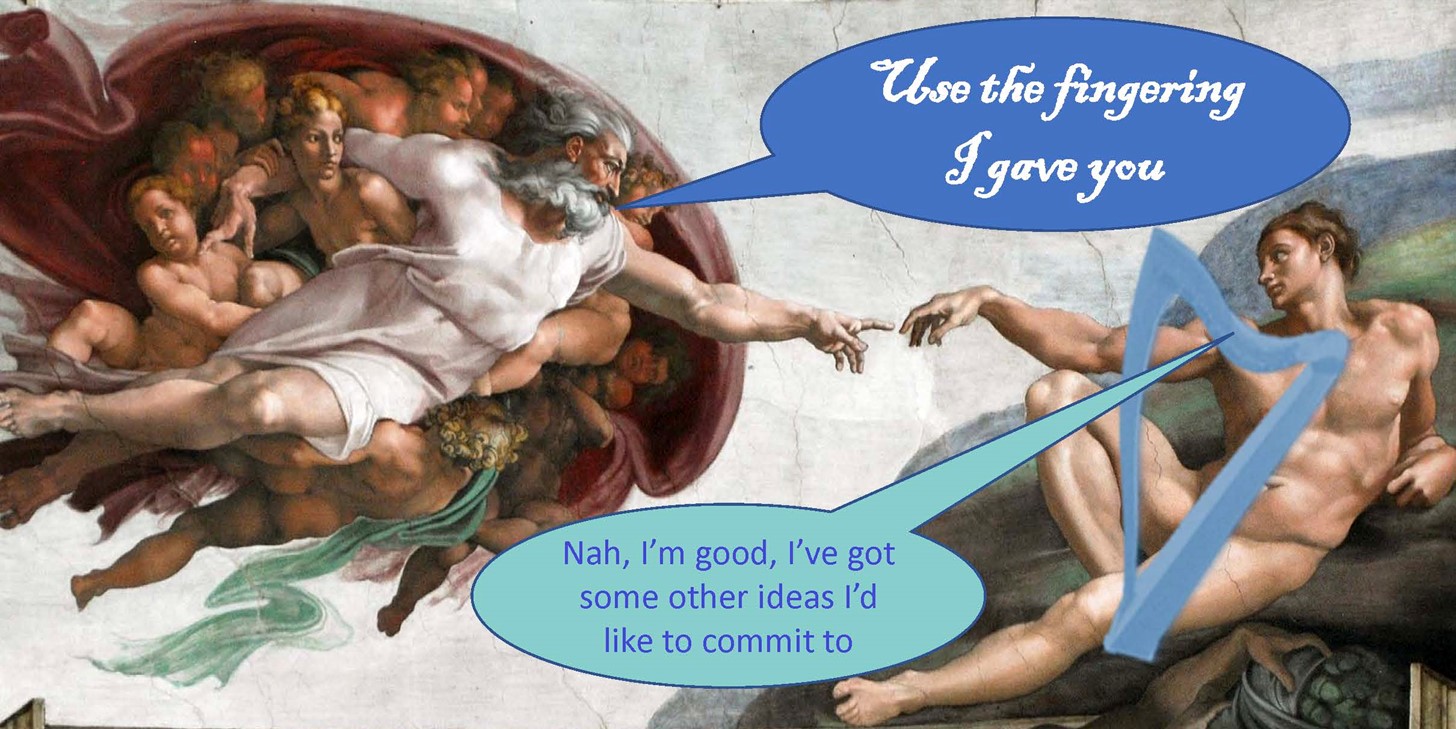
    Commit

    Because when you learn the fingering as part of the tune, rather than embedding the need for fingering in your core, you just let it sort of wash over you.  In effect, you don’t really pay attention to the fingering as an element of the tune, it’s just a means to an end. 

    You learn it but you don’t commit. 

    And at the beginning of acquiring a tune, that’s a good thing.  After all, before you know the tune, how you can you know what the best fingering can be?  How can you understand where the phrases are going to take you?  Where will you place your stamp?  So, at the beginning, you do need a fingering that will get you through the tune.  But do you need to commit to it?  Or is it too soon?

    To successfully play the tune, make it yours, and frankly, to enjoy it, you might need to mix up that fingering, so it might be too soon to commit.  You might change the fingering as you develop your overall approach to the tune and to the harmonies.  You might find that the whole thing will go better if you take this note in the other hand.  Or that a big fat lush rolled chord just there is exactly what you want so you now will play the melody note with the thumb.  Well, those things, those changes, those modifications, those betterments will change your fingering.  If you have already committed to an earlier fingering, it will have been too soon.

    If you’ve committed to a fingering too soon, it will chafe.  And of course, once you’re committed, every change becomes harder to implement (because you have to unlearn what you were doing and relearn the new thing). 

    Once you’ve settled on what you’d like to have, then you could commit to the fingering.   When you have assigned your imprimatur, then you can commit the fingering to memory, based on the development and analysis you bring to the tune.  And then use it!

    When you’re learning a tune, yes, work on the fingering (especially if you’re a newer and shinier harper – if you’re still learning how to play, all of this will apply after more development… learning elementary tunes as taught is helping you build the foundation you need to then later do what I’m advocating here).  As you cultivate the tune, give yourself the freedom to explore other fingerings and approaches to rendering the tune.  Then you’ll be ready to commit, and it won’t be too soon!

    How do you help yourself make the commitment at the right time?  When do you feel ready to commit?  Let me know in the comments!
  • Do You Count? 

    I often think about tunes in “layers”.  All the layers are important, but some are easier to master than others.  The layers include the notes, the fingering, the phrases.  And then there’s the counting.  There are loads of elements that define the music, but time might be the most challenging to really get learned and honed – to get right. 

    Do you Count?

    When you get to brass tacks, music is really a sequence of sounds and not-sounds (rests) over time.  And so, to be true to the melody, share the message, and communicate with our listeners, we have to keep the count.  

    Sometimes, as harp players, we become inured to the silence – we get so little of it with our wonderful resonant instruments. Harps love to keep on playing and that lovely sound “hanging around” may make us lazy – it may feel like it will be easy to get away with not counting.  But that is an illusion.

    Counting can be a challenge when you first begin to learn a tune.  There is so much to learn and all of it important.  We have to keep the important stuff in mind – actively use it.  Time is challenging but it can be so rewarding!  It will help your audience follow your message, it will make playing with other musicians a greater joy, and it will help ensure your tune is what the original composer meant it to be.

    Previously, I have said that I don’t advocate rigid adherence to the beat.  That wasn’t really accurate.  Rather, it is essential to know that timing of the piece and work within that.  With poignant airs you might bend the time to build the expression, but that works best by manipulating the times. Laments need to be sorrowful, but it should never be lamentable!  But the difference will be in how you deal with the time. 

    It is essential that you learn to count.  Ok, I know you can already count.  You have to learn to count while you’re playing…and keep counting, maintaining your counting throughout your playing. Only when you have mastered this tool of communication can you begin to modify its application as appropriate to tell your story.  I know counting can be hard – it’s one more thing to do while you’re also trying to remember what notes come next, which fingers to use, that you need to breathe, etc.  Pesky layers!

    So how do you add counting to that task?  Carefully.

    First, start slowly.  This really is another task you will have to perform while also doing all the other things you have learn. Counting is another thing you have to think about as you bring the tune together – make sure you go slowly enough that your brain can keep up!

    Second, practice.  Counting while you’re playing takes practice.  You want to practice counting enough that it becomes automatic – no matter what you’re playing or where you are in learning it (just starting, polishing, anywhere in between!).  One method I suggest is to include this in your practice away from the harp.  An easy way to practice is while you’re walking or running.  This gives you a physical beat to follow so you can work on counting.

    Third, be consistent.  You can’t practice counting the tune once and be done!  Make practicing counting a regular part of your practice.  If you really are not counting at all – start with simple tunes you already know.  As it gets easier, move on to more challenging tunes and tunes you are learning.  You will get better!

    Finally, always be working on it.  Once you can consistently and accurately count, start making things more complicated and related to other music.  Remember to count to the smallest note value (e.g., the eighth notes if they’re present or 16ths – you will have to do some analysis).  Use whatever counting device works for you – vocables, fruits and veg – whatever works!

    Of course, there’s (always) more to the story, so send me your questions and share your insights in the comments.  In the meantime, stand up for your music – make sure you count!

  • Watching your nails grow – Two steps for progress

    We’re already into February!  That magical time when reality has set in and all our lofty plans for betterment have been shelved.

    Typically.

    Because, even though lots of people don’t set New Year’s Resolutions, with all the hype around the start of winter and the new year, it’s easy to think about whether one might find areas worthy of tinkering.

    Not you, of course.  You’re just right as you are.  But others, certainly.

    One of the reasons people feel that way (not you, of course, but others) is because they cannot perceive any changes in their ability to play.  And that is frustrating.  For them, of course, not for you.

    Because these changes typically come about very slowly.  You might call them “micro-changes” (nano-changes?).  The farther you are from your first experience playing, the smaller the changes are in absolute terms.  And this might make those changes difficult to detect.

    Watching your nails growWhen you first start playing, every day brings new discoveries!  Closing your fingers is an amazing activity.  Placing ahead is a magical mystery which actually does make getting the music out of the harp a little easier.  What you tried to learn yesterday is actually recognizable today!  All great victories.

    But after a while, days of work may not result in a change you can observe.  You don’t remember when you started learning that tune, but you’re sure it was weeks ago (or was it yesterday?).  When did your technique take a nosedive?!?  Why is your repertoire not growing by leaps and bounds?

    It’s like watching your nails grow.  You know they are growing.  But you can’t feel it.  And they sure look the same today as they did yesterday.

    If you measured that growth and marked it on a chart, you would find that your nails grow about 2 hairsbreadths a day.  And yet, while you can see two hairs (in the brush, in the sink, on your sweater, whatever) you don’t see your nails growing.  But they make slow steady progress…and soon you need to cut them!

    The growth is there.  Every day.  You just can’t see it.  But there is a way to get a better view and it has two steps.

    Step 1.  Decide what you’re looking for.  Too often we decide we’re going to watch e-v-e-r-y-t-h-i-n-g.  We’re going to perfect our technique while learning ten tunes all at once, sight read another 7 arrangements and work on our posture, finesse gesturing, while practicing 2 hours more every day.  And we’ll know – and remember – everything from today when we next sit to practice tomorrow (or the next day) so we know where to pick up again.

    I get it, there’s so much work to be done!  But focusing on everything is actually focusing on nothing.  Focus, by definition, is paying attention to a narrow swath.  You are already multitasking by the nature of playing since you need to place both hands, remember the tune, keep ahead of what comes next, stay upright on the bench, breathe, etc. 

    If you have a lot of things to work on – write each of them down.  Then prioritize them.  Be smart – prioritize so that the fundamentals (technique) will be ironed out first, since everything else will grow from there.  After you have finished prioritizing, for each item, write down what “done” will look like.  DO NOT WRITE “always in work”!  If your technique is terrible (!), break it down into the components that need attention and decide when you will declare victory so you can move on.  [BTW – “I’m bored” is not victory!  Being able to perform some element accurately might be your victory.]  Decide if your focus needs an action finish or a time end. 

    Step 2.  Mark that!  Do what works for you – you could write in your practice journal.  You could make a progression video recording.  You could make a chart with colored stars.  It doesn’t matter how you do it, as long as it works for you – and you do it.

    So, the important parts of watching your nails grow? Focus and document.

    What are you going to focus on?  How will you capture it?  Share your ideas in the comments! 


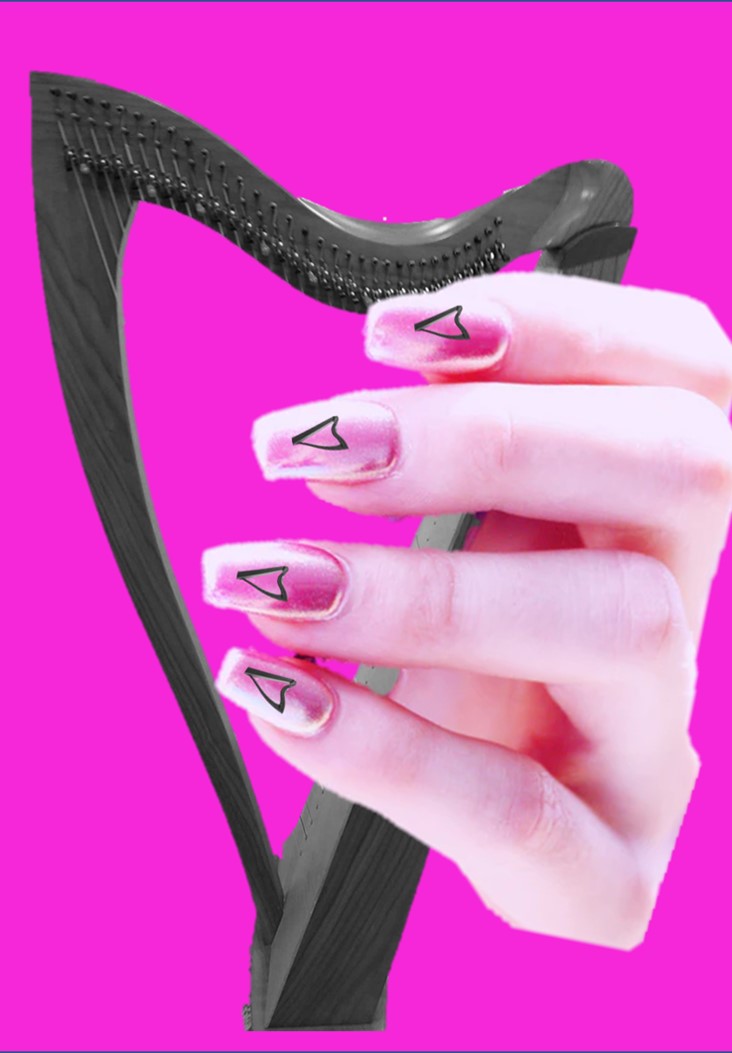
    PS – yes, I know the nails in the photo are horrifyingly long, but you try to paint harps on shorter nails!  And I was trying to make a point!